

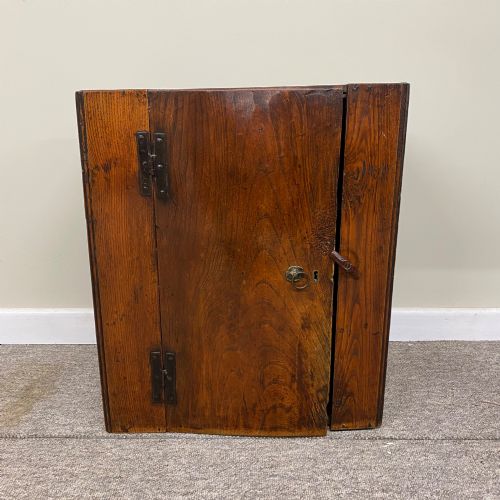
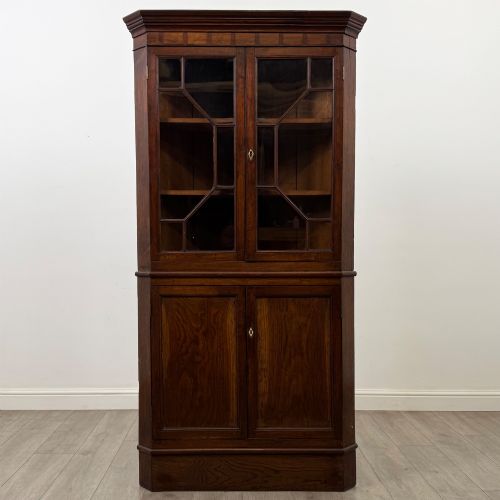
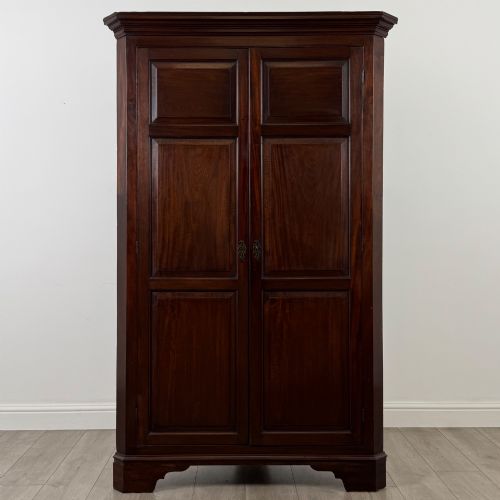
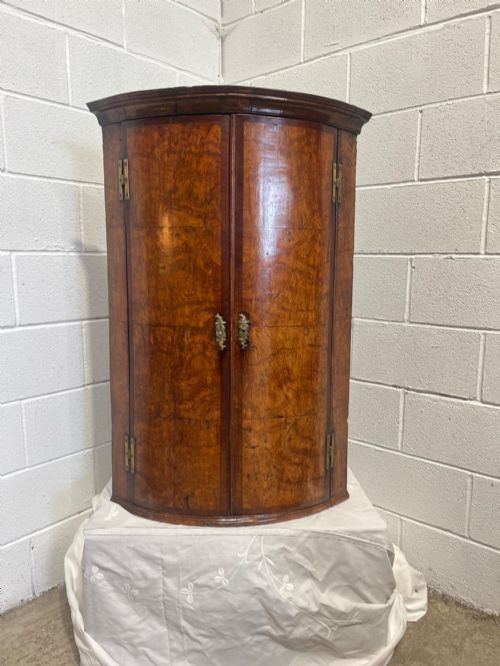
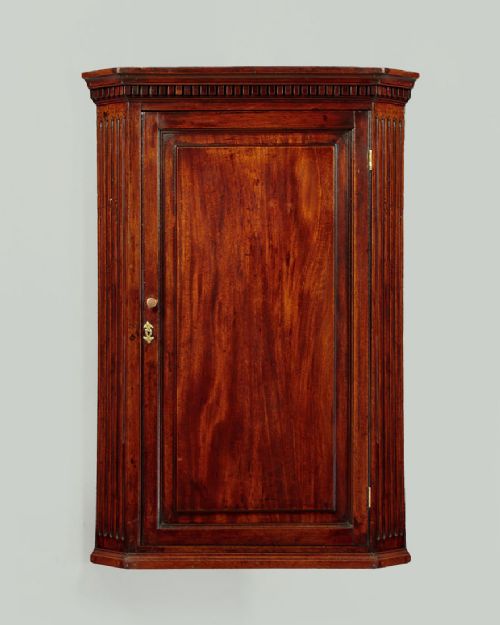
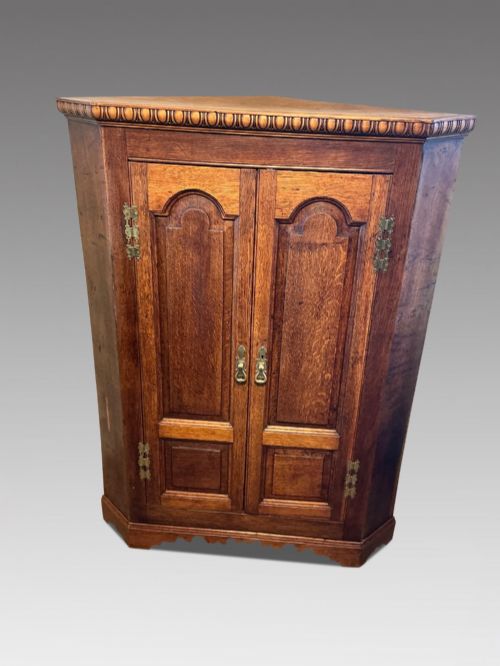
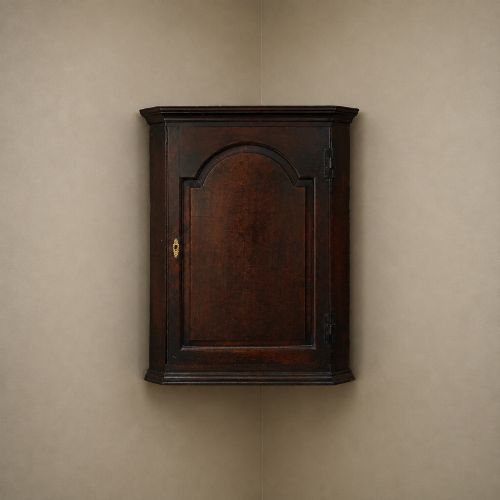

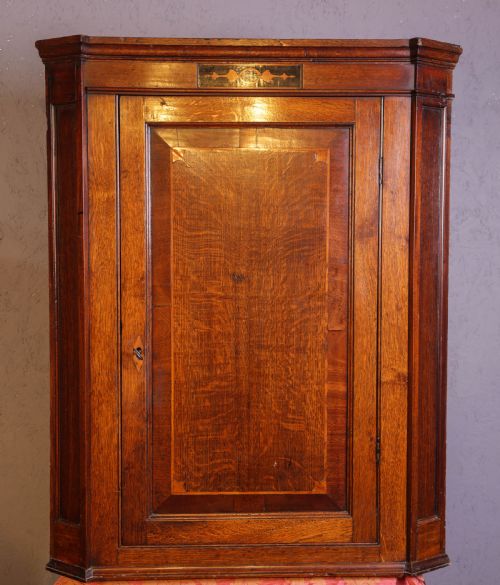
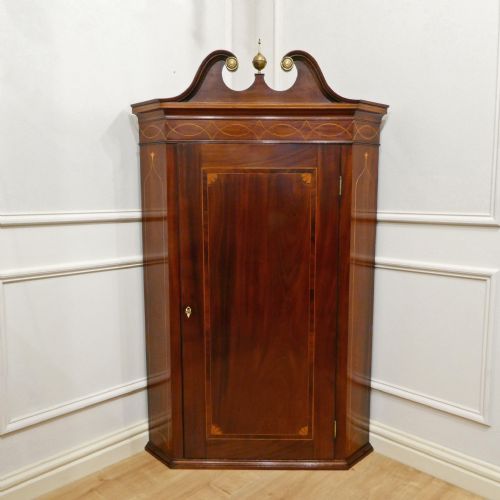


Georgian Period Corner Cabinet
A georgian period corner cabinet turns awkward domestic angles into focal points while hiding clutter behind fielded panels or glass.
Georgian Period Corner Cabinet
You will find formats varying from single-door wall units to two-part standing furniture and bow front variants. Oak and mahogany dominate the choices, often displaying panelled doors, shaped shelving, and sometimes glass display fronts. Welsh origins appear frequently among the oak examples, showing local regional character.
Judgements of quality
Quality rests on the selection of timber and the crispness of the secondary details, such as moulded cornices and brass hardware. A well-proportioned standing cabinet displays harmonious sections where the grain patterns of the mahogany or oak flow naturally across the doors.
The sophistication of the internal joinery and the survival of original backboards distinguish superior examples from plain utility pieces. Refined versions incorporate satinwood stringing, curved bow fronts, or glazed upper doors that elevate the object from simple storage to fine furniture.
Georgian Period Corner Cabinet Retail Price Guide 2026
Typical asking prices for georgian period corner cabinet among the pieces listed under this phrase on Sellingantiques today, from the lower quarter to the upper quarter. They describe what is for sale here now, not the wider market.
Several diminutive Welsh oak examples suggest that eighteenth century kitchens reserved their cosiest corners strictly for small cupboards.
The Georgian Period Corner Cabinet Glossary
- Bow front
- A convex curved cabinet front that projects outward from the corner. This curved profile requires skilled joinery to shape solid timber or bent veneers.
- Fielded panel
- A wooden panel with bevelled edges that fit into a grooved frame. This technique allows the wood to expand and contract with seasonal humidity.
- George III
- The period spanning from 1760 to 1820 covering much of the cabinet production seen here. Furniture from this era often incorporates neoclassical motifs or refined proportions.
- Chippendale
- A style named after cabinet maker Thomas Chippendale, known for classical proportions and carved decorative flourishes. Pieces in this manner show greater sculptural ambition.
Georgian Period Corner Cabinet: Frequently Asked Questions
How do I hang a wall cabinet safely?
Wall-hanging cupboards require secure fixing directly into masonry or through internal battens into wooden wall studs. Because eighteenth century oak and mahogany carry considerable weight, professional installation prevents structural strain on the original hanging brackets.
Ensure the wall plate bears the primary load rather than relying solely on the antique hinges or side boards. Distributing the weight evenly protects the historic joins from twisting over time.
Were these made for dining rooms?
These cabinets served multiple domestic rooms, holding glassware, china, and dry goods in parlours, dining spaces, and kitchens. Their triangular footprint fitted snugly into spaces that rectangular furniture could not occupy.
Tall floor-standing versions often stored bottles and provisions in the lower section while displaying porcelain above. Hanging variants kept everyday tableware within easy reach.
How do I tell oak from mahogany pieces?
Oak furniture tends to have a pronounced grain with visible medullary rays, suiting earlier country pieces and Welsh workshops. Mahogany offers a smoother, reddish-brown surface that became popular for refined urban interiors.
Examining the weight and colour under natural light reveals the primary timber used by the maker. Oak carries a paler, golden-brown hue compared to the deeper tones of eighteenth century mahogany.
What is a two-part corner cabinet?
A two-part cabinet consists of an upper and lower section stacked together to form a tall floor-standing unit. This modular design made transporting large furniture easier through narrow hallways and staircases.
The seam where the two sections meet is usually concealed behind a moulding band. This construction allowed makers to build imposing proportions without creating an impossible single-piece object.