
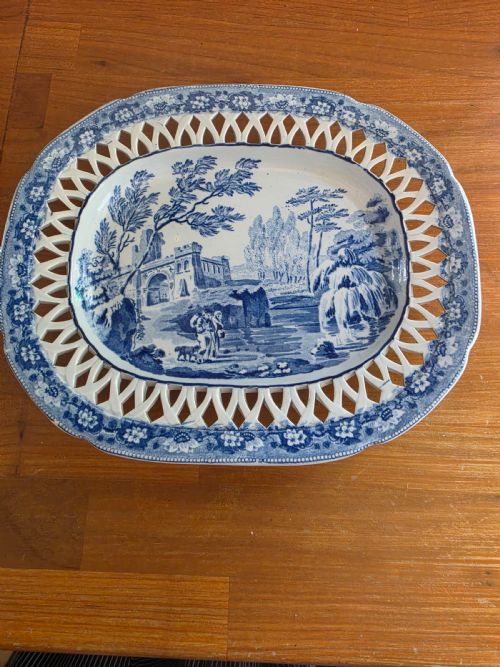


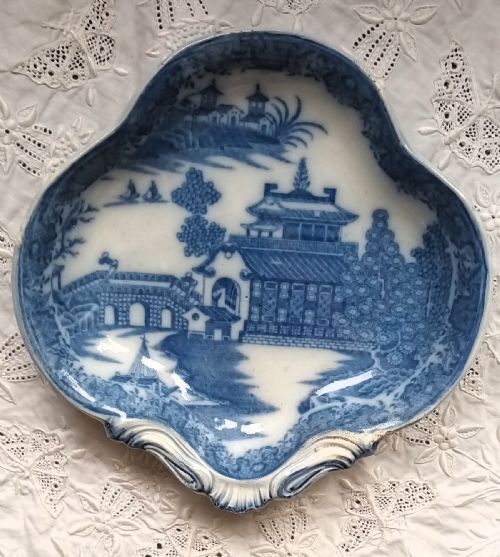


Georgian Pearlware Serving Plate
A georgian pearlware serving plate is an early earthenware platter finished with pale glaze and blue pigment, sought after for its crisp transfer-printed scenery.
Georgian Pearlware Serving Plate
A georgian pearlware serving plate encompasses large platters, tazza dishes and serving dishes produced during the Georgian and Regency eras. These ceramics serve functional dining roles while displaying detailed landscape and architectural transfers.
The versions most commonly met on this page date from the early nineteenth century and feature blue and white transfer printing. Makers applied pictorial scenes such as the London Bridge pattern, classical ruins and Chinoiserie motifs across earthenware bodies.
How they were made
Potters shaped earthenware and pearlware bodies before applying cobalt pigment by hand or through copperplate transfer. A lead glaze provided the characteristic pale, glossy finish that pooled softly in recessed areas.
Firing took place in traditional kilns where pieces received high temperatures to set the blue pigment beneath the glaze. This technique secured the crisp transfer detail seen on serving dishes and platters.
Listings feature earthenware and pearlware forms spanning the nineteenth century, including tazza stands, sauce tureen bases and large platters.
What varies in quality
Quality rests upon the clarity of the blue and white transfer print and the crispness of the earthenware moulding. Sharp architectural lines and deep cobalt tones indicate superior execution.
The smoothness of the lead glaze and the stability of the ceramic body separate standard utility wares from finer cabinet pieces. Even distribution of the glaze across large serving surfaces elevates the visual appeal.
Davenport·Spode·Thomas Lakin·Don Pottery·John Rogers and Son
The Georgian Pearlware Serving Plate Glossary
- Pearlware
- A refined earthenware developed to rival Chinese porcelain by incorporating a small amount of cobalt into the glaze. This gave the ceramic body a faint bluish tint rather than standard cream hues.
- Transfer printing
- A decoration method where a design is engraved on a copper plate, inked with cobalt pigment, and transferred to paper then onto the ceramic surface. This technique allowed intricate patterns to be reproduced consistently.
- Tazza
- A shallow ornamental dish or plateau raised on a stem and foot, used for serving food or displaying items. In this category, tazza forms carry detailed transfer-printed landscapes.
- Chinoiserie
- A European decorative style influenced by Chinese artistic traditions, featuring imaginary oriental landscapes and figures. Potters utilised this style extensively on early nineteenth-century earthenware.
Georgian Pearlware Serving Plate: Frequently Asked Questions
How do I identify a pearlware serving plate?
Look for a slightly bluish tint in the glaze where it pools around the footring or rim, distinguishing it from creamware.
Examine the earthenware body underneath for early nineteenth-century manufacturing characteristics and blue and white transfer prints.
Were these plates used for daily dining?
These large dishes and platters served functional roles on dining tables for presenting roasts, bread or side dishes during formal meals.
Their robust earthenware construction allowed them to withstand regular use in Georgian and Regency households.
How should I display a serving platter?
Platters fit securely on plate stands or wall mountings designed for heavy ceramics to showcase the transfer-printed scenes safely.
Keep them away from direct sunlight and excessive moisture to protect the historic lead glaze.
What patterns are most common?
Blue and white transfer designs dominate, featuring classical ruins, bridges, and exotic Chinoiserie landscapes.
Named patterns like the London Bridge or Bridge of Lucano appear frequently on pieces from this period.