

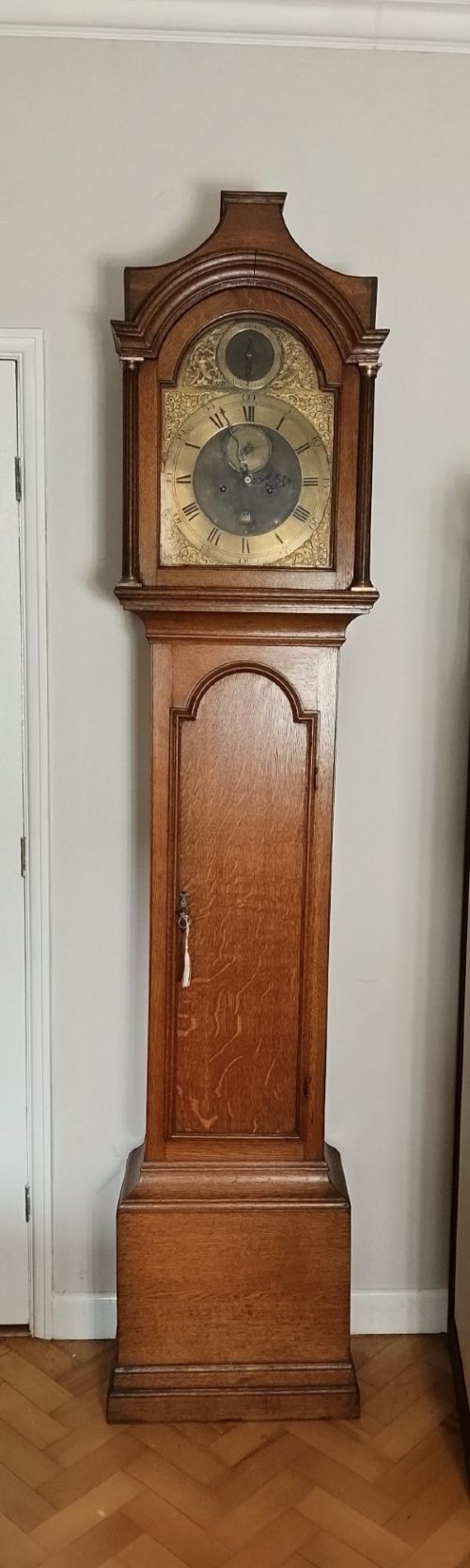


Georgian Oak Horology
Georgian oak horology brings together robust eighteenth-century timepieces and wall clocks that anchor a room with traditional British craftsmanship.
Georgian Oak Horology
Georgian oak horology consists primarily of tall longcase clocks and compact hooded wall clocks produced during the eighteenth and early nineteenth centuries. These timepieces range from thirty-hour movements to eight-day systems, often featuring striking mechanisms and brass dial details.
The versions most frequently encountered on this page are sturdy oak longcase grandfather clocks and provincial wall clocks created by regional makers across Britain. Their practical timber construction and functional dials reflect the domestic requirements of country houses and rural parishes.
How they were made
Makers constructed the timber cases using solid oak planks, frequently paired with brass and painted iron for the clock faces and visible dial components. Steel and glass further supported the internal movements and protected the delicate hands and chapter rings.
Georgian Oak Horology Retail Price Guide 2026
Typical asking prices for georgian oak horology among the pieces listed under this phrase on Sellingantiques today, from the lower quarter to the upper quarter. They describe what is for sale here now, not the wider market.
Listings feature oak material predominantly, alongside brass, painted iron, glass, steel, walnut, and mahogany across the Georgian and Regency periods.
What varies in quality
Distinctions in quality often rest on the complexity of the movement and the regional provenance inscribed upon the dial. Clocks featuring eight-day movements or signed provincial maker details generally demonstrate superior mechanical ambition compared to simpler thirty-hour variants.
The handling of the oak timber and the crispness of the brass dial engraving also divide standard provincial production from finer workshop output. Well-proportioned cabinetry with integrated hood mouldings preserves the architectural integrity of the piece over centuries.
Henry Deykin Worcester·Richard Prew Tewksbury·Mercer Hythe Kent·Herbert of Haversham·J Hummel of Worcester
The Georgian Oak Horology Glossary
- Longcase clock
- A tall pendulum clock enclosed in a wooden case designed to stand directly on the floor. These pieces are frequently referred to as grandfather clocks.
- Hooded wall clock
- A compact clock designed to be mounted directly onto a wall with a protective wooden hood covering the dial. These units often operated on thirty-hour movements.
- Strike or silent
- A mechanical function allowing the clock to either sound the hours on a bell or remain silent. This addition was controlled by a small lever on the dial face.
- Chapter ring
- The circular ring on the clock face that displays the numerals for the hours. They were typically engraved in brass or painted onto iron dials.
Georgian Oak Horology: Frequently Asked Questions
How do thirty-hour and eight-day clocks differ?
Thirty-hour clocks require winding once a day and typically feature simpler gear trains driven by a single or double weight system. They were common in provincial workshops and rural households.
Eight-day clocks need winding only once a week and utilise more complex gear mechanisms. Their movements often incorporate striking trains that require heavier weights and sturdier cases.
Where were these clocks made?
These timepieces were produced by regional horologists operating in towns, cities, and rural parishes across Britain. Many makers inscribed their names and locations directly onto the brass or painted iron dials.
Provincial clockmakers sourced local timber such as oak for their cases while importing specialised brass components and glass from larger industrial centres.
How should I care for an oak horology piece?
Place the clock in a stable environment away from direct sunlight, dampness, and sudden temperature fluctuations. Oak timber reacts to severe humidity changes, so maintaining consistent indoor conditions protects the structural joinery.
Ensure the longcase stands completely vertical on a level floor so the pendulum swings evenly. Professional servicing every few years keeps the historical mechanical movement functioning properly.