
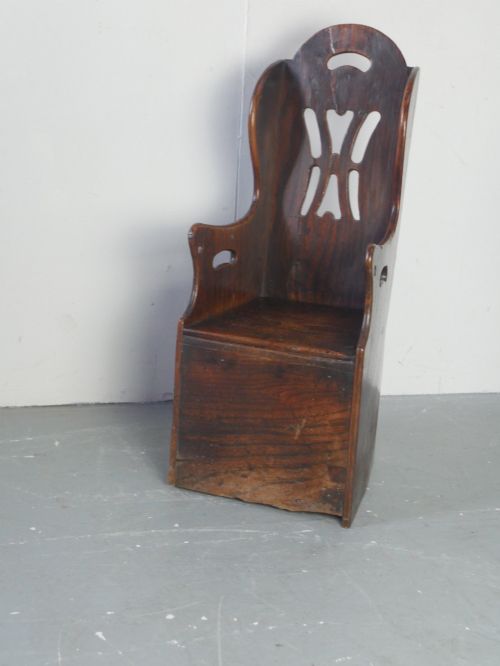


Georgian Miniature Armchair
A georgian miniature armchair is a small-scale seat of the period, offering collectors the charm and joinery of full-sized furniture in miniature.
Georgian Miniature Armchair
A georgian miniature armchair is typically encountered as a child's chair, a stick-back Windsor, or an apprentice piece made in miniature proportions. These pieces appear in forms such as open armchairs, rocking chairs, and hall chairs dating from the eighteenth and nineteenth centuries.
The selection on this page spans regional country vernacular styles alongside revival pieces in mahogany, walnut, and yew. Makers utilised native timbers like elm, ash, and beech to construct functional miniature seating for domestic use.
Materials and construction
Makers constructed these chairs using solid native timbers such as elm seats, yew spindles, and ash or beech bending elements. Windsor forms rely on turned legs and hooped backs wedged directly into a thick wooden seat.
Joinery techniques mirror full-scale cabinetmaking and chairmaking of the period, employing mortise and tenon joints, crinoline stretchers, and hand-carved splats. Finer examples utilise figured mahogany and walnut with delicate pierced splats or caned panels.
Listings feature regional English country vernacular styles alongside formal Chippendale and Regency revivals in elm, yew, and mahogany.
Assessing quality and proportion
Quality in a georgian miniature armchair depends on the fidelity of its scaling and the crispness of its hand-carved or turned details. Superior examples maintain balanced proportions rather than looking merely clumsy or crude.
The Georgian Miniature Armchair Glossary
- Windsor chair
- A chair built with a solid wooden seat into which the legs and back sticks are separately inserted. This vernacular form is frequently found in elm and yew among these listings.
- Crinoline stretcher
- A bowed under-framing stretcher that curves outward from the front legs to brace the rear legs of a chair. It adds structural rigidity while providing a characteristic silhouette.
- Apprentice piece
- A small-scale item created by a trainee craftsman to demonstrate mastery of joinery techniques to a guild. These objects display the exact construction methods of full-sized furniture.
- Splat back
- A chair back featuring a vertical central wooden upright, often shaped or pierced for decoration. Georgian examples frequently showcase vase or interlaced geometric designs.
- Bergere
- An enclosed upholstered armchair with cane work filling the sides and back frames. Miniature iterations incorporate woven cane panels within a solid wooden structure.
Georgian Miniature Armchair: Frequently Asked Questions
Were these miniature chairs made for children?
Many of these pieces served as functional seating for children in affluent households during the Georgian and Victorian eras.
Others functioned as apprentice pieces or salesman samples intended to showcase cabinetmaking skills rather than for actual domestic use.
How do I identify a Windsor chair?
A Windsor chair is defined by its solid carved wooden seat, which acts as the central anchor for all the structural components.
Turned legs, spindles, and a curved back rail are fitted directly into bored holes in the seat rather than forming a continuous frame.
What woods were commonly used?
English country makers relied on locally available timber, pairing elm seats with ash or beech spindles and bending parts.
Finer urban workshops utilised imported mahogany or native walnut and yew-wood for a more refined appearance.
How should I care for antique wood?
Keep wooden and rush-seated chairs away from direct heat sources and sudden temperature shifts to prevent timber shrinkage and splitting.
Apply a traditional beeswax polish sparingly to maintain the natural finish and nourish the dry antique grain.