
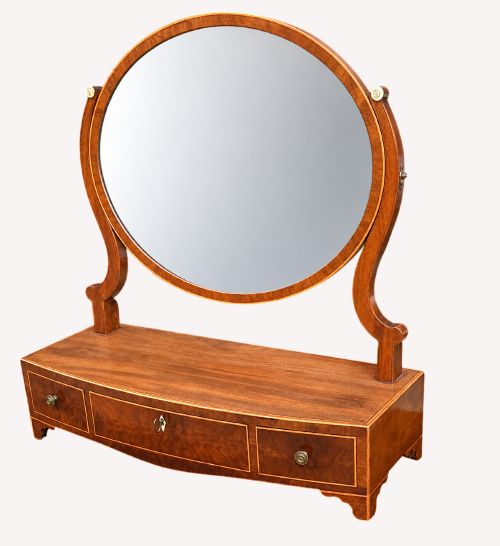
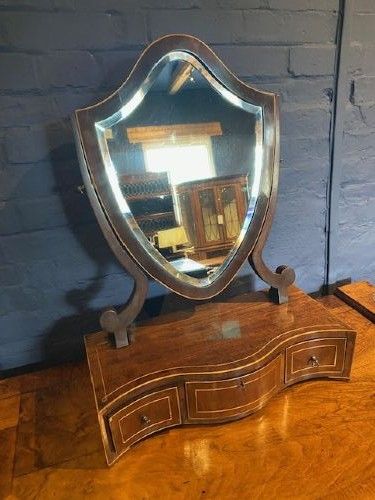
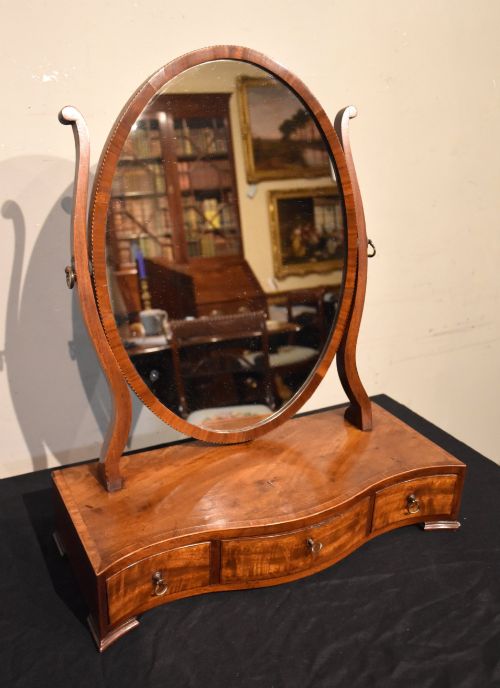
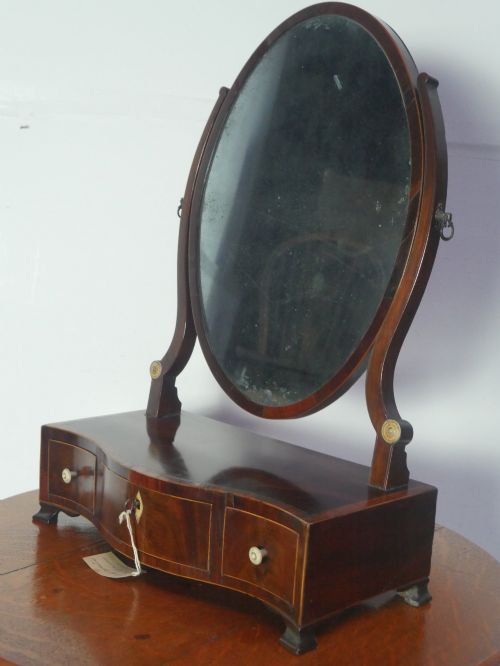
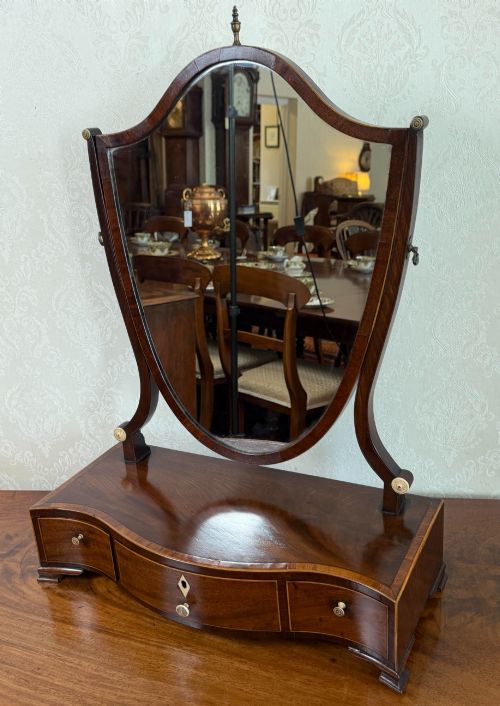


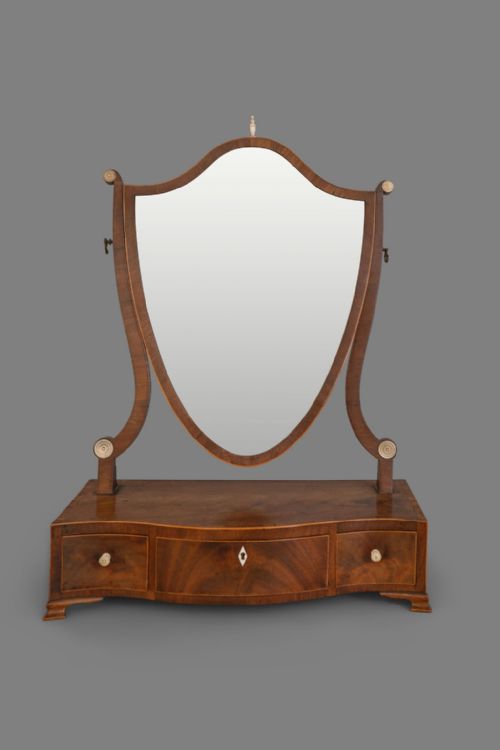


Georgian Mahogany Serpentine Toilet Mirror
These georgian mahogany serpentine toilet mirror examples combine clever cabinet work with practical dressing surfaces for the bedroom.
Georgian Mahogany Serpentine Toilet Mirror
A georgian mahogany serpentine toilet mirror sits on a tabletop, designed to help with daily grooming and dressing tasks in the bedchamber. Most versions encountered here belong to the Georgian and Regency periods, spanning the eighteenth and nineteenth centuries.
The defining characteristic is the serpentine shaped front of the base box, which often incorporates small drawers for storage. Makers fashioned these as dressing table mirrors or tabletop mirrors using rich timber figures.
Surviving examples show a variety of plate shapes, from traditional rectangular frames to oval and shield glass configurations supported by upright arms.
Materials and construction
Cabinet makers utilised solid and veneered mahogany for the structural frames and base boxes, often selecting timber with deep grain patterns. Secondary woods and decorative stringing in boxwood inlay or satinwood added contrast to the drawer fronts.
Mirrors were set within pivoting frames using brass screw caps and arm pivots, allowing the user to tilt the glass plate to the desired angle. Small bone escutcheons and brass drawer pulls completed the hardware.
The serpentine curve of the base required precise woodworking skills to shape the solid timber or bent laminations of the lower chassis.
Listings show these mirrors appearing across the Georgian, Regency, and Victorian periods, constructed primarily in mahogany with brass and glass elements.
Judging the work
Quality rests in the sharpness of the serpentine curves and the smoothness of the timber selection across the drawer fronts. Superior pieces display continuous grain alignment and fine boxwood inlay rather than plain surfaces.
The delicacy of the supporting scroll arms and the originality of the brass fittings determine whether a mirror retains its intended proportions. Heavier, clumsier frames lack the refinement seen in the best eighteenth century examples.
The Georgian Mahogany Serpentine Toilet Mirror Glossary
- Serpentine
- A curved shape that undulates with a convex centre flanked by concave sides. This line gives the base boxes their characteristic flowing profile.
- Toilet mirror
- A small mirror designed for placement on a dressing table or chest of drawers. These pieces typically include small storage drawers in the base.
- Shield glass
- A mirror plate cut into the shape of a heraldic shield. This style appears frequently on late eighteenth century frames.
- Boxwood inlay
- Narrow strips of pale wood inserted into darker mahogany to create geometric borders. Craftsmen used this technique to accent drawer edges.
Georgian Mahogany Serpentine Toilet Mirror: Frequently Asked Questions
Where were these mirrors placed?
These mirrors sat atop dressing tables, chests of drawers or dedicated washstands in bedrooms. Their portable nature allowed owners to move them around the room to catch the best morning light.
Today, they function well on modern chests of drawers or side tables, providing both a useful reflective surface and hidden storage for small items.
How do I date a piece?
Dating relies on observing the timber choice, the profile of the base, and the shape of the mirror plate. Eighteenth century examples often feature finer serpentine shaping and delicate boxwood stringing.
Nineteenth century iterations tend to show heavier proportions and simpler joinery methods, reflecting changing cabinet making fashions across the eras.
What is the purpose of the drawers?
The small drawers built into the serpentine base held personal items such as rings, pins, cosmetics, and small grooming tools. They kept the dressing surface tidy while the owner prepared for the day.
These compartments often feature tiny divider sections or simple open wells suited for small trinkets.
How do I care for the wood?
Mahogany surfaces benefit from occasional dusting with a soft, dry cloth to prevent the buildup of grime. Avoiding direct sunlight protects the timber from fading over time.
Applying a gentle wax polish preserves the natural sheen of the grain without creating a heavy buildup on the antique finish.