
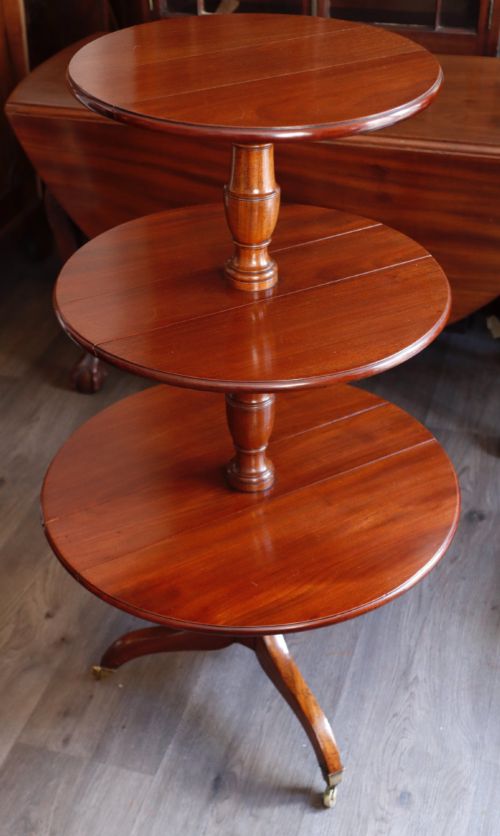
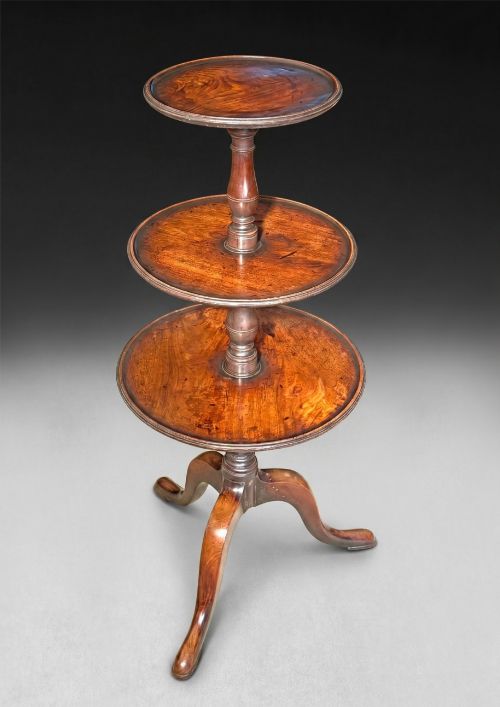
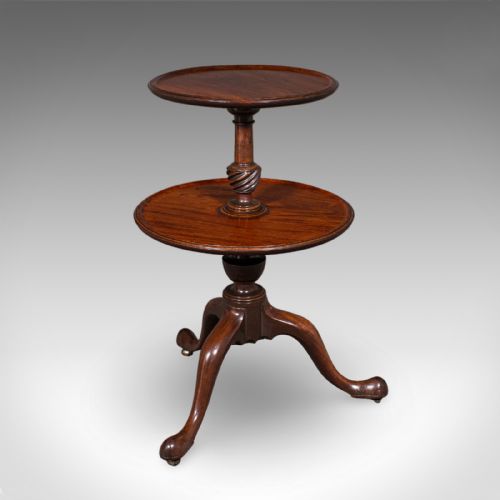


Georgian Mahogany Revolving Stand
These Georgian mahogany revolving stand pieces are tiered serving furniture designed for dining tables or sideboards, offering smooth rotation for access.
Georgian Mahogany Revolving Stand
When you search for a georgian mahogany revolving stand, you encounter tiered dumb waiters, table top lazy susans, and occasional stands designed for dining rooms. These pieces primarily date from the Georgian, George III, and Regency periods, though later interpretations appear from the early twentieth century.
The dominant forms on this page include multi-tiered circular dumb waiters with graduating shelves, alongside smaller rotating tabletop accessories. Their revolving mechanism allows diners or servants to access dishes and condiments without passing items across the table.
Most examples hail from the eighteenth and nineteenth centuries, utilising rich timber to create functional serving furniture. They range from simple two-tier tea stands to substantial three-tier revolving structures supported by tripod pedestal bases.
Factors of Quality
Quality in a georgian mahogany revolving stand rests on the depth of the timber grain, the precision of the turning on the central column, and the stability of the tier mechanism. Superior pieces exhibit well-figured mahogany with a warm patina and tight joints that keep each rotating tier level.
Finer examples demonstrate careful proportion between the graduating circular shelves and delicate yet robust leg supports, often featuring pad feet or brass claw castors. Lesser pieces may show heavy-handed proportions, stiff rotation, or replacement hardware that disrupts the period integrity.
Listings feature mahogany as the primary material, alongside brass hardware and secondary hardwoods across Georgian and Regency periods.
The Georgian Mahogany Revolving Stand Glossary
- Dumb waiter
- A tiered freestanding piece of dining room furniture with revolving shelves designed to hold dishes and cutlery. These tables allowed diners to serve themselves during private meals.
- Lazy Susan
- A revolving tabletop tray or stand placed in the centre of a dining surface to share condiments and food. They appear in circular mahogany formats dating back to the eighteenth century.
- Tripod base
- A support structure featuring three legs radiating from a central pillar, commonly found on nineteenth century dumb waiters and occasional stands for stability.
- Regency
- An English design period spanning the early nineteenth century characterised by classical restraint, influence from ancient Rome and Greece, and dark polished timbers.
- Chippendale style
- A decorative aesthetic drawing from mid-eighteenth-century cabinet maker designs, often displaying carved mahogany details and robust proportions.
Georgian Mahogany Revolving Stand: Frequently Asked Questions
What is a dumb waiter used for?
A dumb waiter served as a helper in the dining room by holding extra plates, glasses, and dishes within arm's reach. This allowed households to dine without constant attendance from servants.
Today, they function well in dining rooms or living spaces as side tables or display stands for books and ceramics.
How do I care for mahogany furniture?
Mahogany benefits from occasional application of quality wax to nourish the grain and protect the polished surface from moisture. Keep the wood away from direct heat sources and strong sunlight to prevent fading and splitting.
Regular dusting with a soft dry cloth maintains the natural lustre of the timber without building up chemical residues.
Are these stands stable when loaded?
Period revolving stands rely on a central column and a balanced tripod base designed to distribute weight evenly across the tiers. While sturdy, heavier items should be placed on the lowest tier to maintain proper equilibrium.
The revolving mechanism should turn smoothly on its pivot without excessive wobble or leaning.
How do I distinguish George III pieces?
George III furniture typically displays restrained classical carving, rich dark mahogany timber, and proportions developed during the late eighteenth century. Cabinet makers of this era focused on functional elegance and sturdy pedestal construction.
Examining the underside reveals period construction methods, hand-cut screws, and timber age that distinguish original pieces from later revivals.