
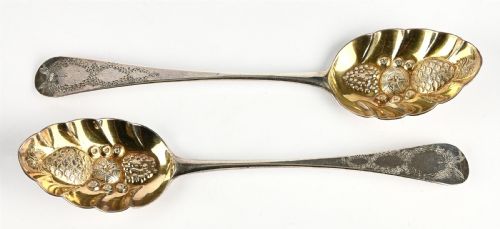


Georgian Fruit Spoons
Georgian fruit spoons are bright, embossed serving pieces that bring traditional elegance to the table.
Georgian Fruit Spoons
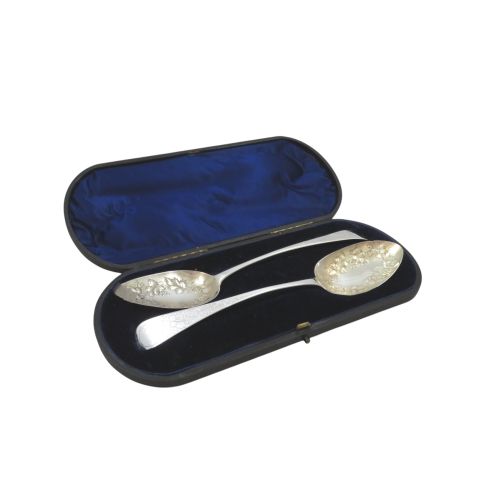
Georgian fruit spoons are specialised serving pieces designed for desserts and fruits, appearing most frequently as pairs or matched sets from the late eighteenth and early nineteenth centuries. When searching for georgian fruit spoons, buyers encounter ornate sterling silver items, often featuring embossed fruit or berry decoration added during the Victorian period to earlier bowls.
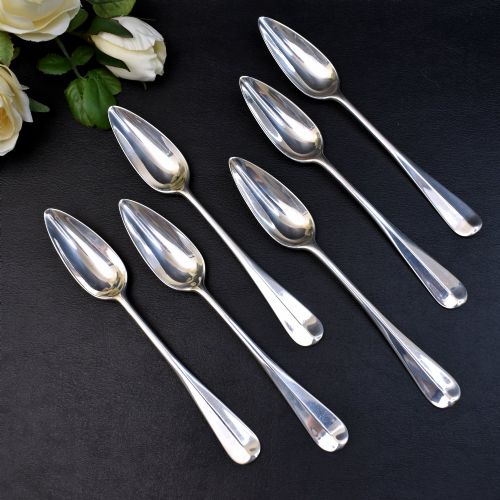
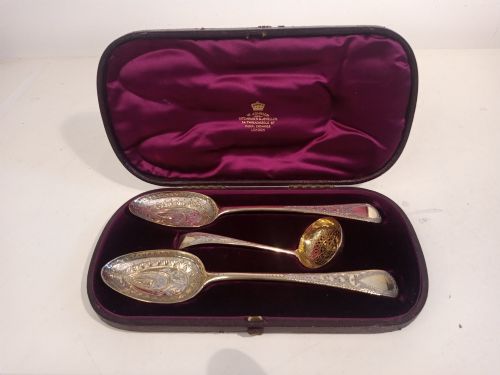
The inventory encompasses single spoons, pairs, and larger matched sets, alongside related cutlery such as sugar sifters and grapefruit spoons. Many examples survive alongside their original fitted cases lined in velvet, silk, or leatherette, preserving the utensils for modern collectors.
How they were made
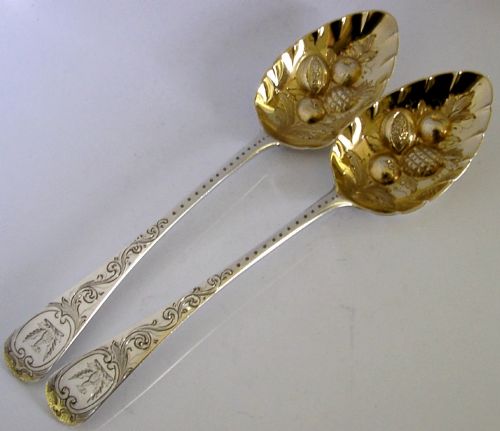
Silversmiths shaped these utensils from sterling silver, applying techniques like hammering, casting, and hallmarking to indicate origin and purity. Select pieces receive a silver-gilt or gold wash finish to the bowl interior, adding a rich tonal contrast against the polished silver handle.
Makers often applied decorative gilding and intricate chasing or repoussé work to transform plain eighteenth-century blanks into heavily ornamented fruit and berry spoons. Fitted presentation boxes utilise wood covered in leatherette and lined with soft silk or velvet to protect the polished metal.
Some berries carved onto these spoons appear surprisingly larger than any fruit grown in an eighteenth-century orchard.
What varies in quality
Quality rests in the crispness of the chased or embossed bowl decoration and the clarity of the maker marks and city hallmarks stamped into the metal. Finer examples retain strong definition in their floral and fruit motifs without excessive thinning of the silver from enthusiastic past cleaning.
The integrity of any fitted presentation case influences desirability, particularly when the original velvet or silk lining remains intact alongside undamaged leatherette exteriors. Matched pairs and complete sets command distinct interest compared to single stray utensils.
Hamilton & Inches·Peter & Anne Bateman·William Chawner II
The Georgian Fruit Spoons Glossary
- Berry spoon
- A serving spoon featuring embossed fruit and foliage on the bowl, often created during the Victorian era on earlier Georgian blanks.
- Hallmark
- An official stamp applied to precious metals indicating the standard of purity, the maker, and the year of assay.
- Silver-gilt
- Sterling silver that has been coated with a thin layer of gold on the surface, sometimes referred to as gold wash.
- Sifter
- A pierced spoon used for sprinkling powdered sugar over fruit and desserts.
- Repoussé
- A metalworking technique where the design is hammered into relief from the reverse side.
Georgian Fruit Spoons: Frequently Asked Questions
What were georgian fruit spoons used for?
These utensils were created for serving soft fruits, berries, and desserts during formal dining occasions. Their broad bowls made them practical for portioning delicate foods cleanly.
Over time, many of these pieces transitioned into display items or treasured family heirlooms housed within protective velvet-lined presentation cases.
Are these spoons made of solid silver?
The pieces in this category are fashioned from sterling silver, meeting official fineness standards of the period. Some examples feature an additional gold wash or silver-gilt layer applied to the interior bowl.
Maker marks and city hallmarks stamped directly onto the metal confirm the metallic composition and origin.
Why do some spoons have fruit embossed on them?
Many spoons originally manufactured as plain flatware during the eighteenth century were later embellished during the Victorian period. Silversmiths added chased and repoussé fruit, leaves, and berries to update older blanks to contemporary tastes.
This secondary decoration transformed standard serving utensils into ornate berry spoons.
How should antique silver spoons be stored?
Keeping the pieces in fitted boxes lined with silk or velvet helps prevent surface scratches and reduces tarnishing from exposure to air. Storing them in dry environments preserves both the metal and the protective leatherette exterior of the case.
Routine handling with clean hands maintains the polished finish without requiring aggressive cleaning.