




Georgian Ebonised Table Clock
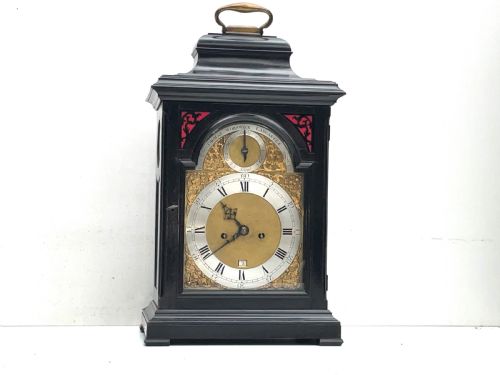
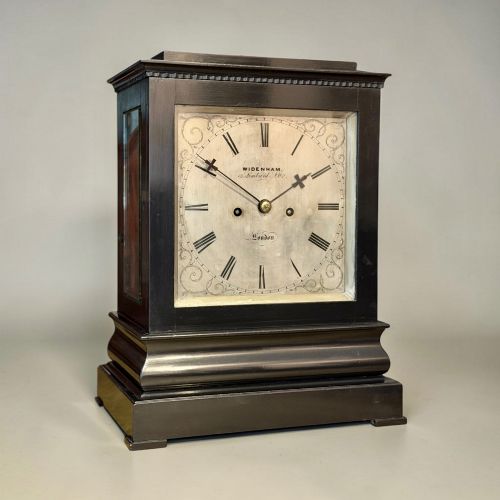
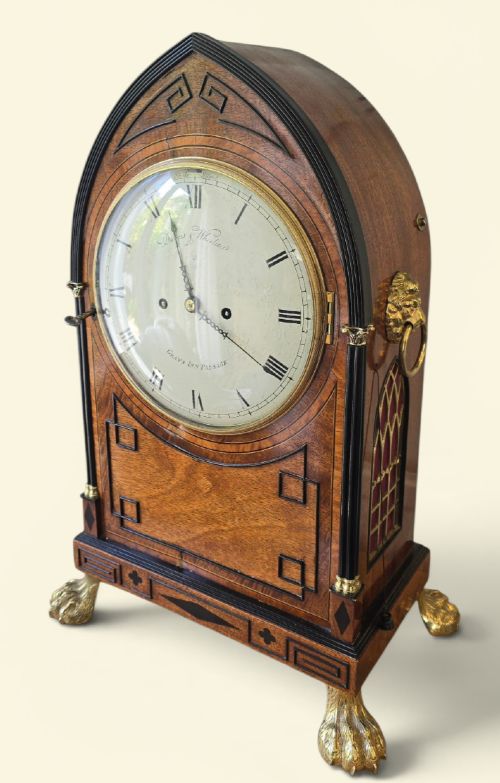
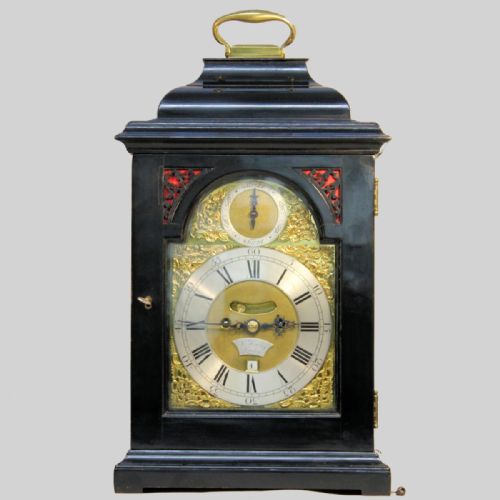
A georgian ebonised table clock delivers precision mechanical timekeeping housed in a dark, architectural case.
Georgian Ebonised Table Clock
A georgian ebonised table clock combines heavy dark timber framing with intricate internal gear trains designed to sit securely on a surface or bracket. The selection here spans the eighteenth century into the nineteenth, featuring mantel, bracket, desk, and wall-mounted formats.
Most examples you encounter take the form of bracket clocks housed in bell-top, inverted bell-top, or break-arch ebonised timber cases. These pieces frequently incorporate brass details, silvered metal dials, and glass panels to protect the movement while revealing the motion within.
Materials and construction
Makers built these clock housings using ebonised wood, ebony, and mahogany, often pairing the dark timber surfaces with cast brass mounts, gilt brass accents, and steel components. Dials typically feature silvered metal plates with engraved markings.
Internal mechanisms rely on fusee movements, verge escapements, and chain drives to regulate time and drive striking or quarter-repeating bells. Glass panels are fitted to the case doors to allow visibility of the dial and movement.
Georgian Ebonised Table Clock Retail Price Guide 2026
Typical asking prices for georgian ebonised table clock among the pieces listed under this phrase on Sellingantiques today, from the lower quarter to the upper quarter. They describe what is for sale here now, not the wider market.
Listings feature bracket clocks, mantel clocks, and desk clocks spanning the eighteenth and nineteenth centuries in ebonised wood, mahogany, and brass.
Variations in quality
The cabinetwork also dictates value, with crispness in the ebonised finish, fine brass fretwork, and well-preserved original brackets separating ordinary cases from superior examples.
Widenham of London·Desbois and Wheeler·John Witherston of Hereford·Des Granges of London·Arnold and Frodsham·Richard Rooker·Grimaldi and Johnson·Somersall London·John Seddon of London·Andrew Marchant of London·Frodsham and Baker London·Berguer of the Strand·William Withers·John Leroux·John Fletcher·John Taylor·William Smith London·Percy Webster·Richard Peckover·James Evans·Isaac Hurley·Joseph Lum·Baldwin of Loughborough
The Georgian Ebonised Table Clock Glossary
- Ebonised wood
- Timber treated to resemble ebony through staining or painting. This dark finish provides a formal, uniform appearance popular on period clock cases.
- Fusee
- A conical pulley used in mechanical clocks to maintain even tension on the gear train as the mainspring unwinds. It ensures consistent timekeeping power.
- Verge escapement
- An early type of clock escapement mechanism that controls the release of the gear train using a crown wheel and a verge rod with pallets.
- Bell-top case
- A clock case style featuring a stepped, curved top resembling the shape of a handbell. This silhouette often accommodates a ringing bell inside.
- Quarter-repeating
- A mechanism that chimes the hours and the most recent quarter-hour upon demand when a cord or lever is pulled. It allowed owners to check the time in the dark.
Georgian Ebonised Table Clock: Frequently Asked Questions
How do I wind a georgian ebonised table clock?
You insert the winding key into the dial holes and turn it gently until you feel resistance from the mainspring. Care must be taken not to overwind the fusee mechanism.
Most movements require a weekly wind to maintain consistent tension on the chain and gear train.
Where should I place my clock?
Position the clock on a stable surface such as a heavy chest, desk, or a dedicated wall bracket away from direct sunlight and drafts. A level placement is essential for the pendulum or balance to beat evenly.
Avoid high-moisture rooms like kitchens to protect the ebonised wood and internal metal parts.
How do I identify the period of the case?
Examine the silhouette of the timber housing, such as bell-top or break-arch forms, along with the engraving style on the silvered metal dial. Eighteenth-century models frequently utilise verge escapements, while later nineteenth-century pieces show distinct mechanical refinements.
Maker signatures inscribed on the brass backplate also help date the piece accurately.