


Georgian Diamond Jewellery
Georgian diamond jewellery brings together hand-cut stones and precious metals from the eighteenth and early nineteenth centuries.
Georgian Diamond Jewellery
Georgian diamond jewellery comprises rings, earrings, pendants, brooches and complete sets dating from the Georgian era through to related later revivals. When you search for georgian diamond jewellery, you encounter pieces designed to catch candlelight rather than electric illumination.
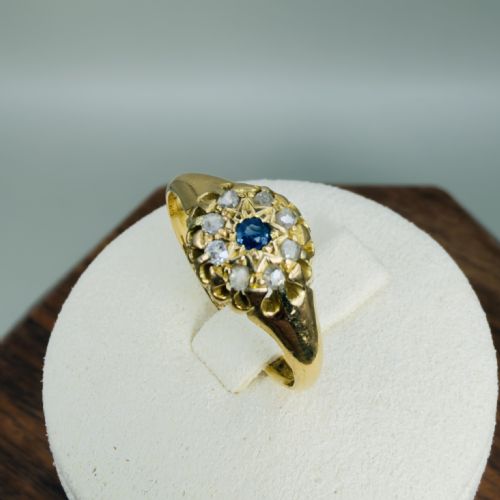
The selections here span rings with clusters and navette heads alongside drop earrings and pendants. Many items combine the period styles of the eighteenth and nineteenth centuries with later Victorian workmanship.
Earrings and rings form the core of what you meet in this category. Pieces often incorporate pearls, emeralds, sapphires and enamel alongside the central diamonds.
How they were made
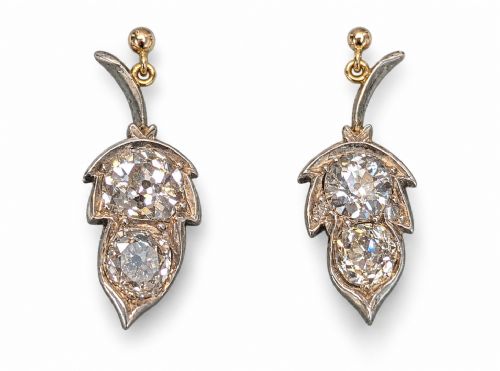
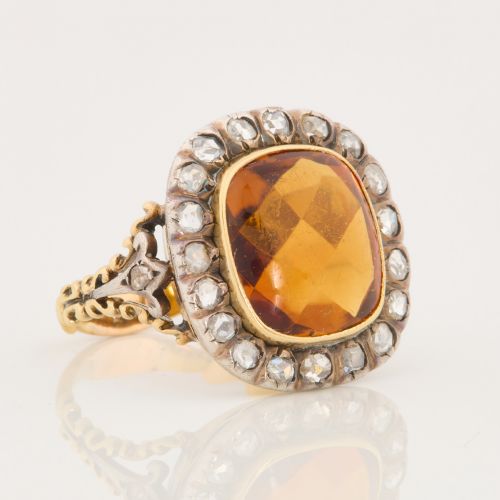
Goldsmiths set diamonds into silver frontages backed with gold to reflect light effectively under artificial illumination. This dual-metal technique characterises much of the work from the period.
Stones feature hand-cut facets such as rose cuts, old mine cuts and old European cuts shaped individually by hand. Jewellers secured these gems in closed or open foils that enhanced their brilliance.
Accompanying stones like emeralds, sapphires, turquoises and pearls integrate into gold and silver mountings. Enamel work frequently adds deep blue colour to the metal surfaces.
Listings in this category span the Georgian, Regency and Victorian periods, incorporating materials such as silver, 18ct gold, turquoise, enamel and natural pearls.
What varies in quality
Quality rests upon the skill of the hand-cutting applied to each diamond and the precision of the metalwork. Stones shaped with care display better light return within their closed or open settings.
The integrity of the original silver-on-gold construction and the preservation of enamel or delicate seed pearls determine the standing of a piece. Finer examples retain their original structural harmony without intrusive modern repairs.
The Georgian Diamond Jewellery Glossary
- Rose cut
- A diamond cut featuring a flat base and a domed crown with triangular facets arranged in a symmetrical pattern. This form appeared frequently before the dominance of brilliant cuts.
- Old mine cut
- An early cushion-shaped diamond cut with a small table, high crown and large culet, shaped by hand to maximise weight. These stones possess a distinct charm under evening light.
- Navette
- A boat-shaped ring setting or pendant outline that tapers to sharp points at either end. This elongated silhouette became popular for accommodating clusters of small diamonds.
- Foil back
- A thin sheet of coloured or reflective metal placed behind a gemstone within a closed setting to enhance its hue and brightness. Jewellers utilised this method extensively before modern stone-cutting techniques developed.
- Night and day earrings
- Convertible drop earrings designed with removable lower sections for day wear and full length for evening occasions. This clever construction allowed versatile styling.
Georgian Diamond Jewellery: Frequently Asked Questions
How do I care for georgian diamond jewellery?
Keep these pieces away from water, ultrasonic cleaners and harsh chemicals because moisture damages the historic foil backs behind the stones.
Store each item separately in a soft pouch to protect the fragile silver-and-gold settings and any delicate seed pearls.
Why are silver and gold used together?
Goldsmiths placed silver on the front of the mount because its bright white surface enhanced the appearance of the diamonds.
They backed it with gold to provide structural strength and to prevent the silver from tarnishing against the wearer's skin or clothing.
How do I recognise rose cut diamonds?
Rose cut diamonds have a flat bottom and a domed top covered in triangular facets rather than the deep pavilions of modern stones.
They produce a subtle, glowing reflection rather than a sharp modern sparkle.