


Georgian Demi Lune Sideboard
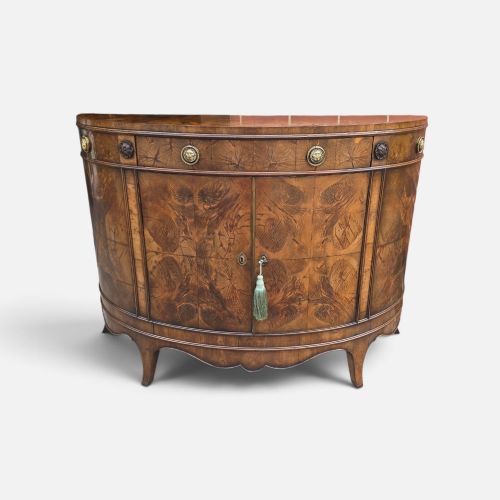
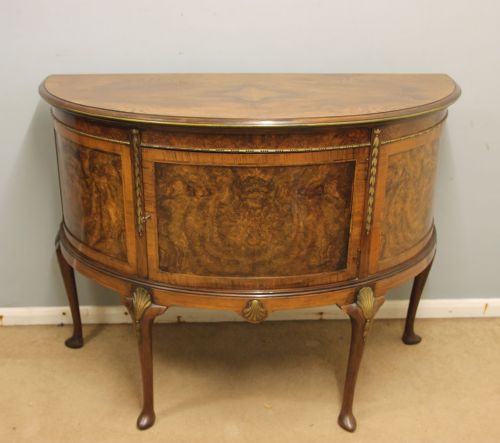
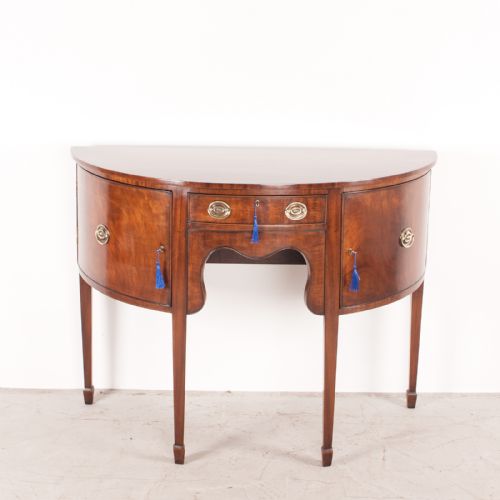
A georgian demi lune sideboard offers a sweeping semicircular profile and refined timber grain, bringing both understated elegance and practical surface space to a formal dining room.
Georgian Demi Lune Sideboard
Most entries on this page present rich timber surfaces and curved cabinetry designed to fit flat against a dining room wall. These pieces function as serving tables or display cabinets while taking up minimal floor space.
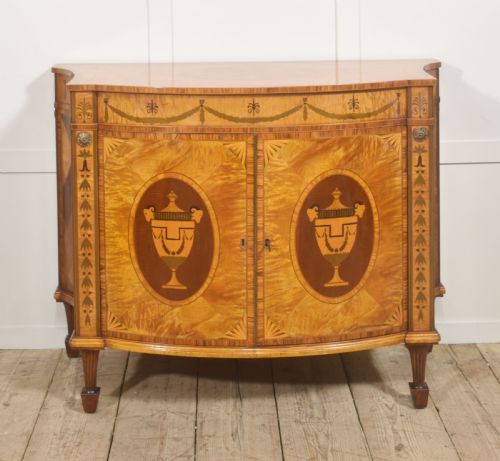
Originating primarily within English cabinet-making traditions, these items span periods from the Georgian era through Edwardian neoclassical revivals. The forms include plain mahogany veneers as well as highly decorative marquetry and painted panels.
How they were made
Cabinet-makers constructed these curved frames using solid timbers and decorative veneers applied over a stable secondary wood base. Mahogany, satinwood, burr yew, and walnut provide the primary visual surfaces, often accented with boxwood stringing.
Detailed marquetry inlay and classical painted panels define the more elaborate iterations. Brass hardware, including handles and escutcheons, completes the construction of doors and drawers.
Materials recorded across these items include mahogany, satinwood, burr yew, boxwood, walnut, burr walnut, and brass.
What varies in quality
Quality rests in the choice of timber figure, such as the depth of the burr yew or the grain alignment of the mahogany veneer. Finer examples display meticulous hand-cut marquetry and precise boxwood inlay rather than simple surface decoration.
The sophistication of the hardware and the crispness of carved or painted classical panels separate standard production from superior craftsmanship. Structural integrity in the curved drawer fronts and side cabinets also marks the grade.
The Georgian Demi Lune Sideboard Glossary
- Demi-lune
- A half-moon shape characteristic of these curved tables and sideboards. This profile allows the furniture to sit flush against a wall while presenting a rounded front.
- Marquetry
- The art of applying decorative pieces of veneer to a structure to form intricate patterns or pictures. Craftsmen utilise contrasting woods like satinwood and boxwood for this work.
- Commode
- A low cabinet or chest of drawers used for storage in formal rooms. Many pieces matching this search take the form of commodes with side cabinet doors.
- Stringing
- A narrow strip of contrasting wood inlaid into the surface of furniture to create a thin border. Boxwood stringing frequently outlines mahogany panels on these pieces.
Georgian Demi Lune Sideboard: Frequently Asked Questions
Where should I place a demi lune sideboard?
These cabinets suit dining rooms, hallways, or drawing rooms where floor space is limited. Their flat back allows them to stand securely against any wall.
Because of their curved front, they soften the hard angles of a room while providing a useful surface for lamps or serving dishes.
How do I care for antique mahogany and satinwood?
Keep timber furniture away from direct sunlight and strong heat sources to prevent the wood veneers from drying out or splitting. Regular dusting with a soft, dry cloth preserves the finish.
Apply a traditional beeswax polish sparingly when the wood appears dry, buffing gently to maintain the natural sheen of the grain.
Are these sideboards practical for daily use?
Most pieces offer internal shelving or drawer space suited for storing dining linens, silver, or glassware. The curved top surface functions well for serving during meals.
Consider the internal depth of the specific cabinet before storing bulky items, as the semicircular shape tapers slightly at the outer edges.
How do I distinguish eighteenth-century pieces from later revivals?
Examine the construction methods of the drawer linings and timber framing for signs of period hand-tooling. Eighteenth-century examples display distinct ageing patterns in the secondary woods compared to Edwardian revivals.
Reviewing the listed period details helps confirm whether a piece originates from the Georgian era or a later nineteenth-century interpretation.