
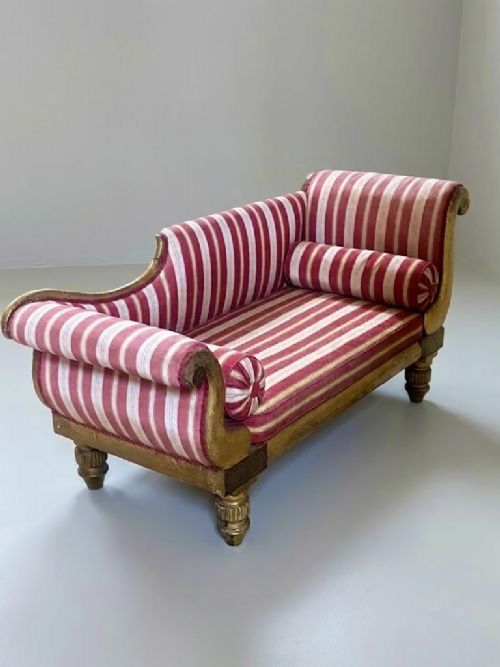
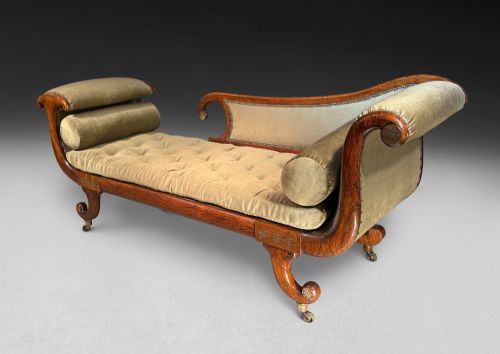
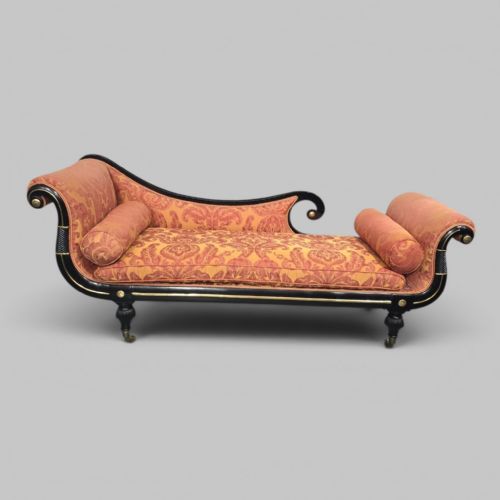


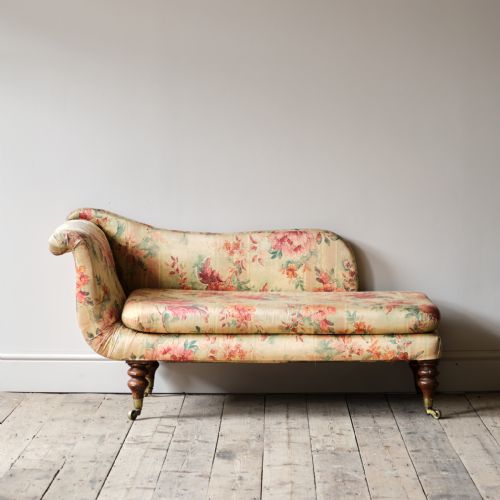


Georgian Daybed Chaise
A georgian daybed chaise brings architectural presence to a drawing room, combining scroll ends and upholstered comfort from the Regency and William IV periods.
Georgian Daybed Chaise
A georgian daybed chaise spans forms recorded as chaise longues, daybeds, and scroll end sofas originating from the Regency and William IV eras. Buyers searching for a georgian daybed chaise will mostly encounter mahogany and simulated rosewood frames with upholstered seating.
The surviving pieces demonstrate a clear preference for scroll end designs and architectural timber framing, often associated with the early nineteenth century and circa eighteen twenty-five. These daybeds and settees bridge the gap between formal seating and reclining furniture without losing their decorative authority.
Makers working in the manner of Gillows set the standard for these forms, producing sophisticated seating that prioritized flowing timber lines alongside rich upholstery. While some examples remain strictly regional country house pieces, others reflect the height of Grand Regency design.
Materials and construction
Makers constructed these frames predominantly from solid mahogany and simulated rosewood, sometimes elevating the appearance with brass inlay. Giltwood also appears on finer formal daybeds, providing a striking contrast to the timber frames.
Upholstery defines the upper surface, utilising antique striped silk, satin, and various traditional fabrics fixed over sprung or webbed foundations. The integration of carved scroll ends required precise cabinet-making skills to ensure the timber could support the sweeping curves without compromising structural integrity.
Listings for this phrase feature pieces predominantly from the Regency period, alongside William IV designs and nineteenth-century interpretations.
Assessing quality and proportion
Quality rests in the crispness of the timber carving and the subtlety of the brass inlay work where present. The transition from the upright backrest to the sweeping scroll end reveals the carver's control over proportion and grain direction.
Finer examples maintain harmonious lines across the entire length of the frame, whereas simpler country house iterations rely on heavier timbers and more restrained decoration. The selection of primary woods, from figured mahogany to carefully painted simulated rosewood, dictates the visual weight of the piece in a room.
Gillows
The Georgian Daybed Chaise Glossary
- Chaise Longue
- A long reclining chair or daybed designed for one person to stretch out. This form combines the backrest of a sofa with the extended seat of a bed.
- Simulated Rosewood
- Timber painted or grained to imitate the rich, dark figuring of genuine rosewood. This technique allowed makers to achieve an exotic aesthetic using native woods.
- Scroll End
- A furniture terminal curving outward and downward in a tight spiral. It provides a distinctive architectural profile on Regency and William IV daybeds.
- Giltwood
- Timber coated with gold leaf or gold paint to create a brilliant metallic surface. It is typically found on the most formal drawing room seating.
- Regency
- The British design period spanning the early nineteenth century, characterised by classical revival motifs and refined proportions. Furniture from this era often incorporates bold timber grains and bronze or brass mounts.
Georgian Daybed Chaise: Frequently Asked Questions
What is a georgian daybed chaise?
A georgian daybed chaise is a nineteenth-century reclining seat designed with a raised headrest and an extended body for lounging. These pieces evolved from classical forms to become central decorative furnishings in period interiors.
They combine the seating capacity of a sofa with the horizontal comfort of a bed, featuring prominent scroll ends and rich upholstery.
How do I date a georgian daybed chaise?
Dating relies on identifying stylistic markers such as Regency scroll arms, brass inlay, and the specific use of mahogany or simulated rosewood. Pieces often trace back to the early nineteenth century, around eighteen twenty-five.
Examining the timber grain and the method of upholstery construction helps distinguish Regency examples from later nineteenth-century interpretations.
Where should I place a georgian daybed chaise?
These pieces suit principal drawing rooms, grand libraries, or spacious hall settings where their sculptural profile can be viewed from multiple angles. Their elongated form works effectively positioned against a primary wall or floating in a large room.
Consider the traffic flow around the scroll ends to ensure the piece commands the space without obstructing movement.
How do I care for antique upholstery?
Protect antique silk and satin fabrics from direct sunlight to prevent fading and degradation of the delicate fibres. Regular gentle vacuuming with a soft brush attachment removes surface dust without stressing the textile.
Consult a specialist conservator for professional cleaning to preserve the integrity of period fabrics.