



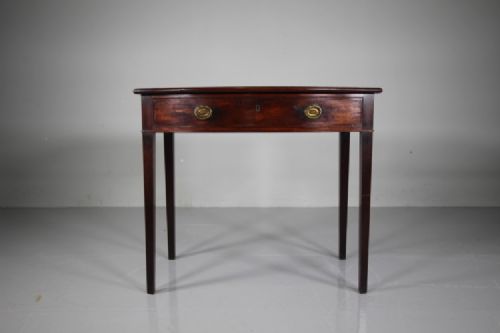


Georgian Bowfront Side Table
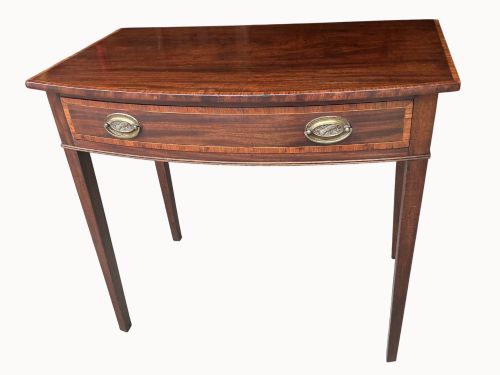
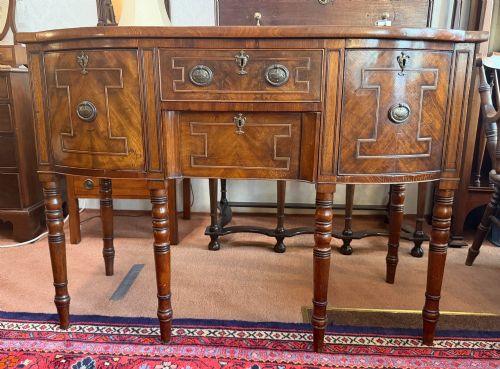
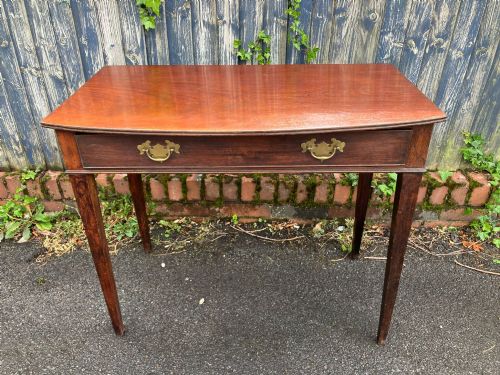
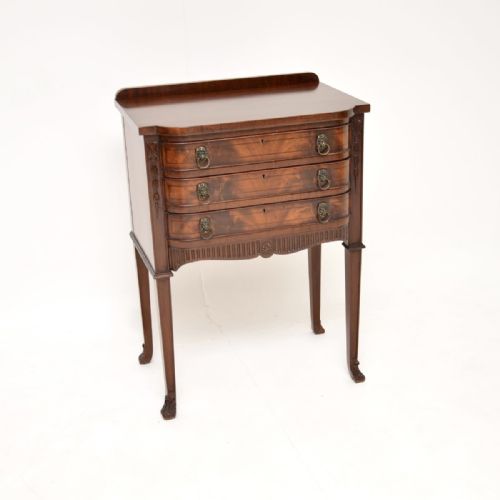
These mahogany pieces are a georgian bowfront side table, designed with a curved profile to anchor a room while providing a useful surface.
Georgian Bowfront Side Table
A georgian bowfront side table combines practical surface space with a curved front elevation that softens room lines. The records show these pieces span the eighteenth century, the regency era, and later revival periods.
Most examples found here date from the georgian era or nineteenth century in mahogany, alongside later twentieth-century interpretations in the sheraton style. Forms range from compact bedside cabinets and writing tables to larger sideboards and serving tables.
The design often incorporates a single frieze drawer or multiple drawers beneath the top. Variations include smaller lamp tables and console pieces designed for hallways or parlours.
Materials and Construction
Makers utilised solid mahogany and flame mahogany veneer, often contrasted with boxwood inlay and satinwood banding. Secondary timbers support the primary facades of these tables.
Fine linear stringing and boxwood details define the inlaid surfaces of sheraton and regency examples. Brass hardware, such as ring pulls or handles, accompanies the drawer construction.
Drawer linings utilise traditional hand-cut joints, whilst the curved carcase requires precise timber bending or shaping. Leather inserts appear on specific writing and dressing variants.
Listings feature mahogany, satinwood, and boxwood inlay across pieces spanning the georgian period into the twentieth century.
Craftsmanship and Proportion
Superior examples display balanced proportions where the sweep of the bow front integrates cleanly with the leg placement. Timber selection plays a role, with striking flame mahogany grain marking out the better pieces.
Execution of inlay and stringing distinguishes workshop standards, alongside the neatness of drawer dovetailing. Retaining original brass fittings and stable structural joints sustains the integrity of the piece.
The Georgian Bowfront Side Table Glossary
- Bowfront
- A curved front convex in shape, designed to project outwards from the frame. This contour is characteristic of many eighteenth and nineteenth-century case pieces.
- Frieze
- The horizontal section situated directly beneath the top surface of the table. This area frequently houses one or more narrow drawers.
- Satinwood
- A light-coloured timber used extensively for banding and inlay work during the sheraton period. It provides a sharp visual contrast against dark mahogany.
- Stringing
- Thin inlaid lines of contrasting wood, such as boxwood, set flush into the surface to create geometric borders. It marks out the edges of drawers and tabletops.
- Serpentine
- A curved line composed of alternating convex and concave sections. It differs from a simple bow front by incorporating multiple directional shifts.
Georgian Bowfront Side Table: Frequently Asked Questions
What rooms suit a bowfront side table?
These tables fit well in hallways, dining rooms, and sitting rooms due to their shallow depth. The curved front allows people to walk past more easily in confined spaces.
They function effectively as serving surfaces, writing desks, or lamp stands depending on the specific height and drawer configuration.
How do I spot a later revival piece?
Revival pieces from the twentieth century often display machine-cut internal joints and more uniform timber colouration. Examining the secondary woods inside the drawers helps clarify the period of manufacture.
Earlier examples from the eighteenth and early nineteenth centuries exhibit hand-cut dovetails and natural age-related patina on the timber.
Did these tables always have drawers?
Many examples include one or more frieze drawers beneath the top, but simpler serving and lamp tables exist without them. The evidence includes variations ranging from writing desks to bedside cupboards with doors.
Internal drawer layouts differ based on whether the piece served as a dressing table, a writing table, or a general side table.
What maintenance do mahogany surfaces need?
Regular dusting with a dry, soft cloth prevents the accumulation of grit on the polished wood. Wax polishing applied sparingly helps maintain the lustre of the mahogany grain over time.
Keeping the furniture away from direct heat sources and strong sunlight protects the timber and veneer from splitting or fading.