


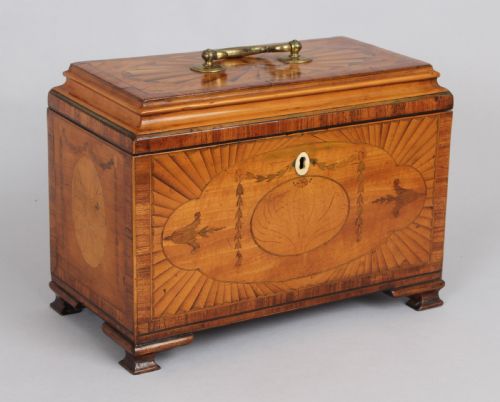


George III Satinwood Box
These pieces of george iii satinwood box work bring figured veneers and light timber into a room with genuine eighteenth-century presence.
George III Satinwood Box
A george iii satinwood box spans tea caddies, toilet mirrors, sewing tables, and desk organisers originating primarily from the Georgian period and the eighteenth century. You will frequently meet oval and octagonal tea caddies alongside dressing table mirrors and small toilet boxes.
The material palette draws heavily on satinwood, harewood, and mahogany, often enhanced by marquetry inlay, bone, and contrasting stringing. Surviving examples reflect both formal Georgian design and later Sheraton revival interpretations from the nineteenth century.
Materials and construction
Cabinetmakers worked with figured satinwood and harewood veneers laid over secondary timbers, adding delicate marquetry inlay and contrasting stringing in ebony and boxwood. Brass handles, escutcheons, and hinges provide functional hardware that complements the golden grain.
Joinery techniques relied on precise carcase construction for boxes and caddies, while mirrors utilised pivoting frames supported on box bases or upright standards. Surface finishes were polished to highlight the natural chatoyancy of the West Indian timber.
One recorded snuff box took the exact form of a small book, likely fashioned as an apprentice piece.
Evaluating craftsmanship
Quality rests upon the selection of the satinwood veneer, where tight, shimmering grain patterns and balanced marquetry placement elevate a piece far above plain timber surfaces. Crisp execution of stringing and well-fitted interior compartments demonstrate superior cabinetmaking skill.
Proportion and the preservation of original brass hardware and surface patination distinguish finer examples from those with altered mounts or heavy refinishing. The subtlety of crossbanding and the precision of edge mitres reveal the maker's hand.
Bayley & Blew
The George III Satinwood Box Glossary
- Satinwood
- A lustrous, hard timber native to the West Indies and Ceylon, prized for its golden colour and reflective, chatoyant grain.
- Marquetry inlay
- Decorative patterns formed by fitted pieces of various coloured woods and veneers set into the carcase surface.
- Cheveret
- A small freestanding writing table fitted with a tiered bookshelf or letter compartment superstructure above a drawer.
- Crossbanding
- A narrow strip of veneer laid around the border of a panel with the grain running perpendicular to the centre.
- Stringing
- Very thin inlaid lines of contrasting timber used to outline panels, drawer fronts, and box lids.
George III Satinwood Box: Frequently Asked Questions
What were these boxes used for originally?
These boxes served practical domestic functions, from storing precious dry tea leaves in locked caddies to holding cosmetics and writing implements on dressing tables. Their compartmentalised interiors were designed to protect high-value household goods.
Over time, they transitioned from utilitarian objects to decorative desk and tabletop accessories valued for their fine veneers and marquetry.
How do I distinguish eighteenth-century pieces from later revivals?
Eighteenth-century pieces typically display period construction methods, hand-cut dovetails, and original secondary timbers beneath the satinwood veneer. Later nineteenth-century Sheraton revival items often show machine-sawn elements and different internal paper linings.
Examining the wear patterns on the base and the oxidation of the wood beneath the hardware helps confirm the age of the piece.
How should I care for satinwood furniture?
Keep satinwood boxes and mirrors away from direct sunlight and strong heat sources to prevent the delicate veneers from drying out or splitting. Gentle dusting with a dry, soft cloth preserves the polished surface without stripping the historic wax.
Avoid placing damp items directly onto the timber to prevent staining the fine grain and inlaid stringing.
Why is some satinwood darker than other pieces?
Natural ageing and exposure to light cause West Indian satinwood to deepen from a pale golden yellow to a rich, warm honey brown over centuries. The specific tree origin and the application of traditional shellac polish also influence the final tone of the timber.