
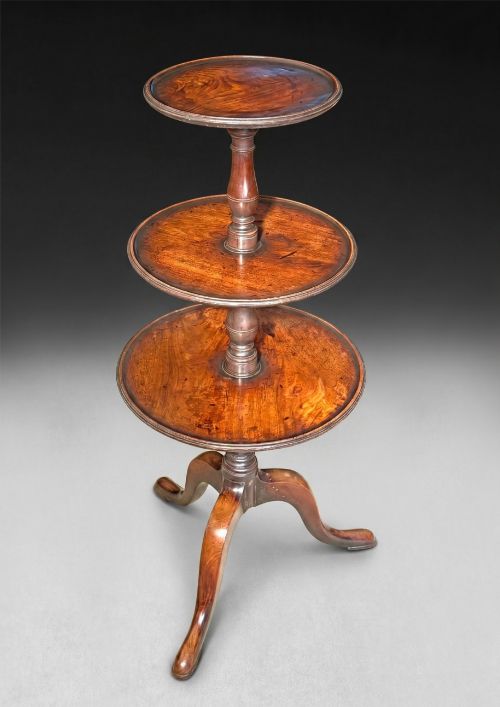
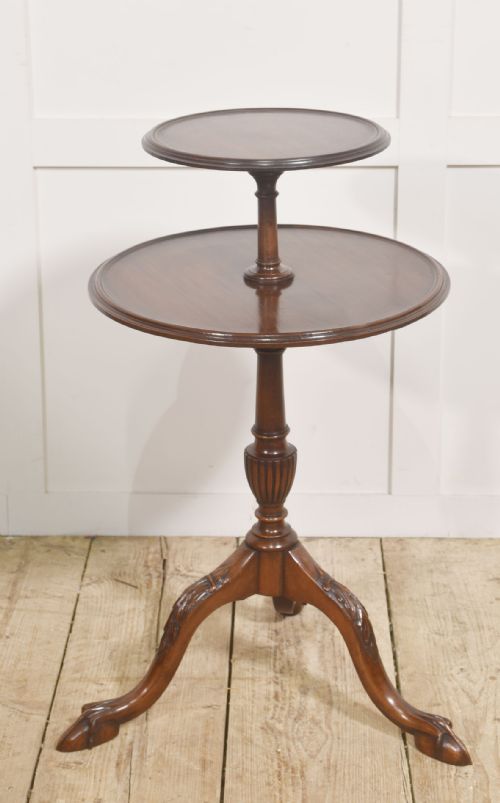


George III Mahogany Dumbwaiter
A george iii mahogany dumbwaiter brings tiered Georgian service to the dining room, offering revolving shelves or drop-leaf trays that make entertaining effortless.
George III Mahogany Dumbwaiter
A george iii mahogany dumbwaiter is a tiered serving table designed to hold dishes and bottles during a meal without the need for a servant in the room. Most examples found here date from the eighteenth century, alongside later revival pieces from nineteen ten.
The forms vary from circular and hexagonal revolving tiers to rectangular drop-leaf tables, etageres, and occasional tables. Three-tier and two-tier stacking formats dominate the selection, often supported by tripod bases.
Origins stretch across the Georgian period, maintaining practical utility whether configured as a traditional dumbwaiter, lazy susan, or tiered side table.
How they were made
Makers utilised rich mahogany for the graduated tiers, turning central columns and support pillars from solid timber to bear the weight of stacked trays. Brass fittings such as castors and pivot mechanisms appear frequently across the joints and legs.
Inlay work provides subtle surface detail on select pieces, while folding actions and drop-leaf mechanisms allow multiple tiers to collapse or pivot for compact storage when not in use.
Some eighteenth-century examples come equipped to fold completely flat, proving that historic dining rooms had to deal with clutter just as much as modern ones do.
What varies in quality
The standard of timber selection and the precision of the turning on the central column set finer examples apart from simpler utility items. Well-executed pivot mechanisms and smooth revolving tiers demonstrate superior workshop execution.
Format complexity also dictates distinction, where unusual arrangements such as hexagonal tops, rectangular drop-leaves, or folding three-tier configurations show greater ambition than standard circular tables.
The George III Mahogany Dumbwaiter Glossary
- Dumbwaiter
- A freestanding tiered table used for holding food and drink in a dining room. It allowed diners to serve themselves without domestic staff present.
- Etagere
- A set of open shelves or tiers designed for displaying or holding small items. The form shares similarities with stacked dumbwaiters.
- Drop-leaf
- A table top featuring hinged flaps that fold down when not in use. This mechanism appears on several rectangular and circular variants.
- Tripod
- A three-legged support base commonly utilised beneath the central column of these tables. It provides stability on uneven dining room floors.
- Lazy Susan
- A revolving tray or tabletop placed on a central axis to allow food to be easily shared. The evidence records this term alongside standard dumbwaiters.
George III Mahogany Dumbwaiter: Frequently Asked Questions
How were dumbwaiters used during meals?
Dumbwaiters held extra plates, dishes of food, and wine bottles within reach of the dining table. Guests served themselves, which kept conversations private by removing servants from the room.
The tiered design meant a large amount of tableware could occupy a small floor space beside the dining chairs.
Are all these tables from the eighteenth century?
The majority date from the Georgian era and the eighteenth century, reflecting the original period of production. A smaller number comprise later revival pieces made around nineteen ten in the George III style.
Listing details distinguish original eighteenth-century items from early twentieth-century interpretations.
What is the difference between a dumbwaiter and an etagere?
While both utilise multiple tiers, a traditional dumbwaiter specifically serves dining functions with revolving or folding shelves. An etagere offers an open tiered format often suited to general display or occasional use.
Several pieces combine these characteristics through unusual formats seen in late eighteenth-century examples.
How do folding tiers function?
Folding three-tier dumbwaiters feature hinges or pivoting joints that allow the upper trays to drop down or swing aside. This mechanism made the furniture easier to store against a wall when the dining room was cleared.
Such folding variants require careful handling to preserve the original mahogany and brass pivots.