

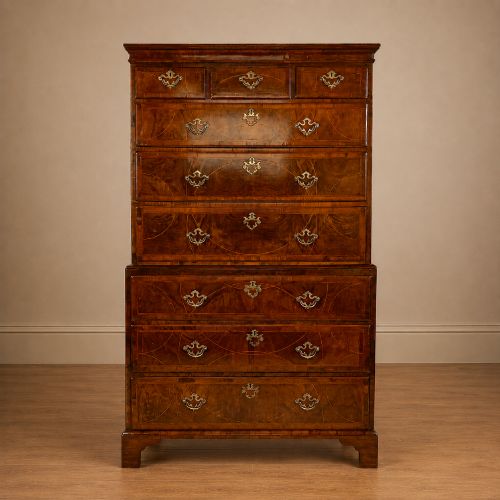


George II Walnut Cabinet
A george ii walnut cabinet brings rich figuring and honest proportion to a room, offering both display and concealed storage.
George II Walnut Cabinet
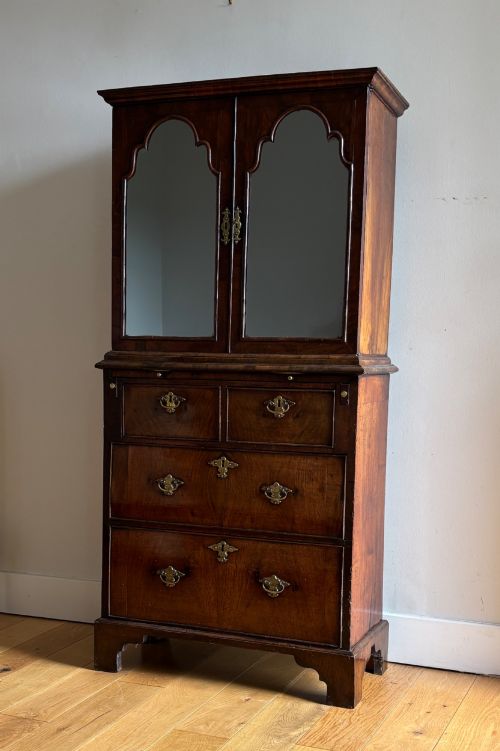
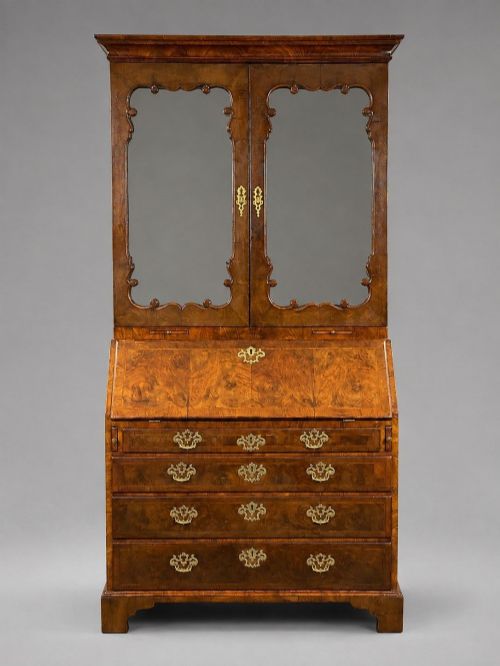
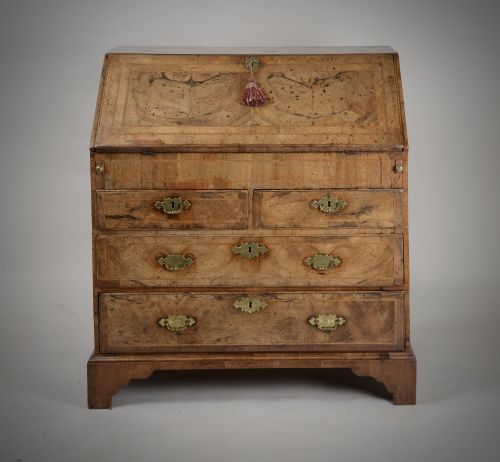
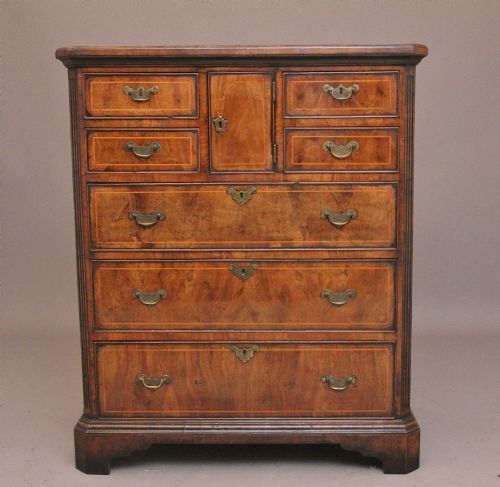
A george ii walnut cabinet encompasses bureau bookcases, chest on chest designs, lowboys, and corner cupboards from the eighteenth century. These pieces combine fitted desks, shelved upper sections, and deep drawers for practical domestic use.
Bureau bookcases and tall chests of drawers represent the most common forms found in this range. They often feature bureau flaps that drop down to reveal fitted pigeonholes and small drawers.
Smaller examples, such as lowboys and diminutive corner cabinets, appear alongside larger library pieces. The work spans the Georgian era and includes later revival pieces built in the George II style.
Materials and construction
Constructed primarily from walnut, burr walnut, red walnut, and oak, these pieces rely on figured veneers laid over sturdy carcass timbers. Craftsmen utilised feather banding and line inlay to frame drawer fronts and panel edges.
Brass handles and escutcheons punctuate the dark timber surfaces, whilst glass and mirror glass feature in the doors of upper bookcases. Secondary woods like oak provide structural strength to drawer linings and internal divisions.
George II Walnut Cabinet Retail Price Guide 2026
Typical asking prices for george ii walnut cabinet among the pieces listed under this phrase on Sellingantiques today, from the lower quarter to the upper quarter. They describe what is for sale here now, not the wider market.
Materials recorded across the selection include brass, mirror glass, oak, and red walnut.
Judgement of quality
Quality rests in the choice of timber and the dexterity of the veneer work. Bookcases and chests with strongly figured burr walnut or rich red walnut display greater visual depth.
The precision of the cabinetmaker shows in the crispness of the feather banding and the integration of secondary woods like oak. Proportions also dictate standing, as smaller and diminutive examples demand tighter joinery to maintain structural integrity.
The George II Walnut Cabinet Glossary
- Burr walnut
- A timber harvested from walnut tree growths, producing swirling, intricate grain patterns used for decorative veneer on cabinet fronts.
- Feather banding
- An inlay technique using small veneers cut diagonally and arranged in a herringbone pattern to frame drawers and panels.
- Chest on chest
- A tall case furniture form comprising a lower chest of drawers beneath an upper chest, often termed a tallboy.
- Lowboy
- A small table with drawers, standing on four legs, frequently used as a dressing or writing table during the Georgian period.
- Escritoire
- A writing cabinet with a fall-front flap concealing a fitted interior of drawers and pigeonholes.
George II Walnut Cabinet: Frequently Asked Questions
What is a george ii walnut cabinet?
A george ii walnut cabinet is an eighteenth-century storage or writing piece made from walnut or burr walnut. These range from bureau bookcases and tall chests to small corner cupboards.
They reflect the styles of the Georgian era, utilising figured veneers, brass hardware, and secondary woods like oak.
How do I identify a bureau bookcase?
A bureau bookcase combines a desk section with a hinged flap and an upper shelving cabinet enclosed by doors. The interior typically houses small drawers and pigeonholes.
Lower sections generally feature multiple graduated drawers for clothes or papers.
Where were corner cabinets placed?
Corner cabinets were designed to fit neatly into room angles, making efficient use of otherwise empty space. They served to display ceramics, glassware, or books.
Single-door walnut models often feature glass panels in the upper section for visibility.
What is red walnut?
Red walnut refers to a specific colour and tone of eighteenth-century walnut timber used in cabinet making. It exhibits a warm, reddish-brown hue distinct from darker European walnut.
Pieces described with this timber often date from the mid-eighteenth century.
How do I care for walnut veneer?
Walnut furniture requires stable room temperatures away from direct sunlight and heat sources to prevent veneer lifting. Regular dusting with a dry cloth keeps the surface clean.
Occasional waxing maintains the moisture and natural sheen of the timber.