
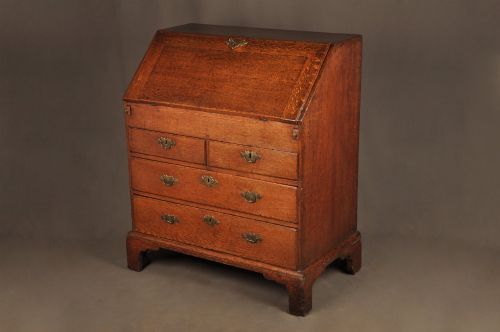


George I Oak Bureau
A george i oak bureau is a robust writing piece with a fitted fall front, valued for its honest early timber and compact domestic proportion.
George I Oak Bureau
A george i oak bureau offers a sloping fall front that opens to reveal a fitted interior of small drawers and pigeonholes above further drawer tiers. Buyers frequently meet simple fall front versions, bureau bookcases with upper shelved sections, and compact examples raised on stands.
The material palette spans sturdy early oak, pollard oak, walnut, and mahogany crossbanding, matched with brass handles and key escutcheons. Pieces originate across the eighteenth century and subsequent Georgian eras, alongside occasional Victorian revivals and arts and crafts interpretations.
Desks and bureau cabinets provide practical writing surfaces combined with concealed compartment storage. These practical domestic items serve as functional writing desks while anchoring a room with seventeenth and eighteenth century presence.
Materials and construction
Joiners built these writing pieces primarily from solid timber planks, utilising oak for structural carcases and drawer linings. Craftsmen employed crossbanding in walnut or mahogany to frame drawer fronts and fall fronts, adding subtle contrast to the native grain.
Makers integrated brass drop handles, escutcheons, and hinges to secure doors and drawer compartments. Fall fronts required sturdy brass support brackets or lopers to bear the weight of the writing surface when lowered.
Available forms include bureau bookcases, kneehole desks, corner units, and compact pieces on stands.
Assessing quality and proportion
Proportion and scale dictate the desirability of these pieces, with smaller widths and diminutive heights commanding greater attention from collectors. The crispness of the interior pigeonhole arrangement and the retention of original brass hardware elevate an example above standard utility pieces.
Surface timber quality appears in the depth of the grain and the warmth of the polished patina. Finer constructions exhibit tight corner joints, well-figured pollard oak or burr surfaces, and undisturbed backboards that demonstrate continuous domestic history.
George W Jack·Morris And Co
The George I Oak Bureau Glossary
- Bureau
- A writing desk featuring a sloping hinged lid that drops to form a writing surface. This flap conceals an interior arrangement of small drawers and pigeonholes.
- Fall front
- The hinged writing flap on a bureau that drops down for use and lifts vertical to enclose the desk interior. It usually locks into place with an iron key mechanism.
- Crossbanding
- A narrow strip of veneer applied to the borders of drawer fronts or tabletops where the grain runs at right angles to the surrounding wood. This technique creates a decorative border.
- Pigeonhole
- A small open compartment within the interior fitted section of a desk used for sorting letters and papers. These compartments often sit above concealed secret drawers.
- Patina
- The surface sheen and mellow colour developed on antique wood over decades of handling, polishing, and exposure to light. It serves as an indicator of age and genuine preservation.
George I Oak Bureau: Frequently Asked Questions
What is a george i oak bureau?
A george i oak bureau is an early eighteenth century writing desk featuring a sloping fall front lid that opens to reveal an interior fitted with small compartments and drawers.
These pieces typically rest on bracket feet or a dedicated stand, combining a compact writing surface with enclosed storage for ledgers and correspondence.
How were these desks used originally?
These desks served as private writing spaces for household accounts, letter writing, and the storage of important family documents. The drop-down lid provided a stable sloped surface for writing before closing securely to hide the contents.
Interior pigeonholes and hidden compartments kept papers organised away from household view. They functioned as the primary administrative hub in a domestic setting.
How do you style them in a modern room?
You can place a bureau in a living room, hallway, or bedroom where its rich oak timber adds texture and historical contrast. The piece functions effectively as a working laptop desk when the fall front is lowered for daily use.
Leaving the writing flap closed presents a clean wooden cabinet front that conceals modern clutter. Pairing the desk with a simple timber chair allows the antique grain to stand out.
How can you tell an early piece from a later copy?
Early pieces display hand-cut dovetails, pegged frame construction, and native oak timber with deep patination rather than uniform modern staining. The interior secondary woods and backboards show age-appropriate tool marks and shrinkage.
Later Victorian revivals or arts and crafts interpretations exhibit different construction methods, machine-cut elements, and distinct hardware styles associated with nineteenth-century workshops.