



Geometric Glass Pendant Shade
These geometric glass pendant shade pieces bring period angularity to interiors, offering authentic lighting for those seeking distinct twentieth-century character.
Geometric Glass Pendant Shade
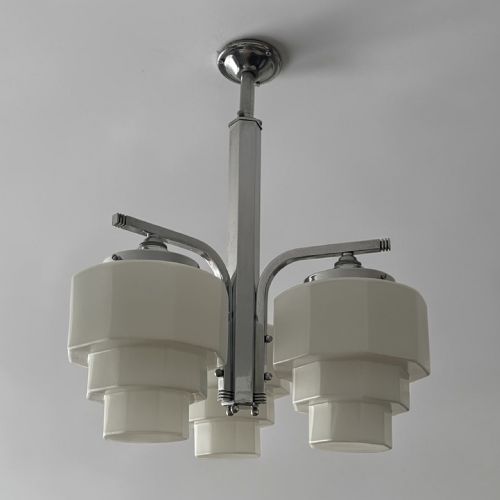
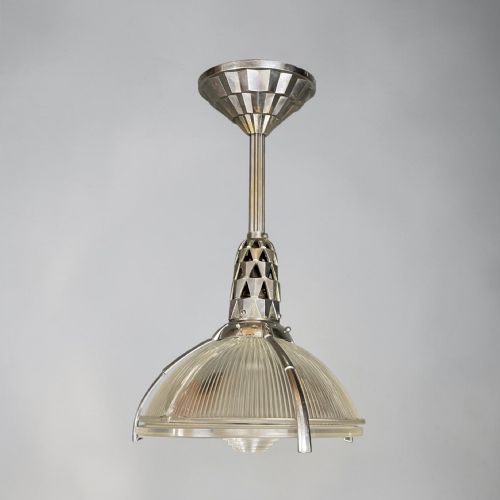
A geometric glass pendant shade provides structural overhead illumination through distinct angular and symmetrical forms. When you search for a geometric glass pendant shade, you encounter ceiling lighting produced primarily during the 1920 and 1930 periods.
The dominant aesthetic across these items follows the Art Deco style, combining straightforward geometric silhouettes with architectural glasswork. Examples frequently manifest as lanterns, plafonniers, and pendant lights suited for central room placement.
How they were made
Construction relies on moulded and frosted glass panels secured within metal frameworks. Materials like brass, copper, chrome, nickel plated metal, bronze, and wrought iron form the structural mounts and suspension hardware.
Moulders utilised opaque and frosted treatments to diffuse light evenly across sharp angles and stepped forms. Metal components were joined to house the glass securely while maintaining clean architectural lines.
Geometric Glass Pendant Shade Retail Price Guide 2026
Typical asking prices for geometric glass pendant shade among the pieces listed under this phrase on Sellingantiques today, from the lower quarter to the upper quarter. They describe what is for sale here now, not the wider market.
Listings span the 1920 and 1930 periods, uniting frosted glass with brass, copper, chrome, and wrought iron.
What varies in quality
Distinctions in quality rest upon the weight and clarity of the moulded glass panels relative to their metal mounts. Heavier gauge metals such as solid brass or wrought iron indicate superior structural integrity compared to lighter plated alternatives.
The precision of the geometric moulding dictates the visual success of the piece when illuminated. Sharper definition in the glass planes and more robust framing elevate certain examples above standard utilitarian production.
Émile-Jacques Ruhlmann
The Geometric Glass Pendant Shade Glossary
- Plafonnier
- A ceiling light fixture mounted flush or close to the ceiling surface. This form directs illumination downward through decorative glass bowls or panels.
- Frosted glass
- Glass treated to create a textured, opaque surface that diffuses light. This treatment softens glare while highlighting the geometric contours of the shade.
- Art Deco
- A design style characterised by sleek lines, symmetry, and geometric abstraction. It dominated decorative arts throughout the 1920 and 1930 decades.
- Pendant light
- A hanging light fixture suspended from the ceiling by a cord, chain, or metal rod. It serves as a primary source of illumination in spaces with sufficient ceiling height.
Geometric Glass Pendant Shade: Frequently Asked Questions
What rooms suit a geometric glass pendant shade?
These ceiling lights fit well in hallways, entryways, and dining spaces where downward illumination and defined shapes matter.
Their architectural presence complements period properties and modern rooms alike, provided the ceiling height accommodates hanging fixtures.
How do I identify a 1930 piece?
Look for the characteristic use of chrome or frosted glass combined with stepped geometric motifs typical of late Art Deco design.
Construction methods from this decade often featured simplified metal mounts alongside heavier moulded glass shades.
What is the difference between a lantern and a plafonnier?
A lantern hangs lower on a suspension mechanism with visible framing enclosing the glass panels on multiple sides.
A plafonnier sits much closer to the ceiling plane, functioning essentially as a shallow bowl light.
How do frosted glass panels affect lighting?
Frosted surfaces scatter light rays to eliminate harsh glare while retaining high overall brightness levels.
This diffusion emphasises the angular corners and decorative patterns moulded into the glass body.