
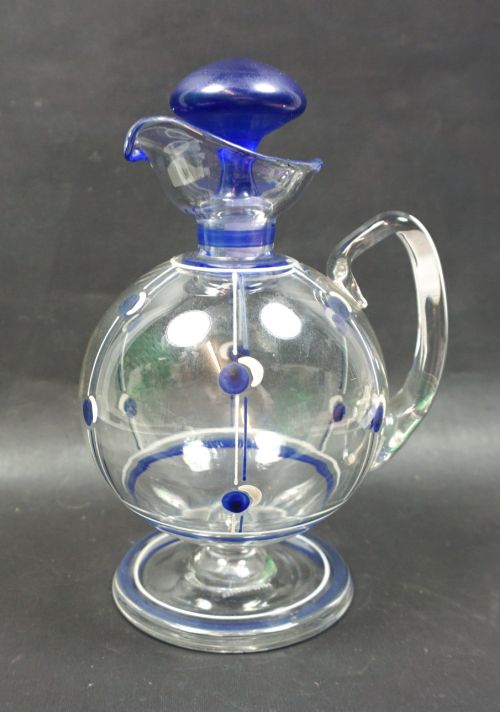


Geometric Glass Decanter
These geometric glass decanter pieces combine sharp lines and striking colour contrasts, offering collectors a functional centrepiece from the early twentieth century.
Geometric Glass Decanter
A geometric glass decanter takes the form of a barware vessel, claret jug, perfume bottle, or a complete matching set with glasses and trays. Most examples found here originate from the 1930s in Bohemia and Czechoslovakia, embodying the architectural rigidity of the Art Deco period alongside occasional Victorian silver-mounted designs.
Makers utilised heavy lead crystal and cut glass, often applying contrasting enamel decoration or chrome mounts to emphasise the angular shapes. These pieces served functional roles on sideboards and cocktail cabinets, while smaller variants functioned as dressing table perfume bottles.
What varies in quality
Quality rests in the crispness of the glass cutting and the precision of the hand-applied enamel work. Superior pieces display clean, deeply carved facets and vibrant, intact enamel lines without blurring.
The integration of metal mounts, whether sterling silver or chrome, defines the standard of the piece. Firmly fitted collars and substantial crystal weight distinguish finer studio productions from simpler moulded glassware.
Listings feature lead crystal and cut crystal vessels decorated with vibrant enamel and mounted in sterling silver, chrome, or silver plate.
Karl Palda·Hukin & Heath·Dr Christopher Dresser·Mosey
The Geometric Glass Decanter Glossary
- Lead crystal
- Glass containing metal oxide that increases weight, brilliance, and refractive index. This material allows for deeper and sharper wheel-cutting.
- Enamel
- Opaque vitreous composition fused to the glass surface through heat. It provides bold blocks of colour characteristic of the period.
- Claret jug
- A pouring vessel specifically designed for serving red wine, typically featuring a handle and a hinged metal lid.
- Cut crystal
- Glass decorated by abrading the surface on rotating wheels to create geometric patterns and facets. The process produces sharp edges that catch the light.
Geometric Glass Decanter: Frequently Asked Questions
How do I clean a vintage decanter safely?
Wash the vessel by hand using warm water and a mild detergent, avoiding sudden temperature changes that can crack aged glass.
Dry the interior thoroughly with a lint-free cloth or let it air dry upside down on a soft mat.
Can I use these decanters for daily serving?
Many sturdy crystal and glass pieces remain fully functional for serving wine, spirits, or water during meals and gatherings.
Inspect the condition of any enamel work or metal mounts beforehand to ensure they withstand regular handling.
What period do most of these pieces come from?
The majority of pieces date from the 1930s, reflecting the height of the Art Deco movement in Bohemia and Czechoslovakia.
Earlier Victorian examples with silver-plated mounts also appear among the selection.
Are matching glasses common with these sets?
Several decanters are accompanied by matching sets of glasses and fitted trays designed together as a cohesive unit.
These complete groupings were originally retailed for home entertaining and cocktail bars.