
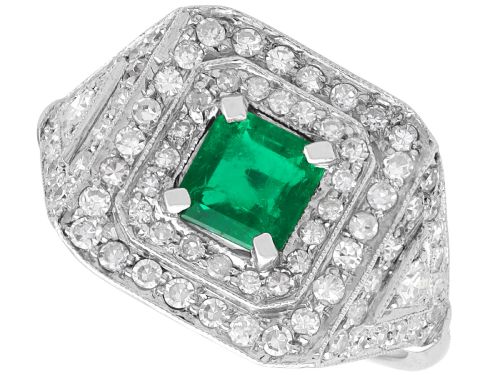


Geometric Diamond Halo Ring
A geometric diamond halo ring is an Art Deco creation of sharp lines and clustered stones that draws the eye straight to the centre.
Geometric Diamond Halo Ring
A geometric diamond halo ring is defined by its angular cluster design, emerging predominantly from the Art Deco era across the 1920s, 1930s, 1940s, and into the 1950s. On this page, a buyer is most likely to meet pieces adhering to the Art Deco style, featuring structured configurations of diamonds flanked by contrasting gemstones.
The forms span engagement rings and general rings, frequently taking the shape of target rings where concentric circles or octagons frame a central stone. These pieces originate from periods spanning 1920 to 1950, capturing an era of bold geometry in jewellery design.
Makers utilised various precious materials to construct these halos, pairing diamonds with sapphire, emerald, onyx, and aquamarine. The resulting configurations offer a distinct visual rhythm that characterises the aesthetic of the period.
Materials and technique
Platinum and 18ct white gold provide the bright, durable framework typical of these rings, holding intricate stone settings securely in place. Yellow 18ct gold also appears, offering a warmer contrast to the cool tones of the diamonds and surrounding gems.
Techniques centre on calibre cut stones, where sapphires, emeralds, or onyx are precisely shaped to fit tight geometric borders around the central diamond. Millegrain edging and fine metalwork finish the perimeters, framing the halo with meticulous detail.
Emeralds in these rings occasionally carry minor oil treatments, adding a touch of historical enhancement to the green fire.
Separating the top of the range
Quality in a geometric diamond halo ring rests on the precision of the stone cutting and the integrity of the geometric layout. Calibre cut gems that align seamlessly without gaps demonstrate superior craftsmanship compared to unevenly matched borders.
The choice of central stone, whether a diamond, a Colombian emerald, or a sapphire, dictates the upper tier of these pieces. Heavier carat weights and specific origin stones elevate the work beyond standard commercial output of the period.
The Geometric Diamond Halo Ring Glossary
- Calibre cut
- Gemstones specifically shaped and cut to fit tightly into a geometric channel or border, common in Art Deco jewellery. This technique requires high skill from the lapidary.
- Target ring
- A circular or polygonal halo ring featuring concentric bands of contrasting stones around a central gem. The layout resembles an archery target.
- Platinum
- A dense, strong, and malleable white metal used extensively in the twentieth century for fine settings. It allows for delicate claws that secure diamonds safely.
- Millegrain
- A decorative border of tiny, raised metal beads along the edges of a setting. It softens the metal profile and adds texture to the design.
Geometric Diamond Halo Ring: Frequently Asked Questions
What is a geometric diamond halo ring?
A geometric diamond halo ring is a piece featuring a central diamond surrounded by a border of smaller stones, arranged in sharp, angular Art Deco patterns.
These designs often incorporate contrasting coloured gems like sapphires or emeralds within strict symmetrical layouts.
How do I spot an Art Deco ring?
Art Deco rings are characterised by clean lines, geometric shapes, and a rejection of flowing Victorian curves. Look for symmetrical arrangements of calibre cut stones and platinum or white gold settings.
The period spans roughly from the 1920s through the 1930s, though styles persisted into subsequent decades.
Can I wear one every day?
These antique rings require sensible care due to their age and detailed setting work, particularly regarding delicate calibre cut stones. Regular checks by a jeweller help ensure the security of the halo.
Removing the ring during manual tasks protects the metalwork and stones from unnecessary wear.