
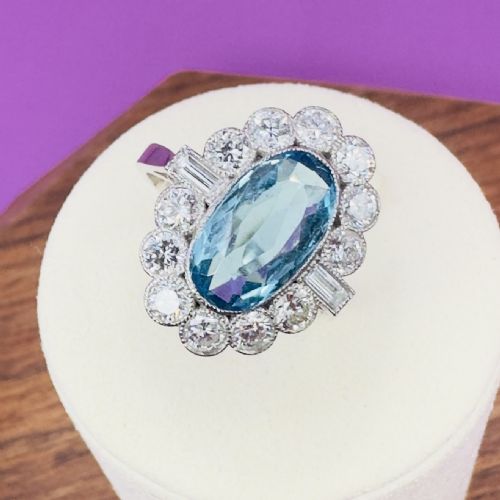


Platinum Aquamarine Ring
A platinum aquamarine ring delivers the cool, pale blue of beryl set against white metal, combining geometric lines with substantial central stones.
Platinum Aquamarine Ring
A platinum aquamarine ring centres on a pale blue beryl, most commonly fashioned as an emerald cut, oval, or marquise stone. These pieces emerge predominantly from the Art Deco period of the 1920s and 1930s, alongside mid-century interpretations from the 1950s and 1960s.
Cluster configurations dominate the selection, framing the central aquamarine with brilliant or baguette cut diamonds. Alongside clusters, buyers encounter trilogy settings, solitaire designs, and twist rings incorporating white gold, yellow gold, or onyx accents.
Materials and construction
Platinum serves as the primary metal for mounting these stones, valued for its strength in holding intricate claw and bezel settings without bulk. Goldsmiths combined platinum with gold in several period examples, pairing white settings with yellow or white shanks.
Diamonds act as structural contrasts to the transparent blue aquamarine, utilised in geometric arrangements typical of Art Deco design. Master craftsmen cut the beryl into emerald, oval, and elongated steps to catch light through the pale facets.
Platinum Aquamarine Ring Retail Price Guide 2026
Typical asking prices for platinum aquamarine ring among the pieces listed under this phrase on Sellingantiques today, from the lower quarter to the upper quarter. They describe what is for sale here now, not the wider market.
The inventory records pieces spanning four decades, with Art Deco designs from the 1930s forming the largest stylistic group alongside 1950s cluster rings.
Standards of craftsmanship and stone selection
Quality rests upon the saturation and clarity of the central aquamarine, where deeper icy blue tones and clean tables command greater appreciation. The cut must align symmetrically with the surrounding metalwork, maintaining sharp pavilion angles.
Setting work differentiates standard production from finer output, visible in the precision of grain-set diamond shoulders and millegrain edges. The gauge of the platinum shank dictates durability, ensuring the gallery withstands daily wear without distortion.
The Platinum Aquamarine Ring Glossary
- Aquamarine
- A transparent pale blue variety of beryl named after seawater. It forms large crystals that permit substantial carat weights in emerald and oval cuts.
- Cluster ring
- A design featuring a prominent central stone surrounded by smaller accent stones, typically diamonds. This arrangement maximises surface brilliance on the hand.
- Baguette cut
- A step-cut rectangular diamond shape utilised for linear shoulders. The long parallel facets offer a restrained contrast to brilliant-cut stones.
- Millegrain
- A decorative technique applying a raised border of tiny metal beads along setting edges. It defines period mountings with a delicate texture.
- Trilogy ring
- A three-stone setting representing past, present, and future. The central aquamarine is flanked by two matching diamonds.
Platinum Aquamarine Ring: Frequently Asked Questions
How do I date a platinum aquamarine ring?
Dating relies upon stylistic markers such as geometric symmetry and stepped shoulders associated with the 1920s and 1930s. Mid-century examples from the 1950s often introduce bolder organic twists or alternative accent stones like blue zircon.
Examining the construction methods and metal combinations provides further context. The integration of white gold alongside platinum helps differentiate mid-century iterations from earlier solid platinum mountings.
Are these rings suitable for daily wear?
Platinum provides a durable setting for the aquamarine, resisting daily wear better than softer white metals. Beryl possesses a hardness rating that handles regular use when mounted securely in a protective bezel or cluster.
Care should be taken to avoid sharp impacts against hard surfaces to protect the corners of emerald-cut stones. Routine checks by a jeweller ensure the claws remain tight around the central beryl.
How do I clean a platinum aquamarine ring?
Cleaning requires warm water, mild washing liquid, and a soft brush to remove oils accumulated beneath the setting. Rinsing thoroughly in clean water restores the transparency of the aquamarine and the brilliance of the surrounding diamonds.
Harsh chemical dips and ultrasonic cleaners should be avoided if the ring incorporates organic accents like onyx. Regular gentle washing maintains the finish of both the platinum and the beryl.