


Aquamarine Cocktail Ring
An aquamarine cocktail ring brings substantial icy blue presence to the hand through prominent mid-century and art deco forms.
Aquamarine Cocktail Ring
An aquamarine cocktail ring centres on a substantial pale blue beryl stone designed to command attention on the hand. You encounter these primarily in mid-century and art deco forms spanning the nineteen twenties through to the nineteen sixties.
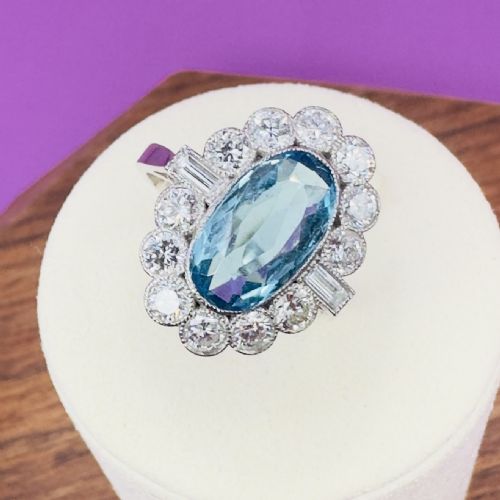
The selection ranges from large emerald cut solitaires to complex cluster designs framed by diamonds and onyx. Yellow gold, white gold, and platinum provide the structural metal settings for these substantial statement pieces.
Materials and construction
Goldsmiths set large natural aquamarine stones into platinum, eighteen carat white gold, or yellow gold bases. Diamonds, onyx, and sometimes blue spinel are integrated as accent stones around the central beryl.
Settings utilise structural techniques such as cluster arrangements, marquise frames, and heavy tank styles to support stones weighing up to thirty-seven carats.
Aquamarine Cocktail Ring Retail Price Guide 2026
Typical asking prices for aquamarine cocktail ring among the pieces listed under this phrase on Sellingantiques today, from the lower quarter to the upper quarter. They describe what is for sale here now, not the wider market.
A gentleman managed to wear a fourteen karat yellow gold aquamarine ring around nineteen twenty, proving that cocktail rings belong on any bold hand.
What separates the examples
Quality rests upon the depth of the aquamarine colour and the crispness of its faceted cut. Larger carat weights paired with balanced diamond accompaniment command attention.
The integrity of the precious metal setting and the precision of the stone claw work distinguish finer studio output from standard production.
The Aquamarine Cocktail Ring Glossary
- Aquamarine
- A blue to bluish-green variety of beryl that forms the central stone of these cocktail rings. It takes its name from seawater due to its translucent pale blue hue.
- Cluster ring
- A design featuring a prominent central gemstone surrounded by a border of smaller stones, typically diamonds. This arrangement maximises visual impact on the finger.
- Tank ring
- A bold, volumetric jewellery style originating from the retro period, characterised by heavy geometric gold work resembling military vehicle armour.
- Marquise cut
- An elliptic gemstone shape with pointed ends, designed to elongate the appearance of the finger when mounted in a ring setting.
Aquamarine Cocktail Ring: Frequently Asked Questions
What periods do these rings come from?
The available pieces originate primarily from the nineteen twenties, nineteen thirties, nineteen forties, nineteen fifties, and nineteen sixties. Art deco and mid-century modern aesthetics dominate the design eras.
Twentieth-century workshops produced everything from delicate platinum cluster rings to massive gold dress rings weighing over thirty carats.
How do I wear a cocktail ring?
These large statement pieces work best worn on the middle or ring finger as the focal point of an outfit. Their substantial stone sizes require careful movement to avoid heavy impacts.
Pairing them with simple clothing lets the geometric platinum or gold settings and pale blue beryl stones stand out clearly.
What metals are used in these settings?
Goldsmiths utilised platinum, eighteen carat white gold, eighteen carat yellow gold, and fourteen carat gold. Platinum and white gold provide a cool backdrop for the ice-blue aquamarines.
Yellow gold appears frequently in retro and mid-century pieces, offering warm contrast against the pale central gemstones.
How do art deco and mid-century styles differ?
Art deco pieces from the nineteen twenties and thirties feature precise geometric lines, platinum settings, and baguette or old cut diamond borders. They tend toward refined elegance.
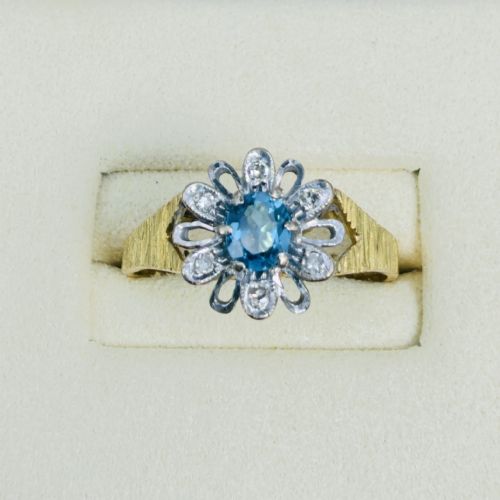
Mid-century and retro rings from the nineteen forties and fifties showcase larger stone carats, heavier gold construction, and bold tank or organic flower configurations.