


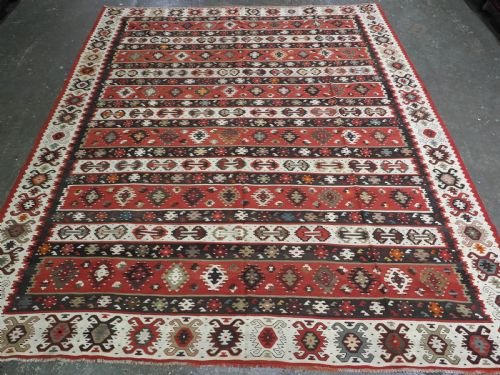
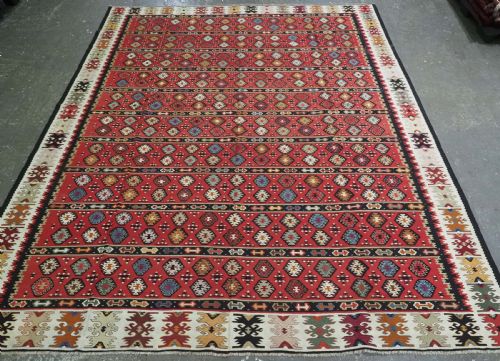


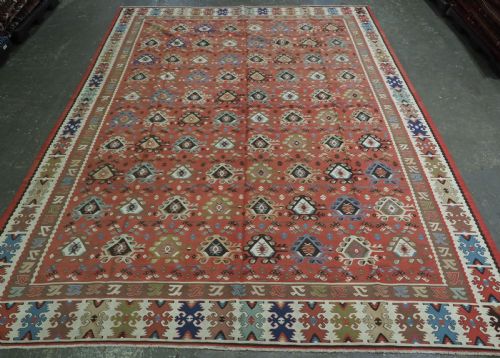


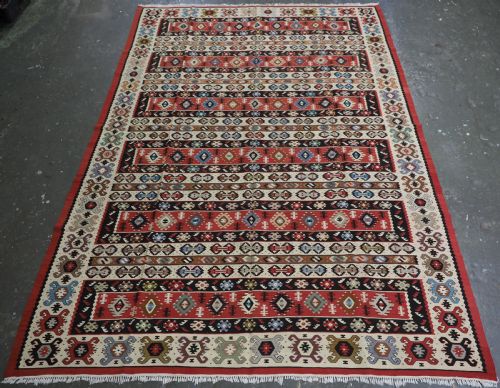

Geometric Balkan Rug
These floor coverings are woven flat without pile, offering sharp geometric Balkan rug patterns that bring strong linear character to a room.
Geometric Balkan Rug
A geometric balkan rug takes the form of flat-woven kilims originating from regions such as Pirot and Sarkoy, produced across the nineteenth and twentieth centuries. These pieces display traditional folk art motifs, including repeat medallions, flowering trees, and banded layouts.
The versions most commonly met on this page date around nineteen twenty, spanning large room sizes down to smaller formats. They arrive under descriptions of traditional Balkan folk and Ottoman styles, showing classic repeat patterns and warm soft colours.
How they were made
Makers constructed these flat weaves using wool and cotton fibres, employing slit-weave techniques to achieve sharp colour transitions. This method creates clean geometric boundaries without extra pile depth.
Dyes delivered the soft reds, pastels, and warm tones seen across the pieces, grounding the traditional all-over designs in organic colour palettes.
Listings span periods from eighteen sixty to nineteen thirty, showcasing wool and cotton materials shaped by Balkan Folk Art traditions.
What varies in quality
Quality rests in the precision of the geometric design and the crispness of the banded or repeat medallion layouts. Finer examples display complex lattice work and balanced proportions across large room sizes.
The depth and harmony of the palette also set examples apart, with certain pieces yielding warm soft colours and pastel contrasts that elevate the visual weight of the floor covering.
The Geometric Balkan Rug Glossary
- Kilim
- A flat-woven carpet or rug produced without pile. This technique creates a lightweight textile suitable for both floor placement and wall hanging.
- Pirot
- A regional town known for producing distinctive flat weaves. Pirot pieces often share stylistic traits with Sarkoy items.
- Sarkoy
- A historic weaving centre associated with traditional Balkan and Ottoman carpets. These rugs frequently utilise banded or repeat medallion layouts.
- Slit weave
- A flat-weaving technique where different colour areas meet along a warp thread without interlocking. This method produces clean vertical lines in geometric patterns.
Geometric Balkan Rug: Frequently Asked Questions
How do I place a geometric balkan rug in a room?
These flat weaves fit well in high-traffic areas or under dining tables because their pileless surface resists crushing from furniture legs. Their linear motifs complement minimalist furniture as well as traditional wooden flooring.
Allow enough surrounding floor space to let the repeat medallions and banded borders frame the room properly. Their flat structure also makes them suitable for hanging on large walls as textile art.
What is the difference between Pirot and Sarkoy rugs?
Pirot and Sarkoy rugs share overlapping design traditions from the Balkan region, often appearing together in nineteenth and twentieth-century inventories. Both types utilise wool and cotton fibres to build flat-woven geometric compositions.
Distinguishing between them usually depends on specific regional motif variations and border arrangements. Both styles maintain a focus on folk art symmetry and banded layouts.
How should I clean a flat-woven kilim?
Regular gentle vacuuming without a rotating brush roll helps remove loose dust from the weave. Lift the rug rather than dragging it to protect the edges.
Professional specialist cleaning is recommended for deeper maintenance to preserve the wool fibres and natural dyes. Avoid soaking the cotton and wool structure in household washing products.
How do I identify the age of these rugs?
Dating relies on stylistic markers, material analysis, and construction methods characteristic of the period between eighteen sixty and nineteen thirty. Pieces from the early twentieth century often display specific repeat designs and pastel or warm red colour palettes.
Examining the natural dye variations and wool consistency provides further clues regarding production eras. Comparing the specific lattice and banded formats against recorded examples helps narrow down the decade.