
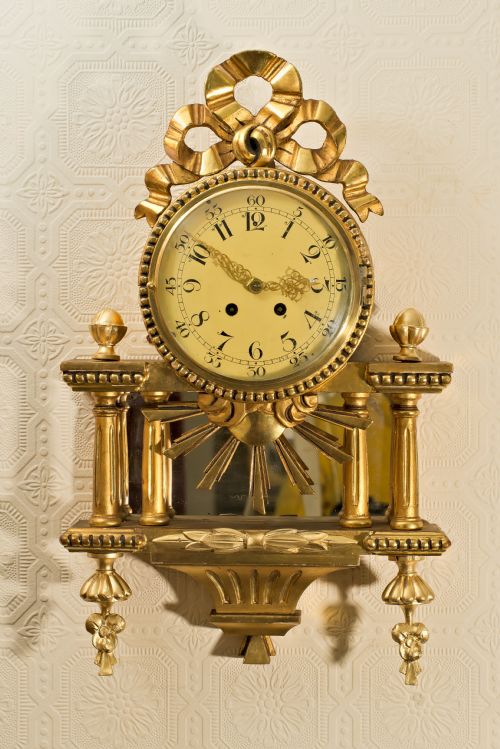


French Style Wall Clock
These French style wall clock examples bring ornamental brilliance to a room, spanning rococo, neoclassical and cartel designs from past centuries.
French Style Wall Clock
When a buyer searches for a French style wall clock, they encounter decorative horological pieces designed to mount directly onto domestic walls. The selection centres heavily upon ornate cartel clocks executed in gilt bronze, ormolu, giltwood and carved wood.
The prevailing aesthetic draws deeply from historical French design vocabulary, including French Rococo, Louis XVI, Gustavian Neoclassical and French Empire styles. Dating across the eighteenth, nineteenth and early twentieth centuries, these wall-mounted timepieces range from modest domestic examples to large substantial statement pieces.
Assessing quality and craftsmanship
Quality separates objects by the crispness of the bronze or ormolu chasing and the depth of the gilding across the metal surface. Superior examples demonstrate rigorous hand-carving in giltwood and timber elements, maintaining sharp architectural detail without softening over time.
The integration of the clock movement with the outer decorative case also dictates standing within the range. Pieces bearing recognised maker signatures or utilising advanced escapement mechanisms reflect higher tiers of period horological production.
One persistent maker apparently stamped their metal dial frames four times in a row just to ensure the message stuck.
WETTERSTRANDS·Valiant Paris·Perivale of England·Henri Dasson·Japy Freres
The French Style Wall Clock Glossary
- Cartel clock
- A wall-mounted clock featuring an ornate frame made of gilt bronze, brass, or carved wood. These pieces were developed primarily in France during the eighteenth century.
- Ormolu
- Finely ground high-carat gold applied to a bronze base using a mercury amalgamation technique. This process creates a rich, durable golden finish characteristic of luxury decorative objects.
- Pinwheel escapement
- A mechanical device used in precision clocks to control the release of the gear train. It utilises pins instead of traditional teeth to interact with the escape wheel pallets.
- Giltwood
- Timber that has been coated with a thin layer of gold leaf or gesso and gold paint. It provides a luminous decorative surface for ornate carved frames.
French Style Wall Clock: Frequently Asked Questions
What is a cartel clock?
A cartel clock is an ornamental wall timepiece housed within an elaborate frame of gilt bronze, brass or carved wood. Developed in France, these clocks combine sculptural metalwork with functional timekeeping.
They mount directly to walls rather than resting on shelves, serving as prominent decorative focal points within period interiors.
How do I hang a heavy wall clock?
Hanging a substantial bronze or giltwood clock requires securing the mounting hardware directly into structural wall studs or utilising heavy-duty wall anchors. The mounting bracket must support both the weight of the case and the tension of the movement.
Professional installation is recommended for larger nineteenth-century pieces due to their significant weight and delicate protruding ornaments.
How do I distinguish Louis XVI from Rococo styles?
Louis XVI style pieces exhibit neoclassical restraint, featuring straight lines, symmetry, urn motifs and classical architectural proportions. The decoration remains orderly and balanced.
French Rococo style embraces asymmetry, flowing organic curves, C-scrolls and naturalistic plant motifs. The overall visual rhythm is dynamic and exuberant rather than geometric.
Are these clocks suitable for daily use?
These historical timepieces function as working clocks, though mechanical movements require regular professional servicing and careful handling. Many feature traditional pendulum or spring-driven mechanisms.
Owners often choose to run them periodically or maintain them primarily as decorative works of art depending on the condition of the movement.