



French Style Sofa Tables
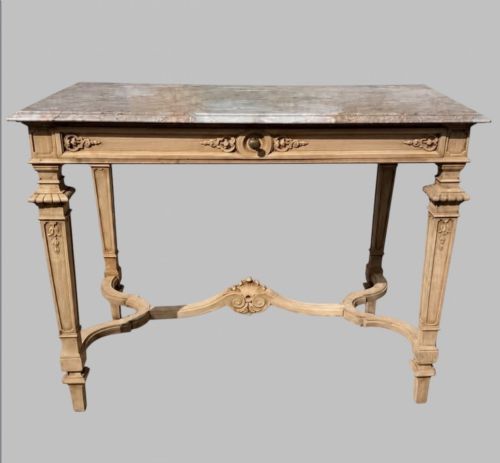
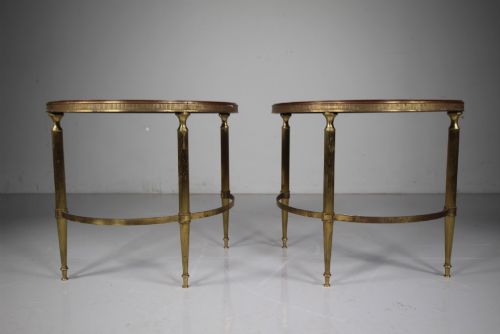
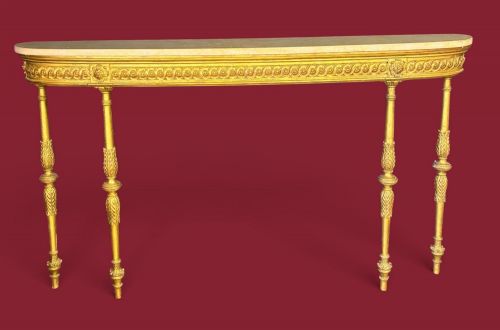
These french style sofa tables bring continental elegance and varied marble or timber tops into reception rooms and halls.
French Style Sofa Tables
When buyers search for french style sofa tables, they typically encounter versatile console tables, side tables, and centre tables rather than traditional twin-pedestal sofa tables with leaves. The examples gathered here span the nineteenth century through the Edwardian period and the early twentieth century, incorporating diverse revivals.
These pieces function successfully in narrow hallways, living rooms, and reception spaces where surface area matters. The presence of marble tops, giltwood frames, and painted wood finishes defines the visual character of the selection.
Materials and construction methods
Cabinetmakers utilised a range of timbers including mahogany, walnut, burr birch, burr elm, amboyna veneer, and ebonised wood to build these frames. Many pieces incorporate carved giltwood or painted wood alongside specialised veneers.
Surface ornamentation frequently includes ormolu mounts, brass details, and inserted porcelain plaques. Heavy marble slabs form the tops on numerous console and side tables, resting directly upon the wooden or gilded frames.
Listings incorporate nineteenth-century and Edwardian pieces alongside 1920s and 1930s examples, utilising amboyna veneer, burr birch, and marble.
Distinctions in construction and finish
The refinement of the carving on the wooden frames distinguishes different tiers of execution, separating standard production from skilled artisan work. Crisp detail in giltwood and carved motifs indicates superior craftsmanship.
Material selection significantly impacts the character of the piece, particularly the thickness and figuring of amboyna, burr walnut, or burr birch veneers, and the quality of the inset marble top.
The French Style Sofa Tables Glossary
- Console table
- A table designed to stand against a wall, frequently secured to it with brackets if the legs are purely decorative.
- Ormolu
- Gilded bronze ornamentation applied to furniture frames and mounts during the eighteenth and nineteenth centuries.
- Amboyna veneer
- A highly prized, richly figured exotic wood veneer derived from the burl of the narra tree.
- Demi lune
- A half-moon shape characteristic of certain side and console tables designed to sit flush against a wall.
- Louis XVI Revival
- A nineteenth-century design movement drawing on the classical restraint and straight-lined symmetry of the mid-eighteenth-century French court.
French Style Sofa Tables: Frequently Asked Questions
How do I style a console table?
Place the table against a prominent wall in a hallway or living room to create a functional surface for lamps and decorative objects. Pairing it with a mirror or painting above establishes a balanced focal point.
Ensure the dimensions of the table match the scale of the wall space to maintain proper proportions in the room.
What is the difference between a console and a centre table?
A console table is specifically designed to stand flat against a wall, often featuring a finished front and sides while the back remains plain. Centre tables are freestanding pieces meant to be viewed from all angles in the middle of a room.
Console tables frequently incorporate wall fixings for stability, whereas centre tables rely on sturdy four-legged or pedestal bases.
How do I identify a Louis XVI Revival piece?
Louis XVI Revival pieces typically feature straight tapered legs, neoclassical geometry, and restrained carving rather than the sweeping curves associated with earlier rococo styles. Look for architectural motifs such as fluting, beaded mouldings, and symmetrical laurel wreaths.
The overall silhouette emphasises vertical lines and balanced proportions derived from classical antiquity.
Can I place hot items on a marble-topped table?
Marble offers good heat resistance compared to polished wooden surfaces, but sudden extreme temperature changes can still risk thermal shock or cracking. Using protective mats remains sensible practice for very hot dishes or heated appliances.
Wipe away acidic spills promptly to protect the polished surface from staining or etching.