
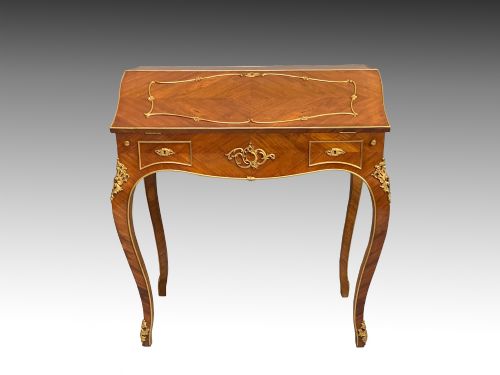
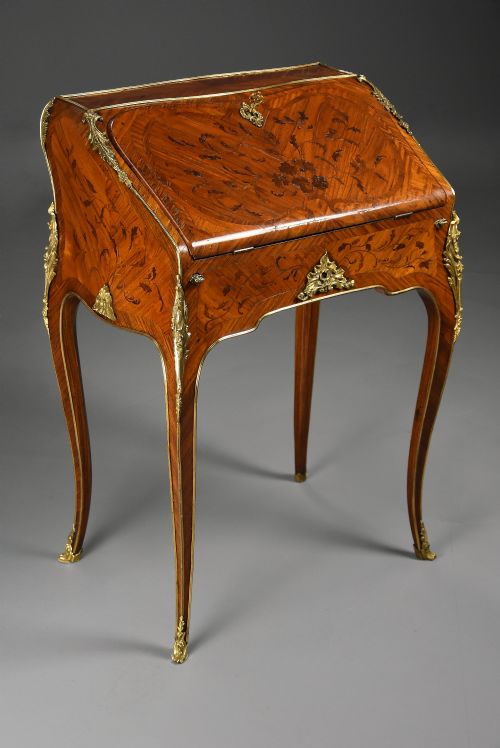


French Style Slant Front Desk
A french style slant front desk brings continental elegance to writing spaces, offering secret compartments beneath a sloping fall front.
French Style Slant Front Desk
A french style slant front desk encompasses compact bureau de dame forms, small secretaires, and larger partner pieces designed for correspondence. These items emerge predominantly in Victorian interpretations alongside mid-eighteenth-century pieces, spanning periods from 1750 to 1920.
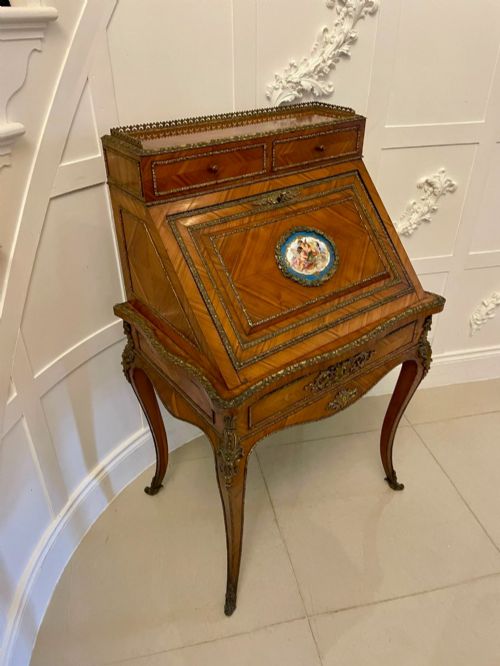
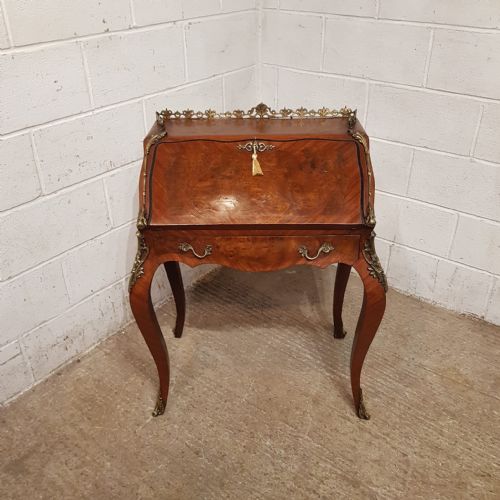
Buyers will most frequently encounter nineteenth-century walnut and kingwood examples adopting Louis XV Revival or French Rococo characteristics. Such pieces combine curved cabriole silhouettes with fitted writing surfaces concealed behind sloping lids.
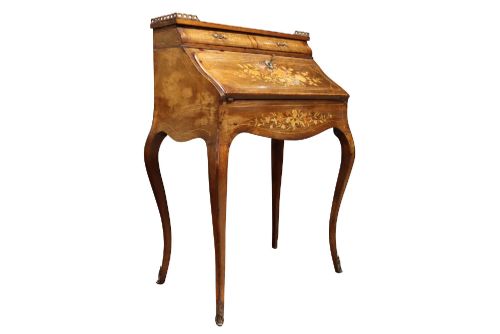
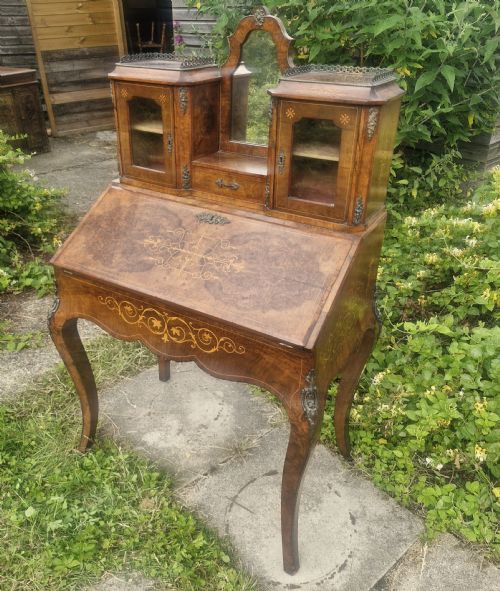
The assortment on this page ranges from petite boudoir writing desks to elaborate marquetry-inlaid bureau tables. Each variant shares the characteristic hinged writing flap that opens to reveal internal stationery drawers and pigeonholes.
Materials and Construction Methods
Cabinetmakers constructed these writing pieces using solid timber carcases overlaid with decorative veneers including kingwood, burr walnut, rosewood, tulipwood, and mahogany. Marquetry and parquetry inlay formed intricate floral or geometric patterns across the sloping fall fronts and tabletops.
Mounts in cast brass and gilded ormolu define the continental aesthetic, accentuating the curved corners and framing the drawer panels. These metal fittings were hand-chased and secured with small screws to protect the vulnerable edges of the veneered surfaces.
Listings feature walnut, kingwood, rosewood, and mahogany veneers paired with cast brass and ormolu mounts across Victorian and 19th-century periods.
Distinguishing Quality in Construction and Finish
Superior examples display precise matching of veneer grains across the fall front and drawer facades, demonstrating careful timber selection by the cabinetmaker. Lesser pieces rely on uniform machine-sawn laminates with less attention to continuous patterning.
The refinement of the ormolu mounts and the intricacy of the marquetry inlay separate standard production from exhibition-quality works. Heavier, finely chased bronze or brass mounts with crisp detailing indicate a higher workshop standard.
BVRB
The French Style Slant Front Desk Glossary
- Bureau de dame
- A ladies writing desk, often featuring a sloping fall front and internal compartments. These dainty forms were designed for private correspondence in nineteenth-century boudoirs.
- Secretaire en pente
- A small sloping-front desk standing on cabriole legs. This continental form conceals a fitted interior behind the angled lid.
- Bonheur-du-jour
- A light daytime writing table featuring an enclosed superstructure with small drawers and shelves above the main writing surface. It became fashionable during the Louis XV period and remained popular in Victorian revivals.
- Ormolu
- Gilded bronze or brass mounts used extensively on french style furniture. These decorative elements highlight the structural contours of the desk.
- Marquetry inlay
- Decorative patterns formed by fitting contrasting veneer pieces into a prepared wooden background. Floral motifs are common on revival pieces.
French Style Slant Front Desk: Frequently Asked Questions
What is a bureau de dame?
A bureau de dame is a ladies writing desk characterised by a compact footprint and a sloping fall front. It provides a private space for writing letters.
Inside the sloping lid, small drawers and pigeonholes organise stationery and personal papers.
How do I identify Louis XV style?
Louis XV style furniture relies on asymmetrical curves, cabriole legs, and elaborate floral marquetry. Ormolu mounts accentuate these flowing contours.
直線 forms are largely absent, replaced by organic scrolls and naturalistic motifs derived from Rococo design.
Where were these desks used?
These writing desks originally served in private drawing rooms, boudoirs, and personal chambers for letter writing and bookkeeping. Their petite scale suited domestic residential spaces.
Today, they function effectively as writing tables or feature pieces in modern studies and living rooms.
What woods are commonly found?
Cabinetmakers utilised exotic and domestic hardwoods including walnut, kingwood, rosewood, and tulipwood. Burr walnut and mahogany also appear frequently in the framing and veneer work.
These timbers were chosen for their rich grain patterns and suitability for decorative marquetry.
How do I care for my desk?
Protect the veneered surfaces by avoiding direct sunlight and maintaining stable humidity levels in the room. Gentle dusting with a dry cloth preserves the polished finish.
Apply occasional traditional wax polish to nourish the timber without building up heavy residue over the ormolu mounts.