

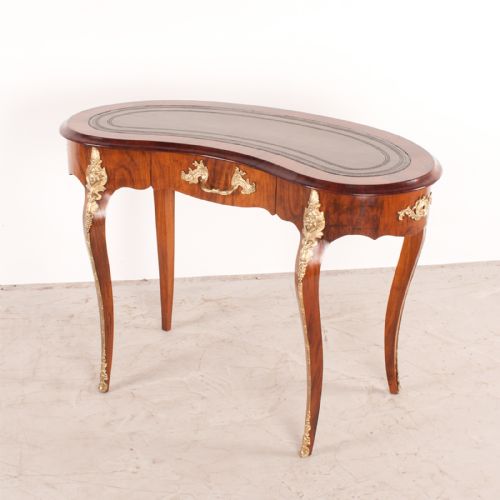


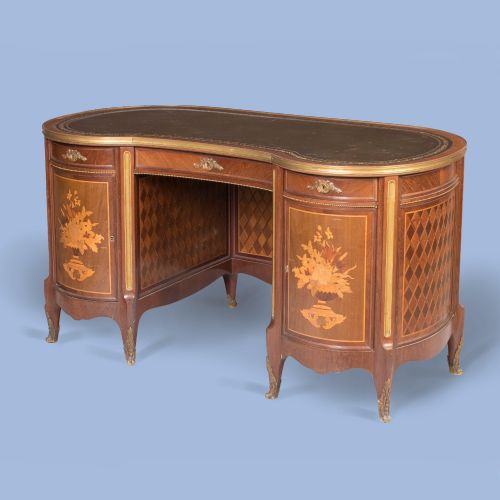


French Style Kidney Desk
A french style kidney desk offers a sweeping curved silhouette designed to sit comfortably away from the wall.
French Style Kidney Desk
When you search for a french style kidney desk, you encounter nineteenth-century writing tables, occasional tables, and dressing tables formed with a distinctive curved outline. These pieces originate from periods including the Victorian era and the years spanning 1850 to 1920, reflecting revivalist tastes such as Louis XV and Louis XVI styles.
The version you are most likely to meet on this page is a freestanding burr walnut or kingwood writing table featuring decorative marquetry inlay and gilt metal mounts. Many examples function as ladies writing desks or library tables, designed to command attention from any angle within a room.
How they were made
Cabinetmakers constructed these writing tables using dense timbers such as mahogany, walnut, kingwood, and rosewood, frequently incorporating burr walnut veneers to create rich, figured surfaces. Tops were often inset with panels of tooled leather to provide a suitable writing hide.
Mounts and embellishments relied upon cast or gilt ormolu and brass applied to borders, legs, and drawer edges. Marquetry inlay added floral or geometric patterns across the curved desk bodies.
French Style Kidney Desk Retail Price Guide 2026
Typical asking prices for french style kidney desk among the pieces listed under this phrase on Sellingantiques today, from the lower quarter to the upper quarter. They describe what is for sale here now, not the wider market.
What varies in quality
The distinction between standard and exceptional pieces rests upon the depth of figuring in the timber veneers and the crispness of the cast ormolu mounts. Finer desks display intricate marquetry and substantial gilt bronze rather than simpler brass trim.
Construction standards show in the fluidity of the kidney curve and the finish applied to the reverse sides, as these pieces were built to stand free in the room rather than against a wall.
The French Style Kidney Desk Glossary
- Kidney desk
- A writing table shaped with a concave front and convex back resembling a kidney bean. This form allows the user to sit embraced by the curve.
- Ormolu
- Gilded bronze used for decorative mounts and accents on furniture. The technique involves applying a gold amalgam to cast bronze.
- Marquetry
- Inlaid wood veneers arranged in pictorial or decorative patterns across a surface. Different coloured timbers create contrast without paint.
- Bureau-plat
- A flat-topped freestanding writing desk typically fitted with drawers. French examples often adopt serpentine or curved lines.
French Style Kidney Desk: Frequently Asked Questions
Where should I place my desk?
These tables are built to be freestanding, meaning the back is finished with the same care as the front. Position your desk in the middle of a study or bedroom so the curved silhouette is fully visible.
Avoid placing the piece directly against a flat wall where the organic kidney shape loses its intended visual impact within the room.
How do I care for the leather top?
The leather writing surfaces benefit from occasional gentle dusting with a dry cloth. Keep moisture away from the gilt tooling along the edges to prevent flaking.
Treat the surrounding wood timber with appropriate furniture wax rather than silicone sprays to maintain the natural sheen of the walnut or mahogany.
What periods do these desks date from?
The listings span the nineteenth and early twentieth centuries, encompassing Victorian craftsmanship and French revival periods. Dates range from mid nineteenth-century examples up to the nineteen-twenties.
Maker choices and decorative motifs often emulate earlier royal French courts, particularly the reigns of Louis the fifteenth and sixteenth.
Can these desks be used for daily work?
While originally designed as ladies writing desks or occasional tables, they accommodate modern laptops and paperwork quite easily. Ensure you measure chair clearance beneath the curved kneehole before regular use.
Consider placing a protective blotter across the leather insert if you intend to write daily to preserve the antique surface.