




French Side Table Bureau
A French side table bureau combines compact writing utility with decorative revival forms from the nineteenth century.
French Side Table Bureau
A French side table bureau serves primarily as a refined writing desk or bureau plat, originating predominantly in the nineteenth century during the Victorian era and spanning periods from the eighteenth to the early twentieth century. These pieces combine the scale of a side table with the function of a writing desk, often taking the form of freestanding centre tables or bureau plat designs.
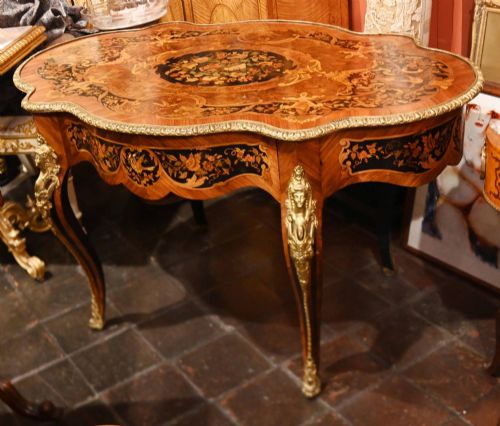
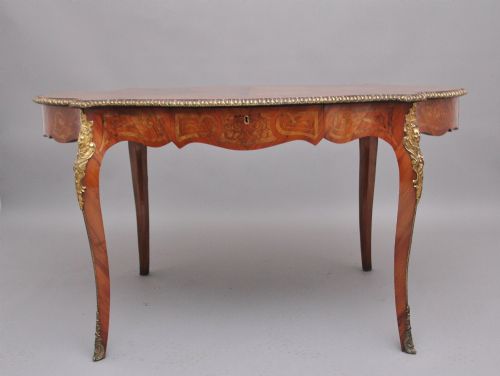
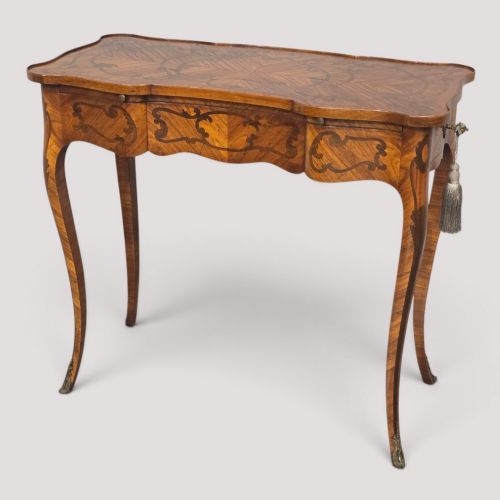
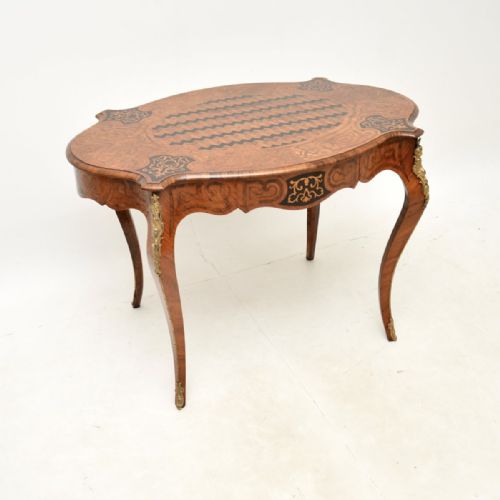
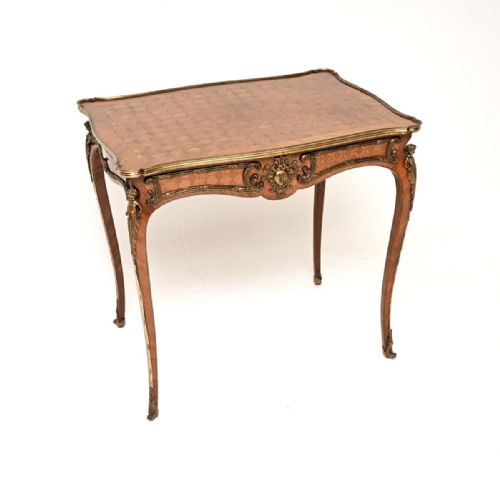
The aesthetic is heavily defined by revivalism, drawing directly on Louis XV and Louis XVI styles as well as French Rococo revivalism. Buyers will frequently encounter serpentine or flat-topped writing tables decorated with intricate marquetry and parquetry patterns.
Proportions remain generally modest, suiting domestic spaces as ladies desks, writing tables, or small side cabinets. Construction reflects both French workshop traditions and British interpretations of continental tastes.
Materials and Construction
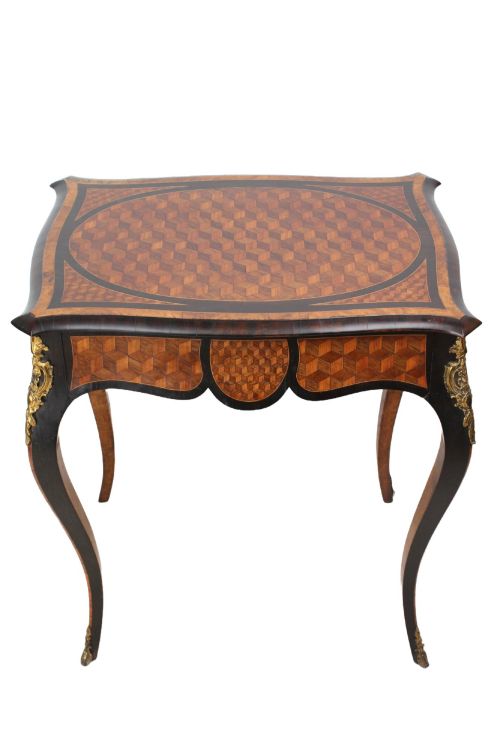
Cabinet makers utilised a rich palette of timbers, prominently kingwood, walnut, rosewood, tulipwood, and mahogany, frequently laid as veneers over sturdy foundational woods. Parquetry and marquetry geometric or floral patterns decorate the surfaces, contrasting lighter and darker grains.
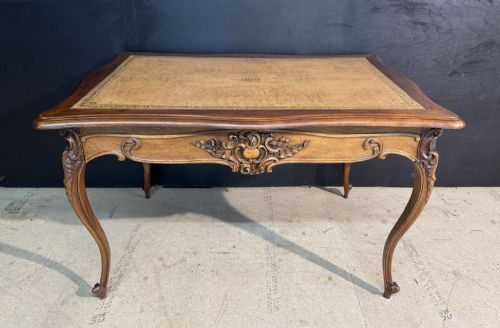
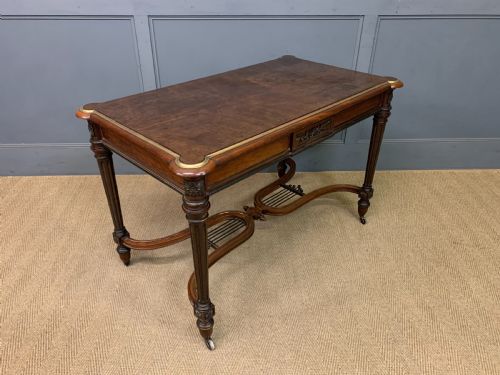
Metal enrichment forms a crucial element of the construction, employing cast ormolu, gilt bronze, brass, and gilt metal mounts along edges, legs, and aprons. Writing surfaces are frequently inset with tooled leather panels to provide a durable writing plane.
Makers sometimes concealed small secret compartments within the frieze drawers of these writing tables for private correspondence.
Evaluating Quality and Detail
Quality reveals itself in the crispness and weight of the ormolu mounts and the precision of the timber veneers. Finer examples display meticulously hand-chased gilt bronze mounts and complex, tightly fitted parquetry rather than printed or simpler inlay work.
The integrity of the structural carcass and the quality of the cabinet maker's joinery distinguish standard pieces from exceptional ones. Signed works by documented makers demonstrate superior execution in both internal framing and surface finishing.
JAS Shoolbred·Francoise Linke·Diehl Paris·Alphonse Tahan
The French Side Table Bureau Glossary
- Bureau Plat
- A freestanding double-sided writing table fitted with drawers in the frieze, popular in France from the seventeenth century onward.
- Ormolu
- Gilt bronze mounted onto furniture pieces for decorative effect, created through a process of applying mercury and gold amalgam.
- Marquetry
- Decorative veneer work forming pictorial or abstract patterns using various coloured woods applied to the furniture carcass.
- Parquetry
- Geometric wood inlay patterns such as cubes or chequers used to ornament table tops and drawer fronts.
- Cartonnier
- A decorative stationary case or paper rack designed to sit upon the top of a desk.
French Side Table Bureau: Frequently Asked Questions
How do I use a bureau plat today?
These tables function well as compact writing desks or laptop stations in a study or living room. Their finished backs allow them to sit away from walls in the centre of a room.
Ensure placement avoids direct sunlight to protect vulnerable polished wood surfaces and leather writing inserts from fading over time.
What is the difference between Louis XV and Louis XVI styles?
Louis XV style pieces, often associated with French Rococo revival, feature flowing serpentine curves, cabriole legs, and asymmetric ormolu mounts. Louis XVI style turns towards neoclassical straight lines, tapered fluted legs, and symmetrical geometric detailing.
Both styles appear frequently among nineteenth century revival furniture.
Are these desks suitable for daily writing?
Many nineteenth century examples feature durable leather writing surfaces and stable timber frames built for regular daily use. Care should be taken with antique veneers and delicate ormolu mounts during writing tasks.
Using blotters or desk pads helps protect the original antique leather and polished wood finishes from accidental scratches.
How can I tell the period of a French writing table?
Dating relies on examining the timber construction methods, interior drawer linings, and the style of the cast brass or ormolu mounts. Nineteenth century revival pieces often imitate eighteenth century designs but reveal their actual manufacturing era through secondary woods and hardware.
Signatures or stamps from makers like Linke or Tahan provide direct attribution to specific workshops of the period.