
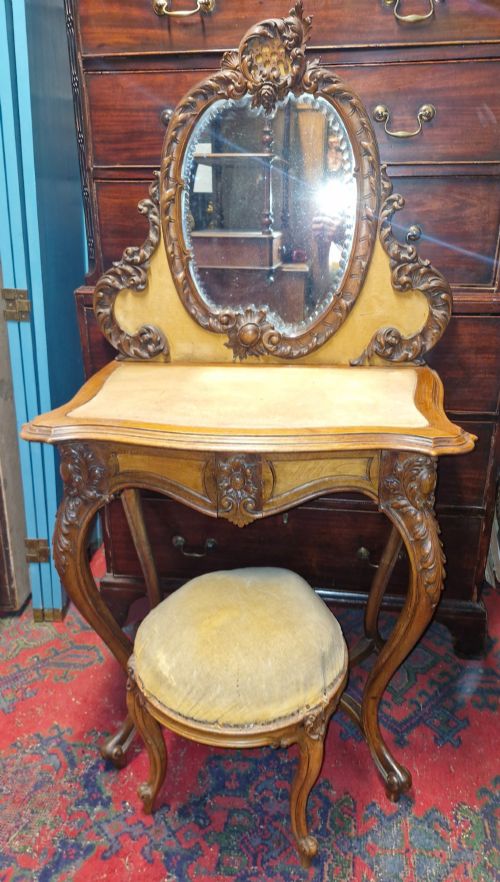


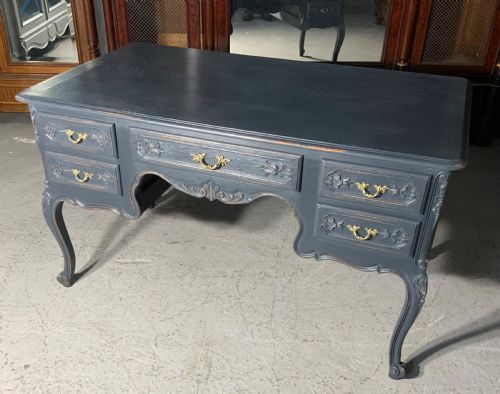

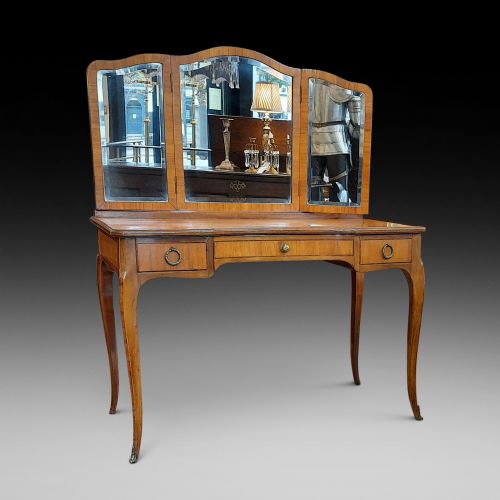


French Rococo Vanity Desk
A French rococo vanity desk brings flamboyant carved scrolls and serpentine lines into a dressing room.
French Rococo Vanity Desk
A french rococo vanity desk combines undulating woodwork with practical surfaces for grooming or writing. The pieces seen here span the eighteenth century up to the nineteen-thirties, drawing on revival movements across the Victorian era and early twentieth century.
Makers drew heavily on earlier French chateau aesthetics, producing side tables and boudoir chairs alongside dedicated dressing furniture. The selection reflects both grand revival pieces and provincial interpretations.
How they were made
Carpenters shaped these items using solid timbers such as oak and walnut, often applying burr walnut veneers to curved surfaces. Frames frequently received coats of gesso before being gilded or painted.
Ornate mounts cast in brass and ormolu were fitted to drawers and corners, while writing surfaces incorporated inset leather panels. Glass formed the pivoting plates of vanity mirrors.
Materials across these listings include burr walnut, giltwood, brass, glass, and leather.
What varies in quality
The finesse of the carved scrollwork dictates much of the visual success, separating sharply chiselled ornament from soft, mechanical moulding. Timber selection also plays a major role, with richly figured burr walnut and book-matched veneers marking out superior examples.
Hardware and mounts reveal the underlying standard of manufacture, where heavy chased ormolu contrasts with thin, plain brass stampings. Structural integrity in serpentine rails and cabriole legs ensures the piece withstands daily use without loosening.
The French Rococo Vanity Desk Glossary
- Ormolu
- Gilded bronze mounts applied to furniture. This technique added opulent metallic highlights to key architectural points.
- Gesso
- A plaster-like mixture applied to wooden carcases as a base for gilding. It allowed carvers to crisp up delicate relief ornament before applying leaf.
- Cabriole leg
- An S-shaped furniture leg curving outward at the knee and inward at the ankle. It derives its graceful silhouette from animal limbs.
- Kingwood
- A dense exotic timber prized for its contrasting dark and golden grains. Cabinet makers used it for decorative crossbanding on table tops.
- Serpentine
- A line or surface that curves outward and then inward in a continuous wave. This undulating contour defines the facade of many rococo desks.
French Rococo Vanity Desk: Frequently Asked Questions
What is a french rococo vanity desk?
It is a decorative dressing or writing table defined by asymmetrical curves, elaborate carving, and cabriole legs.
These pieces emerged from revival movements that copied eighteenth-century continental styles.
How do I style a vanity desk?
Pair the piece with a low boudoir chair or small upholstered stool that tucks neatly underneath.
Keep surface accessories minimal to let the wood grain and ormolu mounts remain visible.
Can these desks be used daily?
Most examples function well as writing surfaces or dressing tables provided the joints remain stable.
Protect vulnerable veneers and leather inserts from moisture and excessive heat.
How do I date a revival piece?
Examine the secondary timbers inside the drawers and the construction methods used on the frame.
Victorian and early twentieth-century interpretations often mix machine-cut elements with hand-finished carving.