


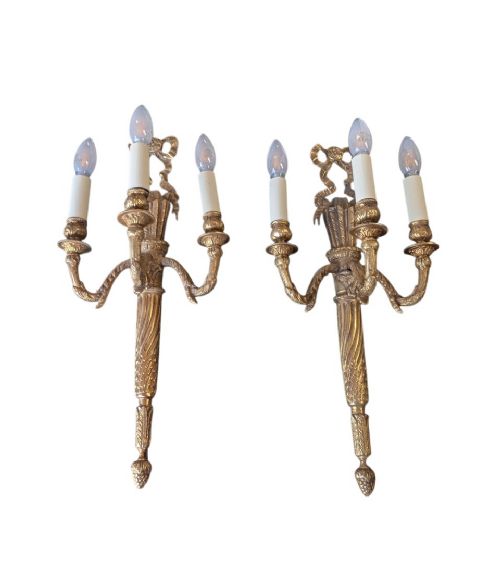
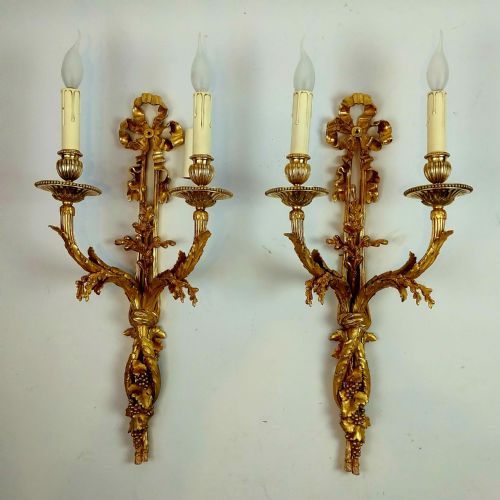
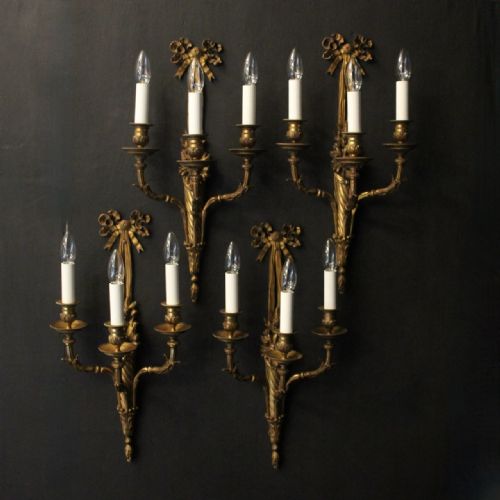
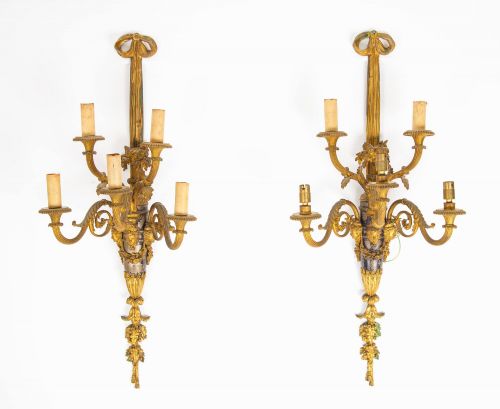


French Ribbon Sconces Pair
When you handle french ribbon sconces pair lighting, you touch the peak of gilt metalwork designed to catch candlelight on a panelled wall.
French Ribbon Sconces Pair
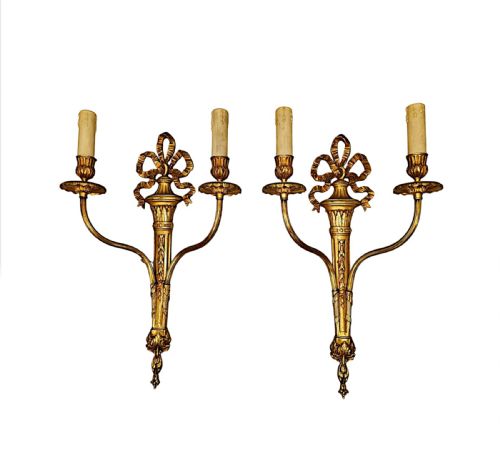
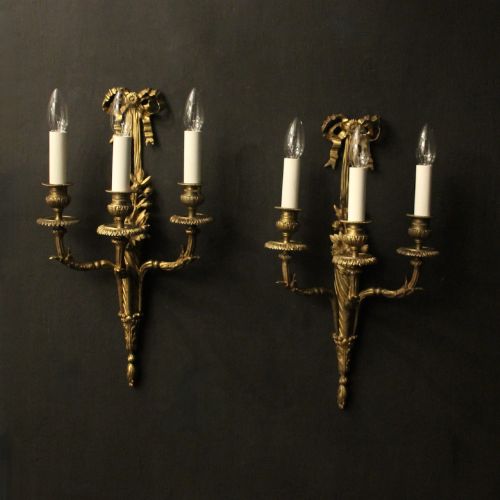
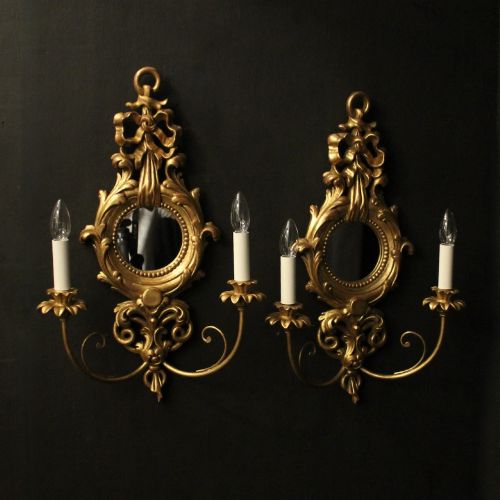
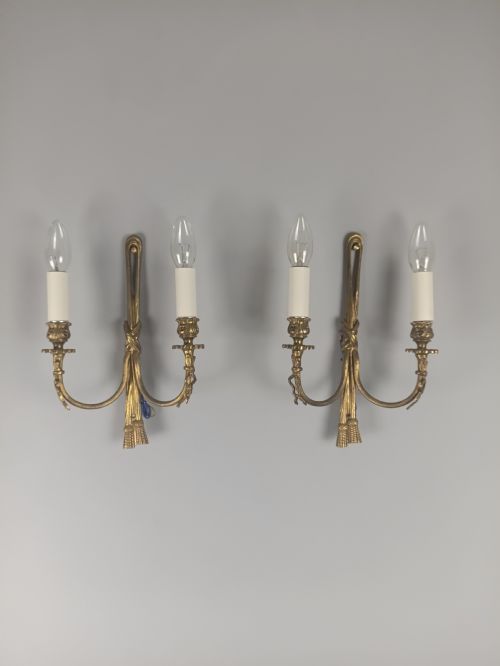
A french ribbon sconces pair brings decorative illumination to domestic interiors through matched wall-mounted fittings. These pieces predominantly take the form of wall lights, girandoles, and occasional wall mirrors equipped with candle branches.
The selections available here stem largely from the nineteenth century and the early twentieth century, spanning periods such as Edwardian and Georgian revivals. Buyers most frequently encounter gilt bronze and brass configurations displaying twin or triple candle arms.
Originating primarily within French workshops, these items reflect enduring classical vocabularies adapted for residential reception rooms and boudoirs. The dominant aesthetic channels Louis XVI and Neoclassical design principles through symmetrical branching and sculpted ribbon motifs.
Construction and Materials
The physical substance of these pieces relies heavily upon cast metals, specifically gilt bronze, ormolu, and brass, which provide the structural rigidity required for multi-armed wall lights. Artisans also utilised carved giltwood and gesso in specific variants to create lighter frames and mirrored backplates.
Casting methods allowed makers to achieve intricate relief work, capturing the crisp folds of knotted ribbons and acanthus leaves before applying gold leaf or mercurial gilding. Subsequent hand-finishing ensured that decorative elements like bow knots retained sharp definition against the polished metal grounds.
Listings demonstrate a strong prevalence of nineteenth-century French manufacture, with gilt bronze and cast brass remaining the primary structural metals across available pairs.
Distinctions in Quality
Quality rests primarily on the crispness of the metal chasing and the depth of the original gilding rather than sheer scale. Superior examples display sharply undercut ribbon folds and hand-tooled leaf work that reveals meticulous attention by the bronzier.
Heavier casting and integrated construction without clumsy post-factory repairs separate the finest specimens from more utilitarian commercial lighting. The integration of structural components directly influences how cleanly the sconce sits flush against the wall surface.
Henri Vian·Maison Baguès·Maison Baques
The French Ribbon Sconces Pair Glossary
- Ormolu
- Finely chopped gold leaf amalgamated with mercury and applied to a bronze base through heat diffusion. This historical technique yields a distinctive warm lustre that differs sharply from modern electroplating.
- Girandole
- A branched wall light featuring a reflective mirror backplate. The glass serves to amplify the illumination cast by candles placed in front of it.
- Giltwood
- Timber carved and subsequently coated with a thin layer of gold leaf over a prepared gesso ground. It appears frequently on mirrors and lighter wall appliques from the period.
- Neoclassical
- A design movement drawing inspiration from classical antiquity, favouring symmetry, straight lines, and motifs like urns and swags. It defines much of the ornamentation found on these lighting fixtures.
- Appliqué
- A wall-mounted decorative light fitting synonymous with a sconce. The term describes fixtures designed to be fixed directly onto panelling or wallpaper.
French Ribbon Sconces Pair: Frequently Asked Questions
How were french ribbon sconces pair mounted originally?
These fixtures were secured directly to timber panelling or plastered walls using heavy screws driven through concealed backplate anchor points. They positioned at eye level or slightly above to maximise the candle illumination reflecting across the room.
Wiring for electricity typically occurred during later twentieth-century adaptations, requiring internal channelling that preserved the exterior decorative ribbon and arm assemblies.
How do I distinguish Louis XVI style from Rococo Revival?
Louis XVI style relies on strict symmetry, straight lines, architectural ribbons, and classical urns or swags. The overall geometry remains controlled and restrained compared to earlier iterations.
Rococo Revival introduces asymmetrical C-scrolls, fluid organic asymmetry, and exuberant shell motifs that eschew the orderly neoclassical rigour found on ribbon-topped pieces.
Can these antique wall lights take modern bulbs?
Most surviving examples feature historical candle tubes or fitted lampholders adapted safely by professional electricians during past decades. Using low-wattage LED candle bulbs protects delicate gilt surfaces from excessive heat exposure.
Any electrical adaptation should respect the original wiring paths and structural integrity of the antique metal arms.