





French Parquetry Wine Table
A french parquetry wine table brings geometric wood patterns and slender proportions into a room, offering a functional surface with distinct continental character.
French Parquetry Wine Table
A french parquetry wine table belongs to a group of small-scale French occasional furniture designed for practical use beside a chair or in a corner. These pieces appear in forms such as side tables, occasional tables, wine tables, and centre tables, originating across the nineteenth and early twentieth centuries.
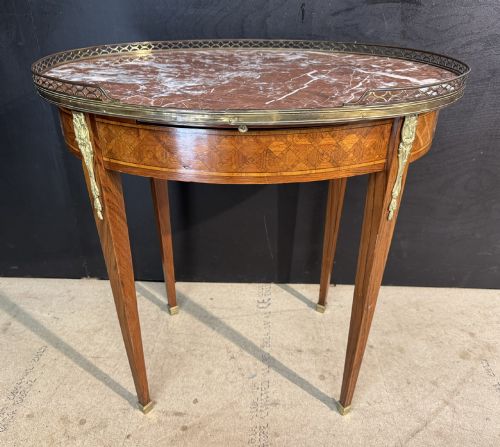
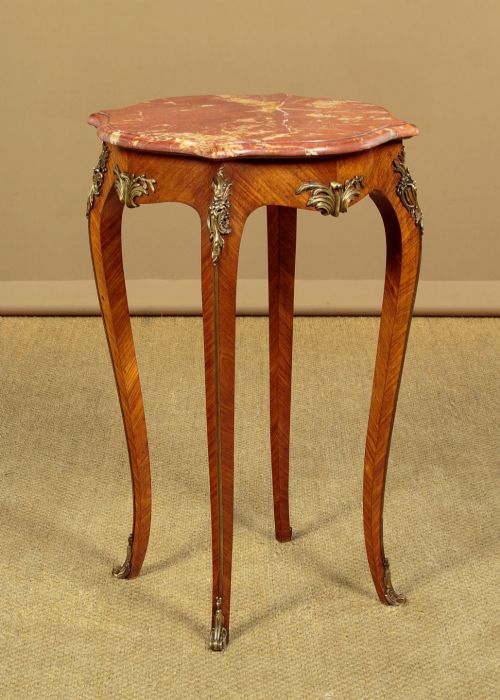
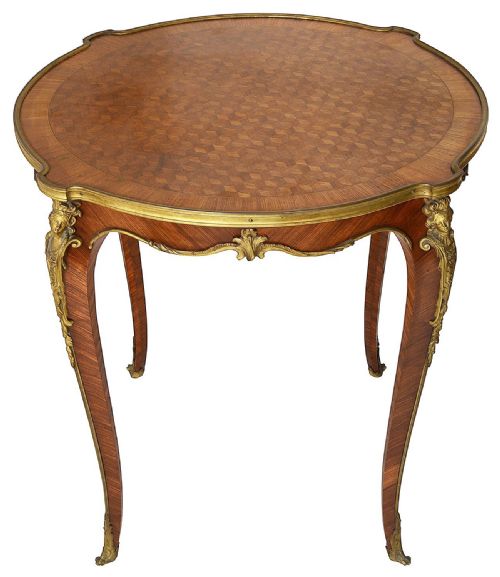
The specific version encountered most frequently on this page is the occasional or wine table utilising decorative wood veneers arranged in geometric patterns. These pieces draw on revival styles including Louis XV, Louis XVI, and French Rococo, reflecting the design vocabulary of Parisian workshops.
Makers such as L.Martin and A.Hugnet produced pieces in this category, alongside works after Linke and items described in styles like French Chateau and French Neoclassical. Buyers find variations in woods including walnut, kingwood, mahogany, oak, satinwood, and rosewood, frequently accompanied by metal mounts.
Materials and construction
Construction relies on timber carcases faced with contrasting veneer timbers such as kingwood, mahogany, satinwood, walnut, and rosewood, cut and fitted together to form geometric parquetry surfaces. Beneath the decorative veneers, structural timbers like oak provide stability for the top and frame.
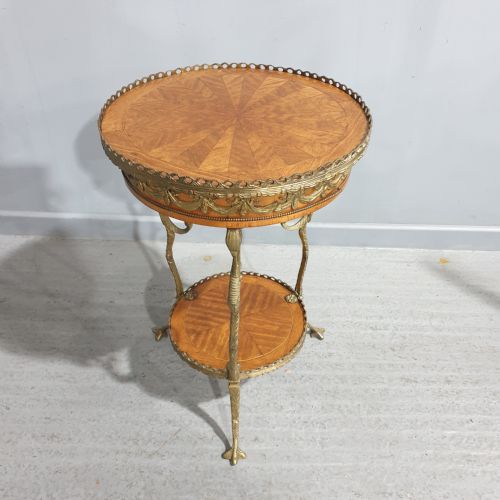
Metal elements including brass and ormolu appear as mounts, galleries, and edgings that protect vulnerable corners and accent the silhouette. Marble tops also feature on certain gueridon forms, inset into the wooden framework to create a solid circular surface.
Listings feature walnut, kingwood, mahogany, oak, satinwood, and rosewood across nineteenth and early twentieth-century periods.
Distinctions in quality
Quality rests upon the precision of the parquetry layout and the crispness of the timber grain selection across the tabletop. Tables executed by documented makers like L.Martin or A.Hugnet display tighter control over veneer alignment and joinery than anonymous workshop pieces.
The integration of cast ormolu mounts and brass galleries distinguishes finer examples, where metalwork fits flush to the wood contours rather than appearing clumsy. Carved details on oak or mahogany structures similarly separate standard production from more ambitious pieces.
L.Martin of Paris·A Hugnet Paris·Linke
The French Parquetry Wine Table Glossary
- Parquetry
- Geometric wood mosaic work formed by small veneer tiles fitted together to create patterns across a surface. This technique decorates the tabletops of many French occasional pieces.
- Guéridon
- A small round table on a central pillar or three legs, originating in seventeenth-century France. These pieces often feature marble tops or delicate brass galleries.
- Ormolu
- Gilt-bronze decorative metal mounts applied to furniture edges and legs. This material provides metallic contrast against dark timber veneers.
- Kingwood
- A dense, richly figured tropical timber utilised for contrasting veneers in decorative nineteenth-century cabinetry. The wood shows distinctive dark streaks and warm brown tones.
- Louis XV Revival
- A nineteenth-century style imitating the asymmetrical curves and natural motifs of the mid-eighteenth-century French court. Pieces in this manner show flowing lines and subtle cabriole legs.
French Parquetry Wine Table: Frequently Asked Questions
What is a French parquetry wine table used for?
These small tables serve as convenient movable surfaces for holding drinks, books, or small decorative objects within a living space.
Their compact proportions allow them to sit beside seating or fit into narrow corners where larger furniture cannot go.
What woods are common in these tables?
The listings show a variety of timber types, including walnut, kingwood, mahogany, oak, satinwood, and rosewood.
These woods appear either as solid structural carcases or sliced into thin veneers to create patterned surfaces.
How can you tell the period of a French wine table?
Dating relies on stylistic revival markers, construction methods, and documentation associated with specific Parisian makers active around the nineteenth and early twentieth centuries.
Details like brass mounts, marble tops, and specific revival idioms help narrow down the decade of manufacture.