


French Ormolu Candle Sticks
French ormolu candle sticks bring together gilded metal and classical form to illuminate a room with nineteenth-century decorative brilliance.
French Ormolu Candle Sticks
French ormolu candle sticks are lighting pieces created across the nineteenth century, including the Regency, Charles X, Restauration, and Victorian periods. When you search for french ormolu candle sticks, you encounter pairs of candelabras, single candleholders, and table stands designed in styles from Neoclassical and Louis XVI Revival to French Rococo and Empire.
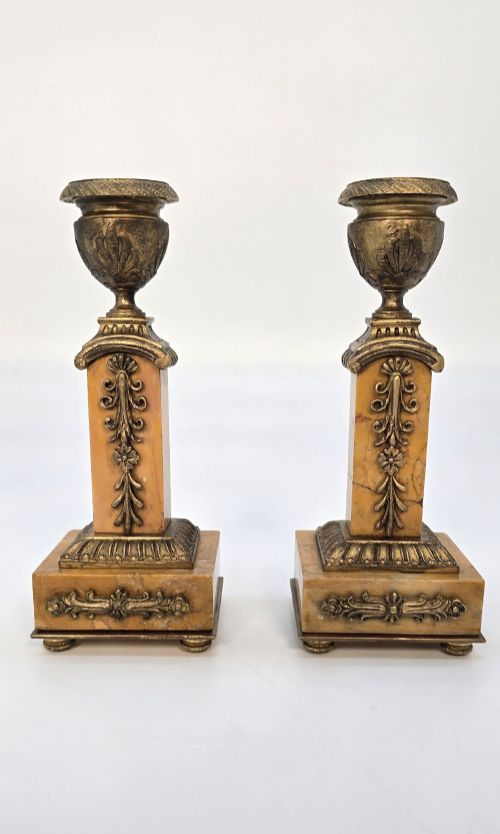
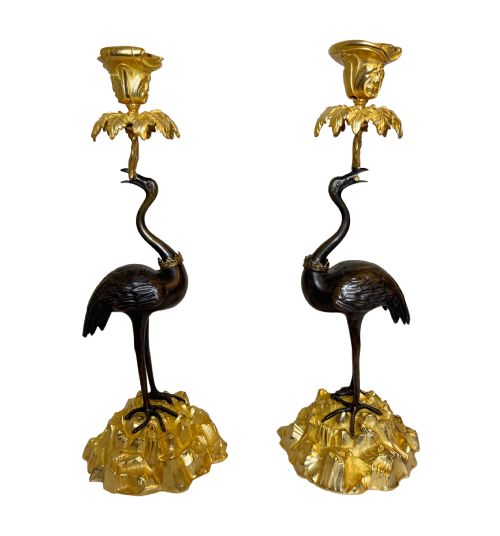
The most common versions on this page are matched pairs dating from the mid to late nineteenth century, frequently incorporating contrasting patinated bronze or mounted on marble and alabaster plinth bases. These pieces reflect diverse decorative influences, ranging from straightforward classical columns to elaborate figurative motifs involving cherubs, satyrs, and flamingos.
Materials and construction methods
The manufacture of these items relies heavily on the combination of bronze, brass, and mercury-gilded or electroplated ormolu, supported by structural elements of white marble, fossil marble, and alabaster. Artisans cast the metal components in sections before chasing the surfaces to sharpen the detail of foliage, scrollwork, and figurative elements.
Makers integrated mixed media such as hand-painted Sevres porcelain, glass lustre drops, champleve enamel, and contrasting patinated bronze alongside the bright gilding. This multi-material construction required precise mechanical joining to secure heavy stone bases to cast metal stems.
Listings feature items from the Regency period through to the late nineteenth century, constructed from gilt bronze, ormolu, brass, marble, and alabaster.
Distinctions in execution and finish
The primary distinction across these pieces lies in the crispness of the metal chasing and the depth of the original gilding. Superior examples display sharply defined relief work on acanthus leaves and drapery without soft edges from worn casting moulds.
Quality also shows in the selection and assembly of secondary materials, such as solid marble plinths and intact porcelain plaques or glass drops. Heavier, well-balanced castings demonstrate a higher grade of workshop production than lighter, hollow components.
The French Ormolu Candle Sticks Glossary
- Ormolu
- Gilt bronze produced by applying a finely ground gold-mercury amalgam to a bronze object before heating to drive off the mercury. This surface treatment gives nineteenth-century French metalwork its characteristic warm, golden lustre.
- Patinated bronze
- Bronze that has been chemically treated to produce a dark brown, green, or near-black surface colour. It provides a visual contrast to the bright gold of the surrounding ormolu mounts.
- Candelabra
- A branched candlestick designed to hold multiple candles simultaneously. These often feature removable arms that allow the piece to function as a standard single candlestick.
- Rococo Revival
- A nineteenth-century decorative style drawing on eighteenth-century French designs characterised by asymmetrical scrollwork, C-scrolls, and naturalistic floral motifs. It appears frequently in later nineteenth-century lighting metalwork.
- Cassolette
- A decorative vessel shaped like an urn, frequently fitted with a reversible lid that converts it into a candleholder. They often combine ormolu mounts with marble bodies.
French Ormolu Candle Sticks: Frequently Asked Questions
How do I clean French ormolu candle sticks?
Dust the metal surfaces gently with a soft, dry brush to prevent the accumulation of dirt in the chased recesses. Avoid harsh chemical cleaners or metal polishes that can strip away the original gold layer.
Keep stone bases free of moisture by using dry cloths only. Protective wax can be applied sparingly to marble plinths by experienced conservators.
What periods do these candlesticks represent?
The pieces span the nineteenth century, encompassing the Regency, Charles X, and Restauration eras as well as later Victorian interpretations. Stylistic markers such as Neoclassical symmetry or Rococo asymmetry help distinguish the exact decades of production.
Empire designs favour militaristic and classical Roman motifs, while later nineteenth-century revivals draw on lighter Louis XVI aesthetics.
Were these items meant for daily use?
Nineteenth-century households utilised these lighting fixtures in principal reception rooms to reflect candlelight from polished metal and glass surfaces. They served both a functional lighting purpose and a decorative display function on mantelpieces and side tables.
Their substantial weight helped stabilise tall candles during an era before electric illumination became standard.
Why are marble bases common on these pieces?
Marble and alabaster provided a heavy, stable foundation that anchored the top-heavy cast metal stems securely to tabletops. The stone also offered a pleasing textural contrast to the bright yellow sheen of the gilded ormolu.
Varieties like Carrera marble and fossil marble introduced natural veining that complemented the classical themes of the metalwork.