
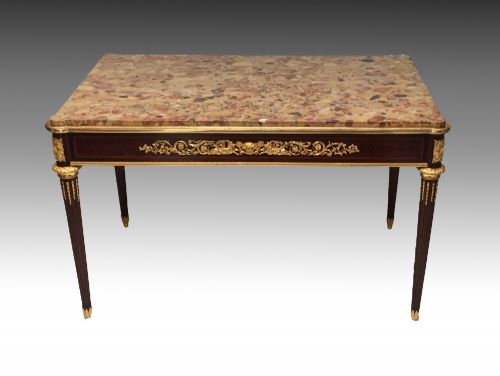
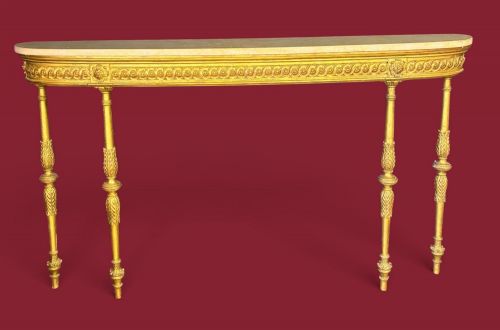

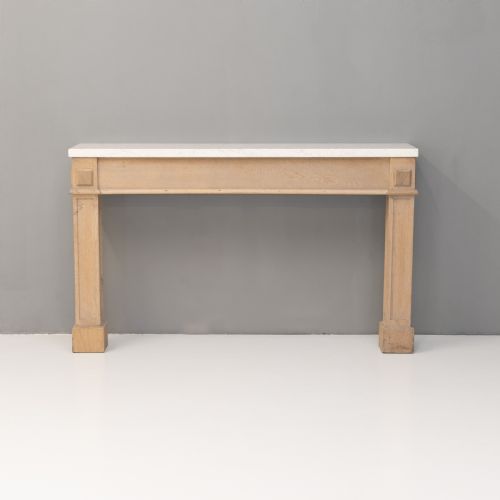


French Neoclassical Console
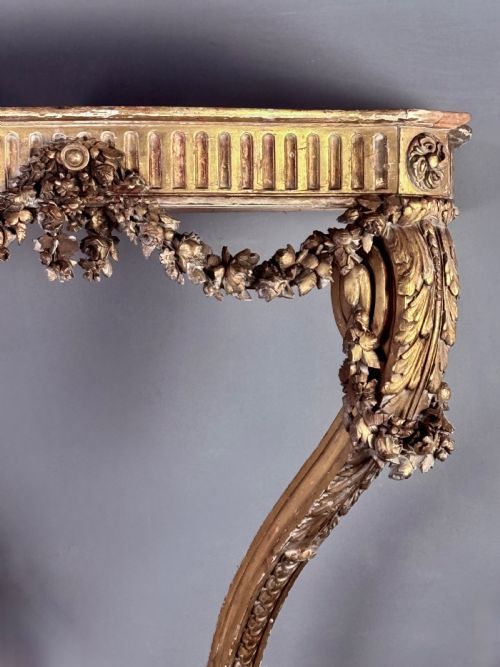
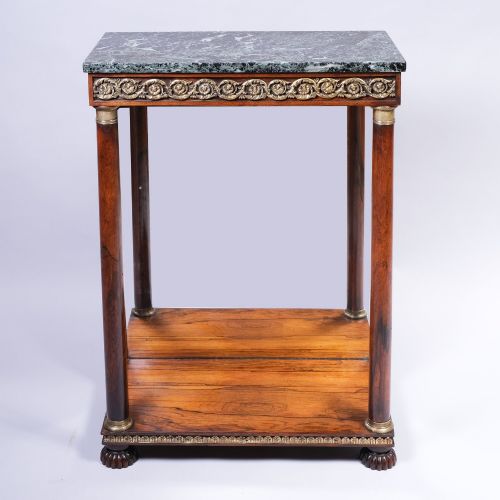
A French neoclassical console brings architectural balance to a room, pairing marble surfaces with carved and gilded timber.
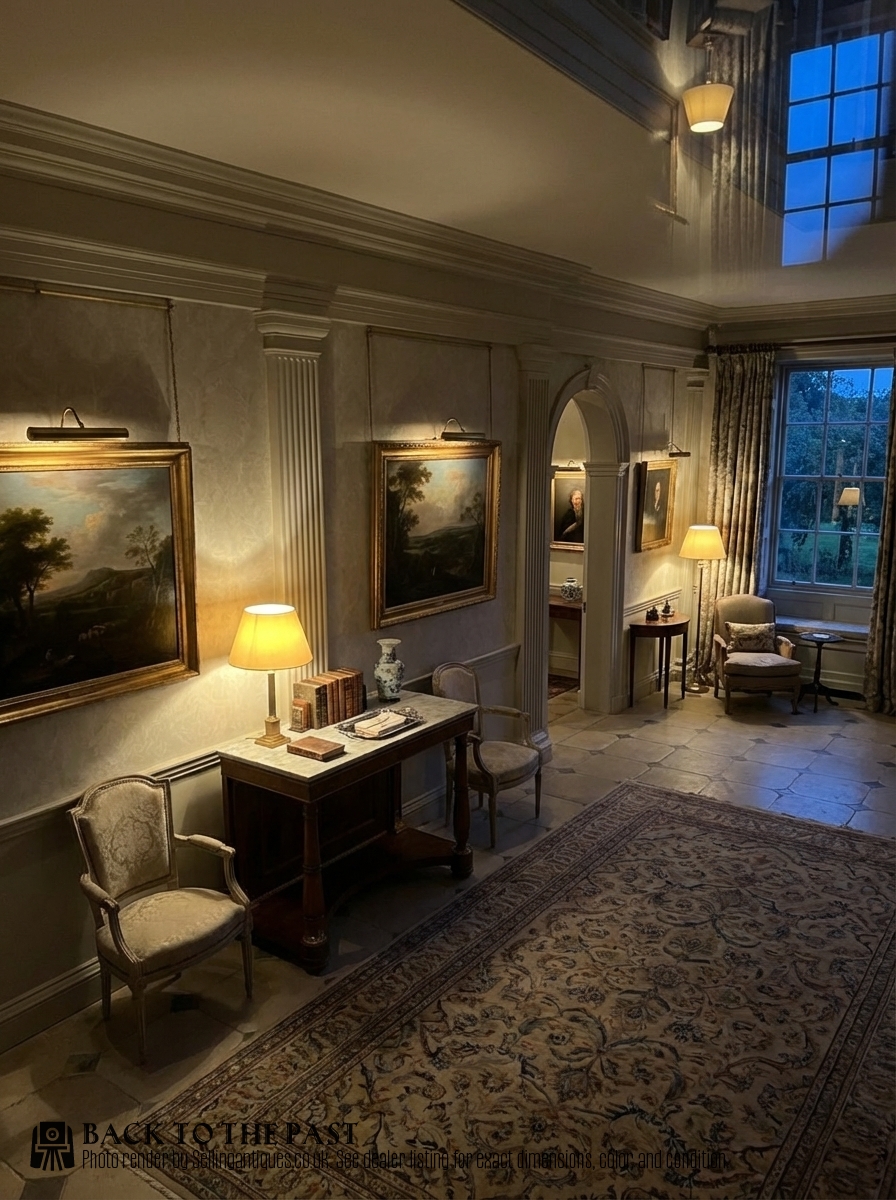
French Neoclassical Console
A French neoclassical console sits flush against a wall, serving as a decorative and functional surface in a hallway or principal room. Pieces matching this description appear across eighteenth, nineteenth, and early twentieth-century periods, often adopting Louis XVI or Empire aesthetic traits.
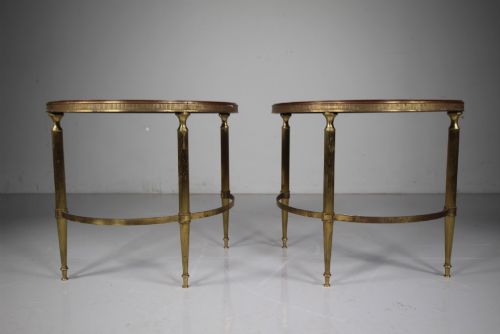
The form typically manifests as a demi-lune or rectangular table, frequently accompanied by matching wall mirrors or constructed as a base designed to support heavy stone. Surviving examples encompass both authentic period pieces and later revival works executed in similar classical proportions.
Makers frequently utilised architectural supports such as fluted legs, pilasters, and restrained geometric carving rather than the exuberant curves seen in earlier rococo furniture. These tables demonstrate a deliberate return to ancient Greek and Roman design vocabularies.
Materials and construction
Construction relies heavily on dense hardwoods like mahogany and walnut, alongside softer timbers intended for gesso application and surface gilding or paint. Cabinetmakers shaped structural elements through traditional joinery before applying decorative finishes.
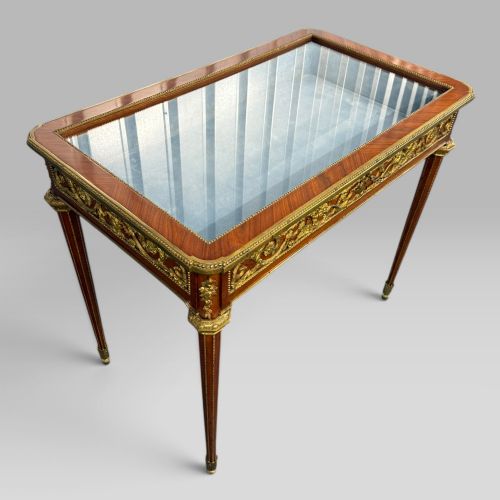
Surfaces feature heavy slabs of marble, fossil marble, granite, or rouge marble, cut and polished to fit the profile of the wooden frame. Ormolu and brass mounts provide contrasting metallic detail, secured to the timber structure with precision pins or screws.
Some nineteenth-century tables include metamorphic mechanisms, transforming a simple wall console into a functional dining or serving surface.
Evaluating craftsmanship
The refinement of the carved ornamentation distinguishes standard workshop production from exceptional cabinetmaking. Crisp depth in gesso work and hand-chiselled detail on ormolu mounts indicate superior execution.
The selection and thickness of the stone top contribute significantly to the structural integrity and visual weight of the piece. High-grade marble or granite matched precisely to the wooden base reflects deliberate intent by the maker.
Felix Alfred Ternisien·François Linke·Jean Joseph Chapuis·Gillows
The French Neoclassical Console Glossary
- Console table
- A table designed to stand against a wall, frequently secured to the vertical surface for stability when carrying heavy stone tops. These pieces often feature finished decoration only on the front and sides.
- Ormolu
- Gilded bronze used for decorative mounts and accents on furniture. The technique involves applying a mercury and gold amalgam to a bronze base before heating.
- Demi-lune
- Half-moon shape characteristic of tables designed to sit flat against a wall. This profile saves floor space while providing a functional surface.
- Giltwood
- Timber coated with a fine layer of gold leaf over a prepared gesso ground. This finish catches candlelight and natural illumination in formal rooms.
- Louis XVI style
- A classical revival design movement favouring straight lines, symmetry, and ancient architectural motifs. It rejects the asymmetrical curves of the preceding rococo period.
French Neoclassical Console: Frequently Asked Questions
Where should a console table go?
These tables suit hallways, entrance foyers, and principal reception rooms where floor space is limited. Their shallow depth allows them to sit against a wall without obstructing pathways.
Pooled beneath a mirror or painting, they create a balanced focal point within an interior scheme.
How do I care for marble?
Clean stone surfaces using a soft, damp cloth without acidic household detergents. Protect the polish by avoiding direct contact with liquids that might etch the surface.
Regular dusting keeps the grain clear and prevents particulate buildup in carved crevices.
Are these tables fixed to walls?
Original console tables often required wall brackets or structural pins for stability, particularly when supporting heavy marble tops. Many surviving examples retain these fittings or show evidence of past wall attachment.
Free-standing variations also exist, particularly among later nineteenth-century adaptations.
How do I spot a revival piece?
Revival furniture from the late nineteenth and twentieth centuries often utilises machine-cut components and standardised hardware alongside traditional joinery. Examining the timber shrinkage and underside construction helps clarify the date of manufacture.
Stylistic cues often borrow heavily from earlier eighteenth-century forms while reflecting the technological capabilities of a later workshop.