


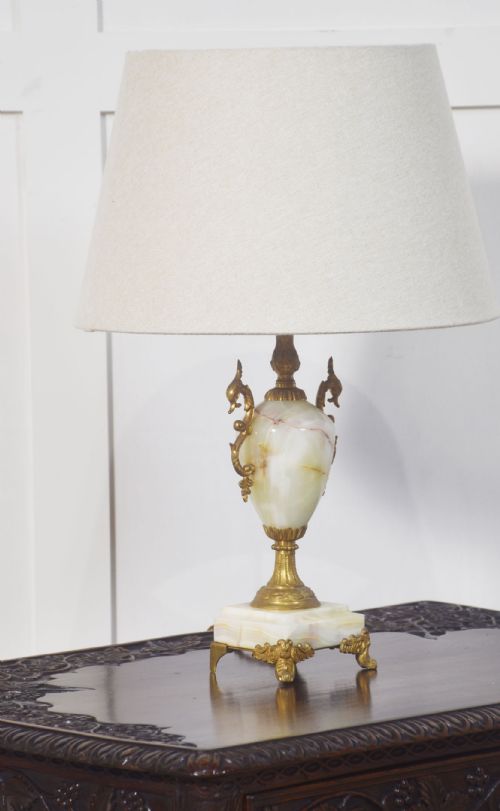


French Marble Urn Lamps
French marble urn lamps bring classical weight and rich metals to a room, turning heavy stone vessels into warm points of light.
French Marble Urn Lamps
When you examine French marble urn lamps, you look at heavy stone bodies mounted with cast metal handles, collars and bases. These pieces borrow the shape of classical vessels and adapt them to hold electrical fittings.
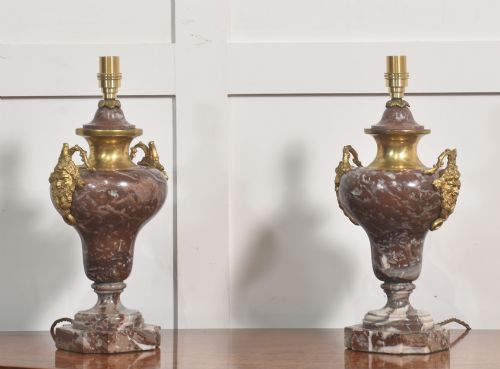
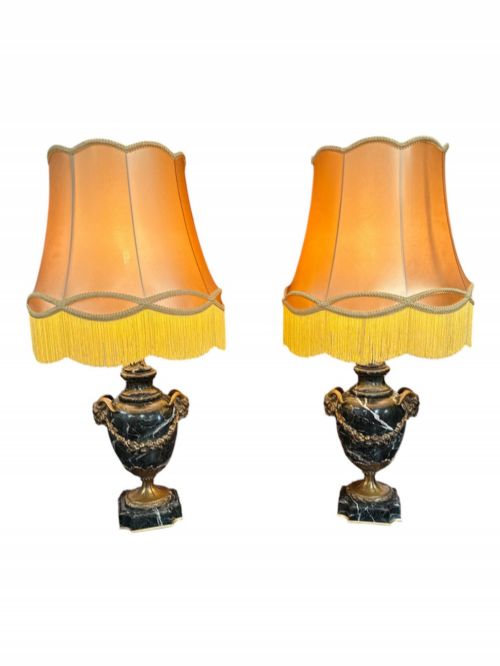
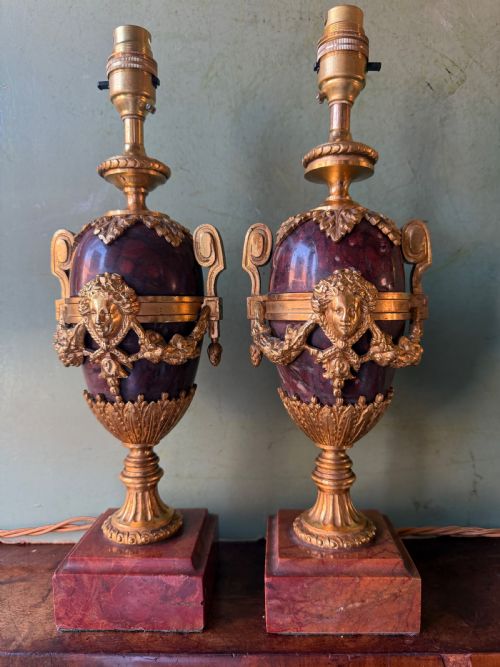
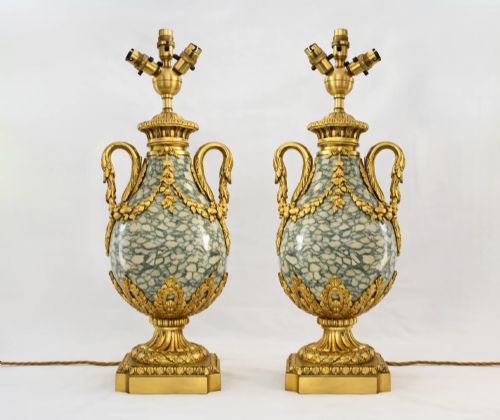
You are most likely to meet pairs on this page, often built from rouge or white marble and styled after the Louis XVI period. The forms lean heavily on neoclassical design, carrying handles, swags and mounts in gilt bronze, ormolu or brass.
Makers drew on 19th-century and early 20th-century aesthetics, ranging from formal French classical to ornate revival styles. Alongside standard table lamps, you occasionally find cassolette forms and decorative stands sharing the same vocabulary of stone and metal.
Materials and construction
Turned and polished marble forms the core of each piece, utilising stones such as white marble, rouge marble, rouge royal, and siena marble. Workshops shaped these mineral blocks into distinct urn and amphora silhouettes.
Gilt bronze, ormolu and gilt brass provide the decorative mounts, collars and paw feet that accent the stone. Craftsmen cast these metal elements separately before fixing them securely around the marble bodies.
Some heavy specimens rest upon tiny gilt metal paw feet, allowing a dignified stone urn to stand on tiptoe.
Standards of craftsmanship
The weight and selection of the marble set the foundation for the piece, with dense, deeply figured stones sitting at the upper end. Finer examples show crisp turning in the stone rather than flat or lazy curves.
The precision of the metalwork defines the finish. Crisp, deeply chased ormolu and gilt bronze mounts that follow the contours of the marble cleanly separate superior objects from simpler brass-mounted alternatives.
The French Marble Urn Lamps Glossary
- Cassolette
- A decorative vessel with a reversible lid that functions as a vase or a burner. In lamp form, the original turning is adapted to hold a central rod.
- Ormolu
- Gilt bronze created by applying a mercury and gold amalgam to cast bronze and firing it. This technique produces a warm, durable metallic finish found on finer mounts.
- Rouge marble
- A rich red limestone variety quarried in France, often marked with white or grey calcite veins. It provides a striking contrast against polished gilt metal.
- Neoclassical
- A design style inspired by classical Greece and Rome that values symmetry, restraint and architectural motifs. It dominates the decorative language of these pieces.
- Amphora
- A two-handled ancient jar shape with a narrow neck, frequently used as the body for urn lamps. The handles often serve as anchor points for metal mounts.
French Marble Urn Lamps: Frequently Asked Questions
Are these lamps converted from old vases?
Many pieces use bodies derived from decorative urns or cassolettes, but workshops frequently produced them specifically to house wiring. The distinction lies in whether the bore through the stone was planned from the outset.
Examining the underside and the fitting entry points helps clarify how the conversion or original assembly was achieved.
How do I identify Louis XVI style?
Louis XVI style relies on straight lines, classical proportions, architectural swags, and leafy motifs rather than the curved asymmetry of rococo. Look for clean columnar forms and balanced mounts.
This aesthetic draws heavily on excavated Roman antiquities popular during the late eighteenth century and revived throughout the nineteenth.
What is the difference between ormolu and gilt bronze?
Ormolu specifically refers to mercury gilding on bronze, a hazardous historical technique producing a distinct lustre. Gilt bronze is a broader term that can include modern electroplating methods.
Both serve to enrich the metal components attached to the marble bodies.
How should I clean the marble?
Dust the stone regularly with a dry microfibre cloth and avoid harsh chemical cleaners that can etch the polished surface. Mild soapy water on a damp cloth suits most sealed stone.
Keep moisture away from the metal mounts and electrical components during cleaning.