




French Marble Fireplace Clock
A french marble fireplace clock brings weight and steady motion to a room, anchoring a mantelpiece with stone and gilt metal.
French Marble Fireplace Clock
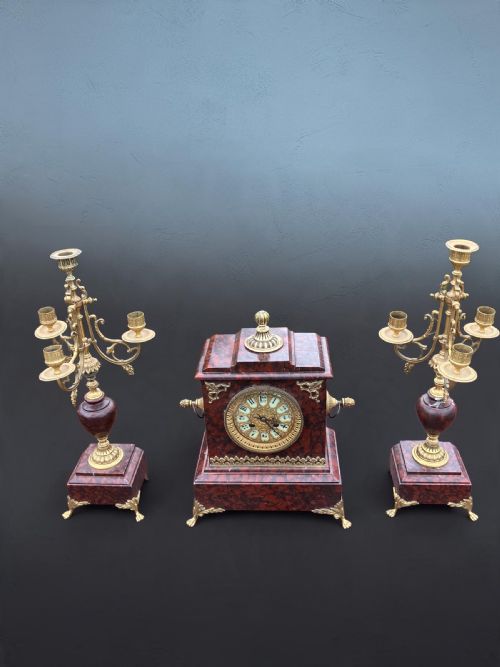
A french marble fireplace clock serves as the structural centrepiece of a room, combining heavy stone housing with precision clockwork movements. When you browse for a french marble fireplace clock, you encounter both single mantel pieces and larger matched sets complete with side garnitures or candelabra.
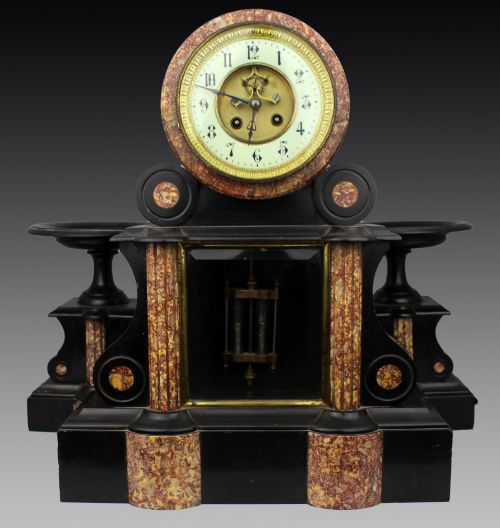
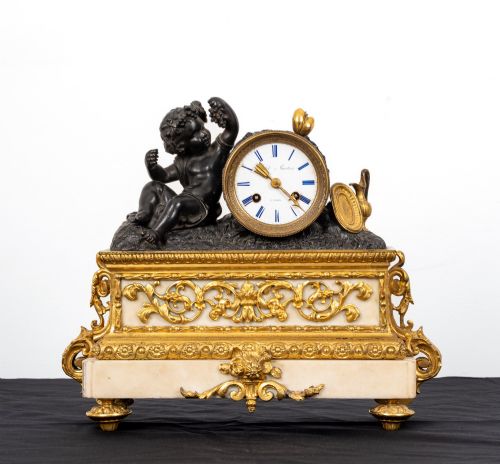
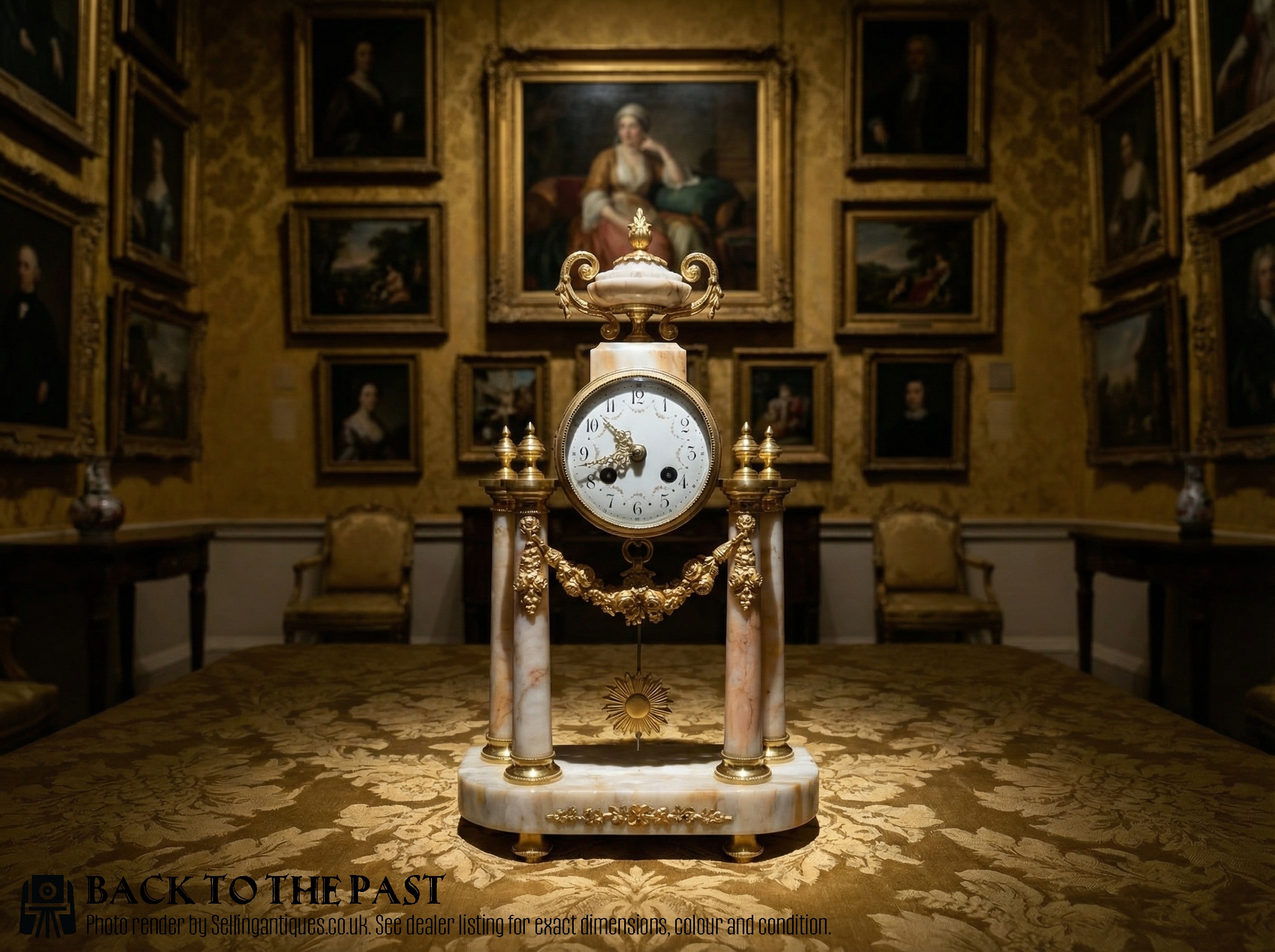
The selections span the nineteenth century, drawing heavily on Victorian tastes alongside French Second Empire, Louis XVI, and Neoclassical styles. Formats range from upright portico designs and drumhead clocks to heavily ornamented figural compositions featuring cast bronze or ormolu mounts.
Many examples arrive accompanied by matching side pieces, creating a balanced display across a shelf or hearth. The stone body typically utilises black slate, white marble, or red rouge varieties, often contrasted against bright gilt bronze details.
Materials and construction
The primary bodies rely on dense quarried stone such as black slate and various coloured marbles, cut and polished into architectural or sculptural shapes. Metal components like ormolu, gilt bronze, and brass are cast and chased to form decorative mounts, bezels, and dial surrounds.
Clockmakers housed eight-day mechanical movements within these heavy stone housings, often featuring enamel chapter rings and glass covers to protect the hands and face. Side garnitures share the same material vocabulary, matching the central clock through coordinated use of marble and cast metal.
French Marble Fireplace Clock Retail Price Guide 2026
Typical asking prices for french marble fireplace clock among the pieces listed under this phrase on Sellingantiques today, from the lower quarter to the upper quarter. They describe what is for sale here now, not the wider market.
Listings feature clocks spanning the nineteenth century, incorporating materials like black slate, white marble, rouge marble, ormolu, and gilt bronze in various styles.
Judging the work
Quality rests in the crispness of the bronze casting and the depth of the marble polishing, where finer pieces display sharper detail in figural mounts and smoother stone surfaces. The integration between the heavy stone housing and the metal ornaments reveals the maker's hand, particularly in how securely and neatly the mounts fit.
The movement itself dictates much of the standing of an individual piece, moving from standard utility mechanisms to signed works by notable makers. Completeness also alters the character of a listing, as surviving matching garnitures or candelabra elevate a simple clock into a balanced set.
Japy Frères·Siffel & Cartier·Deniere and Cailleaux·James Ritchie & Son·Vincenti
The French Marble Fireplace Clock Glossary
- Garniture
- A set of matching decorative objects designed to be displayed together on a mantelpiece, typically consisting of a central clock flanked by two matching urns or candelabra. These sets create a symmetrical arrangement popular in nineteenth-century interiors.
- Ormolu
- Gilt bronze produced by applying a finely ground high-carat gold mercury amalgam to a bronze object before heating to drive off the mercury. This technique imparts a rich, durable golden finish to decorative mounts.
- Portico clock
- A mantel clock featuring a architectural case supported by four columns, resembling a classical temple facade. They often house a visible pendulum swinging between the pillars.
- Drumhead clock
- A clock design where the dial and movement are housed within a circular metal drum resting on a rectangular or stepped stone base. This profile creates a clean silhouette against a fireplace wall.
- Chapter ring
- The circular ring on a clock face that bears the numerals marking the hours. They are frequently made of white enamel with painted black Roman or Arabic numerals.
French Marble Fireplace Clock: Frequently Asked Questions
What is a clock garniture set?
A clock garniture set includes a central mantel clock accompanied by matching side pieces such as urns, vases, or candelabra. These items are designed to be displayed together on a fireplace mantel for a symmetrical look.
Such sets were popular in the nineteenth century, allowing homeowners to create a unified decorative scheme across the hearth.
How do I wind an eight day clock?
An eight-day clock requires winding approximately once a week using a matching key inserted into the winding holes on the dial. Care must be taken not to over-wind the mainspring.
Most nineteenth-century mechanical movements operate on this weekly cycle, keeping time through a pendulum regulated by the escapement.
Are these clocks suitable for daily use?
These mechanical clocks can keep reliable time when properly set up, levelled, and periodically serviced by a professional clockmaker. The heavy stone and bronze cases provide a stable housing for the delicate gears inside.
Placing them on a sturdy, level surface prevents the pendulum from going out of beat and ensures consistent operation.
How do I tell Louis XVI style from Empire style?
Louis XVI style pieces lean towards restrained classical symmetry, straight tapering columns, and delicate floral or ribbon mounts in ormolu. They reflect eighteenth-century French royal aesthetics revived during the nineteenth century.
Empire style objects tend to be heavier and more militaristic or imperial in feeling, drawing on ancient Roman and Egyptian motifs with bold, solid bronze ornamentation.