
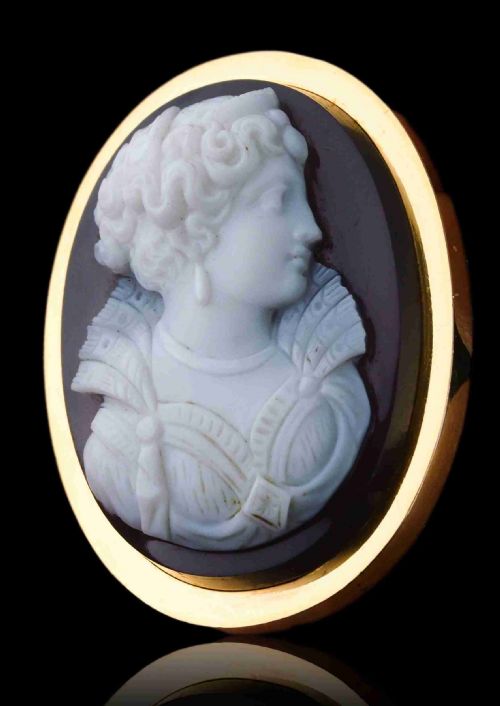


French Gold Brooch
A french gold brooch brings together gold, silver, diamonds and hardstones in forms spanning the Victorian era to the mid-twentieth century.
French Gold Brooch
When you search for a french gold brooch, you encounter pieces that range from Victorian floral sprays and hardstone cameos to Art Deco geometric bar brooches and mid-century novelty designs.
The selections on this page feature work from the eighteenth century through the 1960s, with nineteenth-century and Victorian pieces appearing frequently alongside Belle Epoque, Art Nouveau, and Art Deco examples.
Forms include classic bar brooches, floral spray designs, pendants that convert into brooches, and hatpins, incorporating materials such as agate, amethyst, garnet, onyx, and labradorite.
Materials and construction
Maker's workshops built these items primarily in 18ct yellow gold and silver-topped gold, a technique that placed silver on the face to reflect diamond light while retaining gold strength at the back.
Master jewellers combined precious stones like diamonds, rubies, emeralds, sapphires, and pearls with hardstones including agate, amethyst, garnet, and labradorite, often accented by vitreous enamel.
Construction techniques include delicate pierced gallery work, triple cartouche designs, and FIX gold plating found on enamel and turquoise pieces.
French Gold Brooch Retail Price Guide 2026
Typical asking prices for french gold brooch among the pieces listed under this phrase on Sellingantiques today, from the lower quarter to the upper quarter. They describe what is for sale here now, not the wider market.
Assessing quality
Quality rests upon the crispness of the hand-carving in hardstone cameos and the precision of the stone setting, particularly in multi-gem floral sprays and calibre-cut sapphire and diamond arrangements.
Superior pieces display harmonious proportions between the central gems - such as natural pearls, diamonds, and rubies - and the supporting gold or platinum mount, showing clean soldering and balanced design.
The integration of convertible elements, such as pendant loops that fold away cleanly on a brooch, separates standard production from finer atelier work.
Rene Lalique
The French Gold Brooch Glossary
- Bar brooch
- A slender horizontal pin, frequently set with central stones or geometric motifs popular during the Art Deco and Victorian periods.
- Hardstone
- Opaque or translucent mineral stones, such as agate and labradorite, carved in relief for cameos or used flat in jewellery.
- Silver-topped gold
- A manufacturing method bonding a silver face to a gold base, historically utilised to enhance the white sparkle of set diamonds.
- Convertible pendant
- A piece fitted with a hidden bail or loop allowing it to function as either a necklace pendant or a pinned brooch.
- Calibre-cut
- Stones, particularly sapphires or rubies, cut precisely to fit tightly together in channel or invisible settings without visible metal gaps.
French Gold Brooch: Frequently Asked Questions
How do I wear a antique brooch?
Pin these pieces securely onto heavy fabrics like wool coats, lapels, or thick scarves to support their weight without pulling the textile.
For convertible items, attach a suitable chain through the integrated loop to wear the piece as a pendant necklace.
Are these brooches solid gold?
Many items utilise 18ct yellow gold or 15ct gold, while others employ a traditional silver-topped gold construction where silver faces the front to set diamonds.
Some specialised pieces incorporate gold-filled processes like FIX alongside enamel and turquoise work.
How do I date a french brooch?
Examine the stylistic markers, such as Neoclassical motifs from the eighteenth century, naturalistic floral spray designs from the Victorian era, or geometric lines from Art Deco periods.
Material choices, gem cuts, and mounting techniques also help place items into eras spanning from the 1760s to the 1960s.