




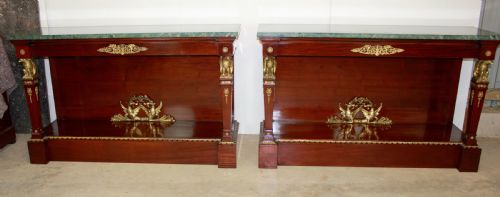
French Gilt Hallway Table
A French gilt hallway table brings architectural presence and gilded warmth to an entrance, combining classical lines with reflective marble surfaces.
French Gilt Hallway Table
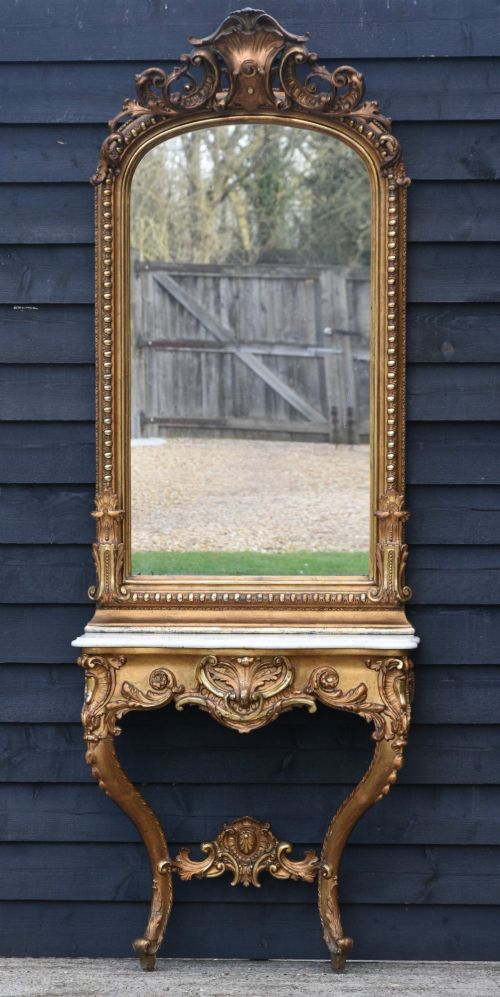
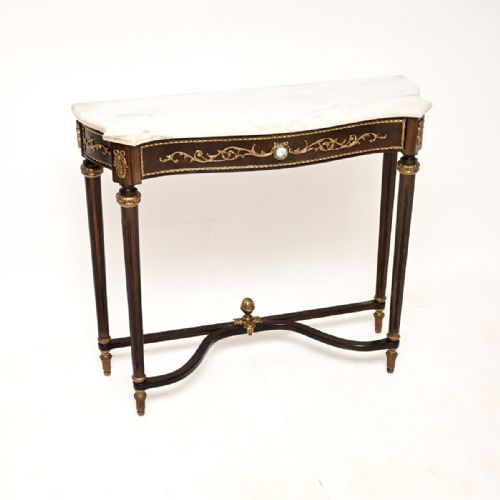
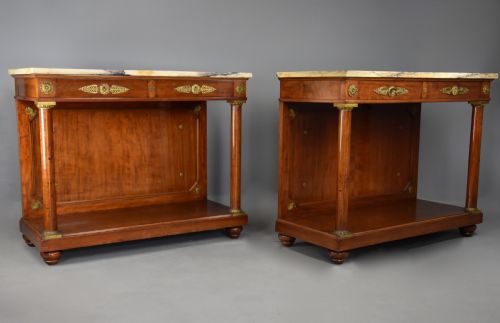
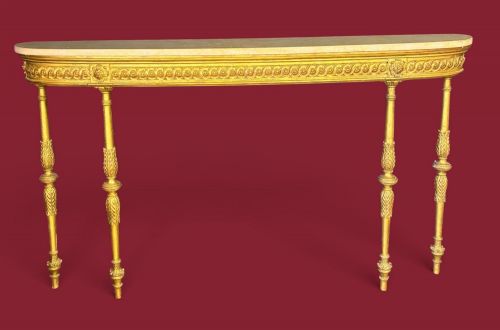
A French gilt hallway table is primarily represented here by console tables and console table and mirror sets designed for narrow spaces. These pieces combine decorative wall-anchored or freestanding frames with functional surfaces.
The selections span the nineteenth century, nineteen hundred, and early twentieth century, drawing on French Rococo, French Empire, Neoclassical, and Louis XVI design vocabularies. Such variety reflects both period originals and later revival interpretations.
Makers and workshops utilised mahogany, walnut, and carved timbers finished with gold leaf, gesso, or paint, frequently paired with contrasting stone surfaces.
How they were made
Craftsmen built structural frames from timbers such as mahogany, walnut, and pine, applying gesso as a smooth preparation layer for subsequent gilding with gold leaf or paint. Carved details relied on hand-chiselled ornamentation following established classical motifs.
Table surfaces incorporated heavy slabs of marble, including rouge and Sienna varieties, cut and polished to fit the serpentine, demi-lune, or rectangular contours of the console bases. Ormolu mounts and bronze details were cast and chased to accent key structural junctions.
French Gilt Hallway Table Retail Price Guide 2026
Typical asking prices for french gilt hallway table among the pieces listed under this phrase on Sellingantiques today, from the lower quarter to the upper quarter. They describe what is for sale here now, not the wider market.
Listings feature materials such as marble, giltwood, glass, mahogany, ormolu, gesso, gold leaf, and painted wood across multiple periods.
What varies in quality
Quality rests upon the crispness of the timber carving and the depth of the gilding, where hand-applied gold leaf displays a richer light play than flat painted finishes. The integration of the marble top to the timber base demonstrates the maker's precision.
Constructive integrity is visible in the stability of the frame joints and the weight and figuring of the chosen marble or mahogany. Stamped signatures or documented attributions elevate specific pieces above standard workshop production.
Krieger Paris·Gillows
The French Gilt Hallway Table Glossary
- Console table
- A table designed to stand against a wall, historically supported by wall brackets or front legs. These tables suit narrow hallways and often feature matching mirrors.
- Giltwood
- Timber that has been coated with thin sheets of gold leaf over a gesso base. This finish provides a warm, reflective metallic sheen.
- Ormolu
- Gilded bronze used for decorative mounts and hardware on furniture. It adds contrasting metallic highlights to wood and marble surfaces.
- Demi-lune
- Half-moon shape used for table tops and frames. This curved profile allows the furniture to sit compactly against a flat wall.
- Serpentine outline
- A curved edge that undulates in a convex-concave-convex rhythm. It demands advanced woodworking skill to shape timber and marble accurately.
French Gilt Hallway Table: Frequently Asked Questions
How do I style a hallway table?
Pair the table with a matching pier mirror to create vertical height and reflect light within a narrow entrance space. Keep surface objects minimal to let the carved timber and marble top remain visible.
Ensure the table depth allows comfortable passage through the hallway without obstructing doors or movement.
Are marble tops original to these tables?
Most period console tables retain their fitted marble tops, which were selected to provide a durable and cool surface. Variations in stone colour, such as rouge or Sienna, reflect the preferences of the specific decade of manufacture.
Replacement marble is sometimes fitted during restoration if the original stone suffered structural damage over time.
How do I distinguish Louis XVI from Rococo styles?
Louis XVI furniture relies on straight lines, symmetry, and classical architectural motifs such as fluted legs and acanthus leaves. This style reflects a return to a more restrained aesthetic.
Rococo pieces embrace asymmetrical curves, exuberant scrolling foliage, and flowing serpentine outlines designed to create dynamic visual movement.
Do these tables require wall attachment?
Many traditional console tables were structurally designed to lean against or fix directly to the wall for complete stability. Freestanding versions rely on sturdy front and rear legs to bear the weight of heavy marble tops.
Checking the base construction helps determine whether additional wall anchoring is necessary for daily safety.