


French Fold Over Table
A french fold over table converts from a slim console into a green-baize surface for cards, and collectors prize them for their ingenious geometry.
French Fold Over Table
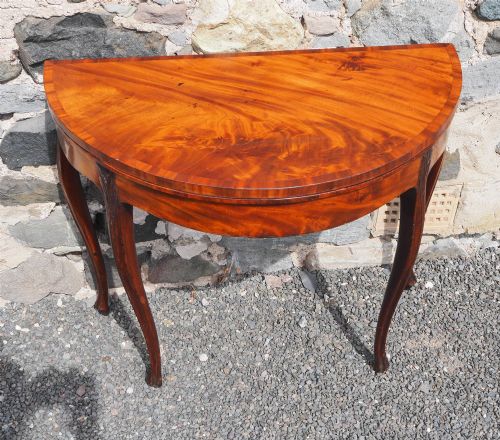
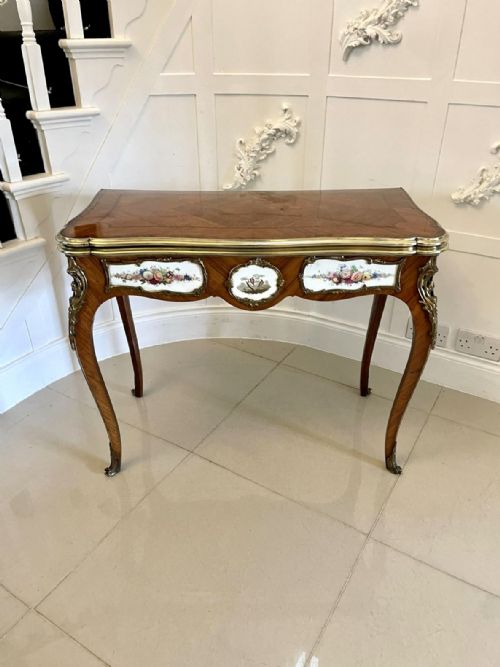
When you search for a french fold over table, you encounter forms that double in size by rotating, flipping, or pivoting the top over a concealed well. The pieces seen here appear primarily as card tables, games tables, and console tables.
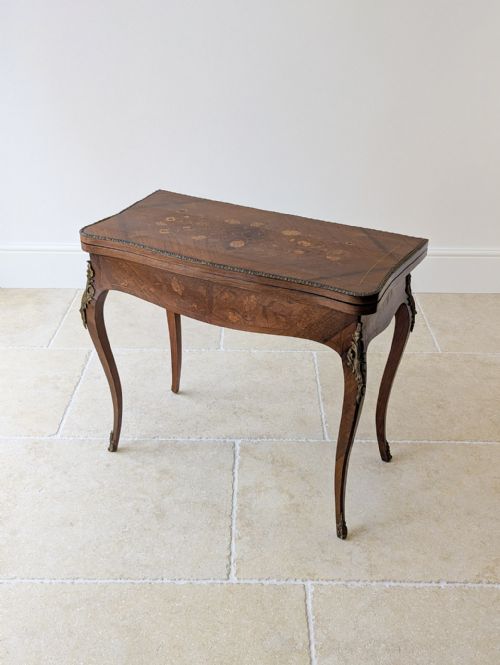
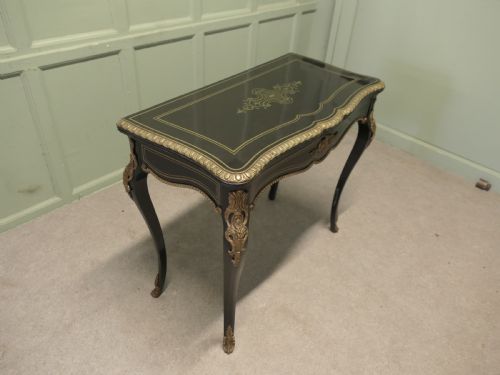
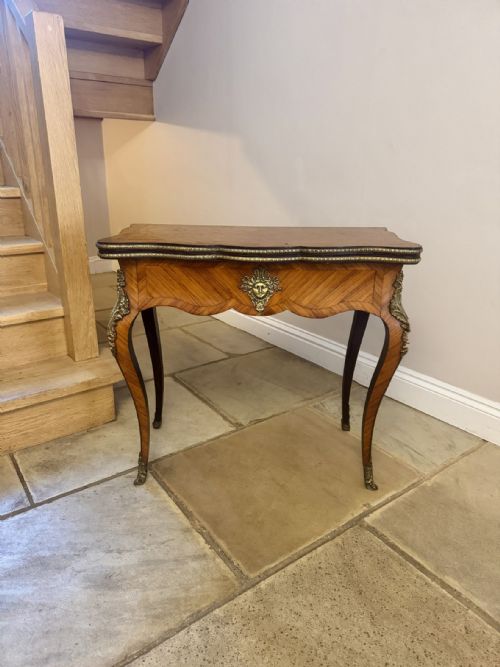
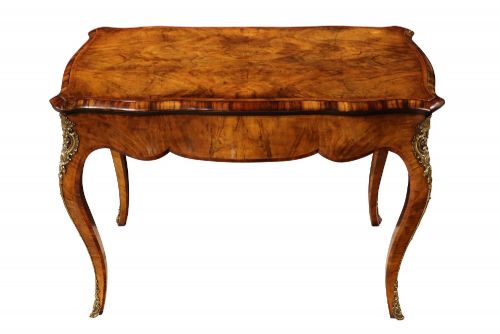
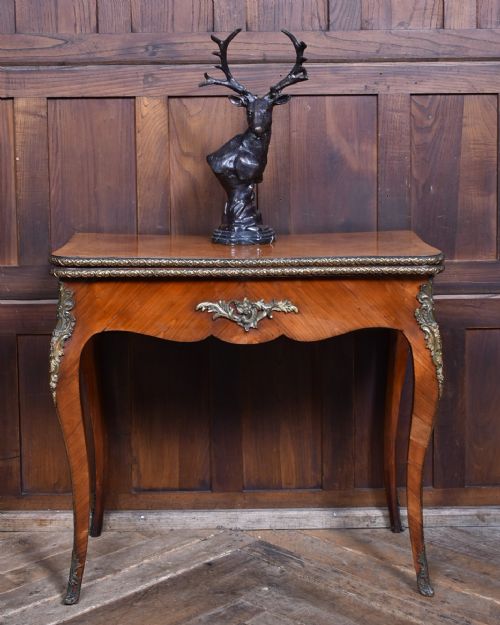
The materials and aesthetic span the eighteenth century through the Victorian era, heavily leaning towards Louis XV style, Louis XVI revival, and French Rococo revival. Walnut, kingwood, mahogany, and ebonised wood dominate the selection, often ornamented with marquetry or parquetry.
Many examples arrive with specific dual functions, serving as console tables against a wall before opening for evening entertainment. Others incorporate porcelain plaques, mother-of-pearl detail, or brass inlay alongside traditional cabinet woods.
How they were made
Cabinet makers built these tables using dense timbers such as mahogany, walnut, and kingwood over sturdy oak or pine carcases. Marquetry and parquetry patterns required meticulous hand-cutting of exotic veneers, arranging contrasting wood grains into floral and geometric designs.
Mounts in cast ormolu and brass framed the edges, corners, and aprons to protect the vulnerable timber joints and accentuate the serpentine contours. Brass inlay and mother-of-pearl detail were sunk directly into the wooden surfaces, demanding precise chiselling and embedding.
The folding mechanisms relied on pivoting wooden leaves or rotating hinges that required exact engineering to maintain a level surface when opened.
French Fold Over Table Retail Price Guide 2026
Typical asking prices for french fold over table among the pieces listed under this phrase on Sellingantiques today, from the lower quarter to the upper quarter. They describe what is for sale here now, not the wider market.
Card tables often reveal hidden wells beneath their folding tops, originally designed to store counters and ivory markers for parlour games.
What varies in quality
The division between standard workshop production and exhibition pieces rests in the ambition of the marquetry and the crispness of the bronze mounts. Pieces carrying maker attribution often display finer hand-chiselling on the ormolu and more complex floral or pictorial veneer work.
Timber selection dictates the baseline quality, with figured burr walnut, amboyna, and richly cross-banded kingwood indicating higher tier construction. The precision of the joinery around the folding hinge mechanism determines whether the top sits flush and stable in both configurations.
G T Morant·Edwards And Roberts·Henry Dasson
The French Fold Over Table Glossary
- Ormolu
- Gilded bronze mounts applied to furniture edges and legs. This decorative technique added metallic contrast to dark cabinet woods during revival periods.
- Marquetry
- The art of applying pieces of veneer to a structure to form decorative patterns. Craftsmen utilised various exotic woods to create floral or geometric pictures.
- Boulle
- A form of marquetry consisting of tortoiseshell and brass inlay. It takes its name from the master cabinet maker André-Charles Boulle.
- Parquetry
- Geometric mosaic woodwork formed of small veneer tiles. Artisans arranged alternating wood grains to produce chequered or cube patterns.
- Serpentine
- A furniture front or top curving inward and outward in a continuous wave. This undulating contour defines much of the Rococo revival output.
French Fold Over Table: Frequently Asked Questions
What is a french fold over table used for?
These pieces functioned primarily as dual-purpose furniture for nineteenth-century reception rooms. Closed, they stood against a wall as a console or side table supporting decorative objects.
Opened for the evening, the hinged top doubled the surface area to provide a stable baize-lined table for card games and social assemblies.
How do you open a french fold over table?
The mechanism usually involves swinging the top leaf outward on a pivot hinge while the rear legs move in unison to support the overhang. Some versions lift and rotate ninety degrees before dropping flat onto the framework.
Care is required to ensure the hinges move freely without forcing old timber joints.
How do you distinguish Louis XV style from Louis XVI style?
Louis XV style pieces are characterised by flowing curves, asymmetry, and rich serpentine contours typical of Rococo revival design. Ormolu mounts follow organic floral motifs rather than rigid geometry.
Louis XVI revival work introduces straight tapered legs, neoclassical symmetry, and restrained parquetry patterns reflecting an architectural influence.
How do you care for marquetry and ormolu?
Wood surfaces benefit from occasional waxing with traditional beeswax to preserve the grain and prevent the veneer from drying out. Avoid modern silicone polishes that penetrate old finishes.
Ormolu mounts require gentle dusting with a soft brush, keeping moisture away from the gilt bronze and the surrounding wood.