






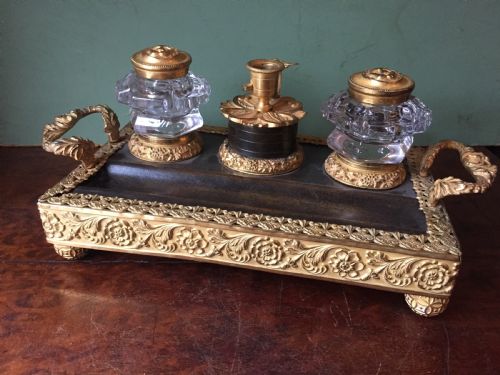


French Empire Desk Accessory
These French Empire desk accessory pieces bring neoclassical gravity and heavy gilt bronze into a modern study.
French Empire Desk Accessory
A French Empire desk accessory is a functional writing object designed in the grand neoclassical manner of nineteenth-century France. Buyers searching for a french empire desk accessory encounter heavy inkstands, inkwells, candlesticks, and decorative boxes created to dignify the writing table.
The objects seen here rely heavily on the combination of natural stone bases and cast metal mounts. Inkstands and inkwells dominate the selection, often accompanied by matching desk sets, caskets, and desk candlesticks.
Origins trace across the nineteenth century, including specific periods like the French Restoration and Second Empire. The forms remain resolutely architectural and sculptural, echoing the military and classical motifs of the early eighteen-hundreds.
How they were made
Maker workshops utilised fire-gilded bronze, commonly known as ormolu, alongside patinated bronze and cast brass for the metal elements. These components were chased by hand to achieve crisp detail before mercury gilding was applied to the bronze surfaces.
Heavy bases were carved from various marbles, including Sienna, vert, and onyx, providing a solid foundation for the metal mounts. The stone and metal components were then mechanically secured together using threaded bolts and pins hidden beneath the base.
French Empire Desk Accessory Retail Price Guide 2026
Typical asking prices for french empire desk accessory among the pieces listed under this phrase on Sellingantiques today, from the lower quarter to the upper quarter. They describe what is for sale here now, not the wider market.
Napoleon watches silently over the ink from a miniature bronze bust.
What varies in quality
Quality rests in the crispness of the bronze chasing and the depth of the fire-gilding. Superior examples display sharp relief in acanthus leaves, lions, and classical figures, whereas lesser pieces show softer, more rounded casting marks.
The selection and preparation of the marble base also dictate overall value. Fine-grained stone with rich, natural veining and precise corner bevels elevates the entire object above standard production pieces.
The French Empire Desk Accessory Glossary
- Ormolu
- Gilded bronze produced by applying a mercury and gold amalgam to a bronze base and heating it to drive off the mercury. This technique creates a deep, durable golden lustre characteristic of nineteenth-century metalwork.
- Encrier
- A French term for an inkstand or inkwell fitted for writing equipment. These portable containers typically incorporate glass or ceramic ink inserts housed within a decorative metal frame.
- Patinated bronze
- Bronze that has been chemically treated to produce a dark, uniform surface colour. It offers a muted contrast against bright ormolu mounts.
- Sienna marble
- A yellow-gold ornamental limestone quarried in Italy, featuring dark purple and brown veining. It was widely used in grand nineteenth-century desk accessories.
- French Restoration
- A stylistic period spanning the early decades of the nineteenth century between the fall of the First Empire and the July Revolution. Objects from this era soften severe imperial designs with more restrained decorative flourishes.
French Empire Desk Accessory: Frequently Asked Questions
What is a French Empire desk accessory?
It is a nineteenth-century writing desk item, such as an inkstand, casket, or candlestick, made in France during the neoclassical revival.
These pieces combine heavy cast bronze with marble bases to create formal items for the writing table.
How do I clean an ormolu inkstand?
Dust the piece gently with a soft brush and avoid using harsh chemical polishes that strip historical gilding.
Moisture should be kept away from both the gilt surfaces and the marble to prevent staining.
Are these desk accessories still usable?
Many inkstands and inkwells retain their original glass or ceramic liners, allowing them to hold ink if desired.
Most buyers today use them as decorative desk ornaments rather than functional writing tools.
How do I identify the period of a desk set?
Dating relies on examining the casting quality, the style of the bronze chasing, and the type of marble used.
Early pieces from the nineteenth century show sharper neoclassical detailing than later nineteenth-century revivals.