


French Draw Leaf Table
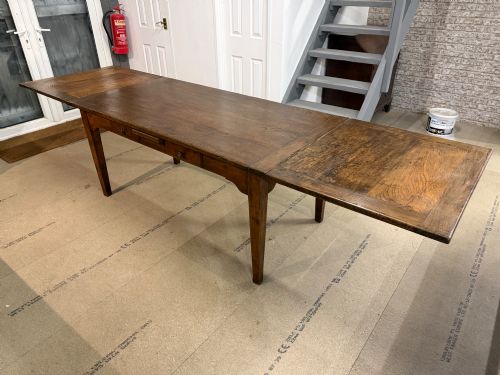
A french draw leaf table offers an ingenious expanding surface for dining, combining robust provincial charm with clever hidden leaves.
French Draw Leaf Table
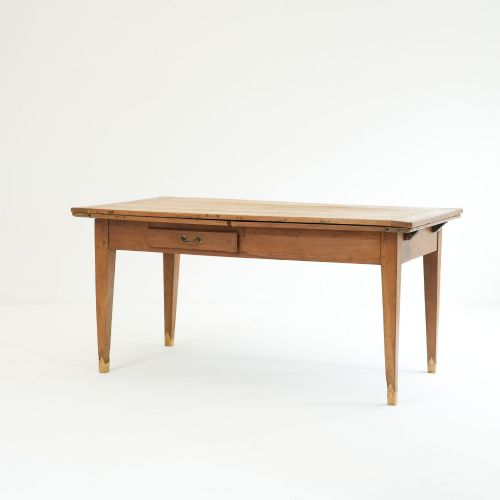
A french draw leaf table provides a versatile dining surface through two sliding leaves concealed beneath the main top, which pull out to extend the table length when needed. These pieces emerge predominantly in sturdy hardwoods from provincial dining rooms and kitchens, designed to adapt easily for larger gatherings.
The versions most commonly met span the nineteenth century and the early decades of the twentieth century. They frequently adopt regional styles such as rustic farmhouse or French provincial, prioritising practical everyday use alongside traditional craftsmanship.
Dining tables of this form appear in various proportions, ranging from intimate kitchen formats to large refectory formats seating ten or twelve people. Their primary function remains hosting meals while retaining the character of rural European interiors.
Distinctions in quality
Quality rests significantly on the precision of the extending mechanism and how smoothly the hidden leaves slide on their internal runners. Finer examples maintain an even surface plane when fully extended, ensuring the leaves lock securely without sagging at the joints.
The choice of timber and the complexity of surface decoration also separate standard items from superior pieces. Tables featuring intricate parquetry top designs, carved cabriole legs, or dense hardwoods like walnut and fruitwood demonstrate a higher standard of joinery and material selection.
Recorded periods range from the mid nineteenth century through the early decades of the twentieth century.
The French Draw Leaf Table Glossary
- Draw-leaf
- An extending table design where two leaves slide out from beneath the main central top to lengthen the surface.
- Parquetry
- A geometric mosaic of wood pieces used for decorative surfaces, commonly seen on table tops.
- Cabriole leg
- A furniture leg that curves outward and then tapers inward, finishing in a modest foot.
- Fruitwood
- Timber gathered from fruit-bearing trees such as cherry or pear, prized for its warm tone and smooth grain.
- Refectory table
- A long, narrow dining table traditionally used in communal dining halls and large kitchens.
French Draw Leaf Table: Frequently Asked Questions
How do the extending leaves work?
The hidden leaves sit directly beneath the main central top on sliding wooden runners. When extra length is needed, the user lifts the main top slightly and pulls each end leaf outward until it drops into alignment with the surface.
This clever mechanism avoids the need to store separate table boards elsewhere in the room. The leaves slide smoothly back underneath when the meal finishes, returning the table to its compact footprint.
What rooms suit these dining tables?
These tables find a natural home in spacious kitchens, open-plan dining rooms, and rustic living spaces. Their adaptable length makes them practical for households that require an everyday surface which can expand for dinner parties.
Pinned against provincial or traditional interior schemes, their warm wood tones and parquet patterns create a welcoming focal point. Benches or mismatched chairs pair naturally with the farmhouse aesthetic.
How can I tell the period?
Dating relies on examining the timber species, construction marks, and decorative styles visible across the frame. Nineteenth-century examples often display heavier oak construction and hand-cut joinery, while early twentieth-century pieces incorporate lighter fruitwood and geometric parquetry.
Subtle details like the shape of the legs, such as cabriole supports or straight tapered posts, offer further clues to the decade of manufacture. Hardware components and the wear patterns on the sliding runners also indicate age.
Are these tables sturdy enough for daily dining?
Constructed from dense hardwoods like oak, walnut, and cherry, these tables are built to withstand generations of family meals. The frame and undercarriage provide robust support even when the leaves are fully extended.
Routine care involves simple cleaning and occasional waxing to protect the timber surface from daily wear. The mechanism itself requires gentle handling to ensure the sliding runners remain aligned over years of use.