



French Desk Inkstand
A french desk inkstand sits at the centre of the writing table, holding glass wells, sanders and nibs in cast metal and polished stone.
French Desk Inkstand
A french desk inkstand gathers the implements of correspondence into a single decorative arrangement upon the writing table. These pieces serve to hold ink reservoirs alongside pen trays, candlestands and letter racks.
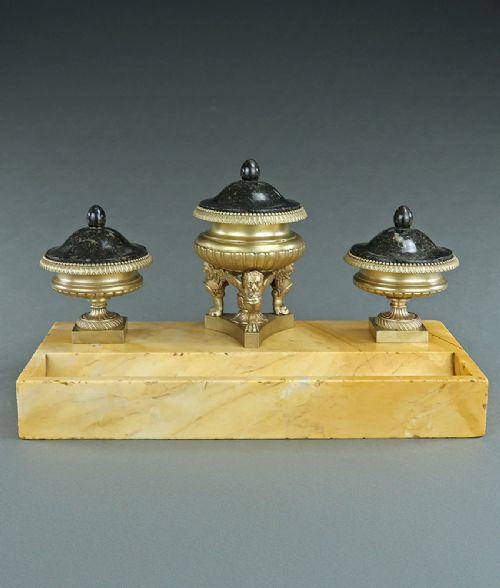
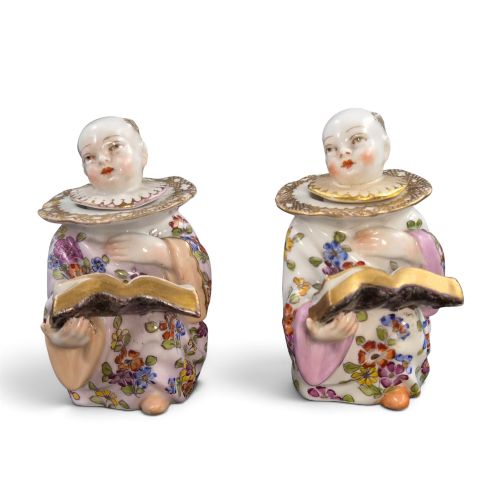
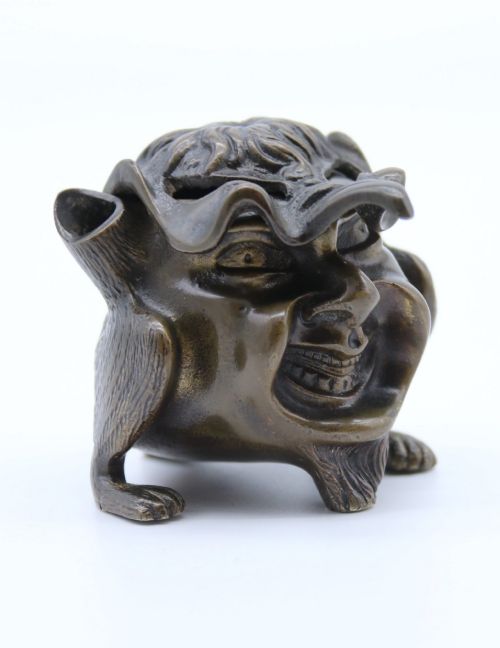
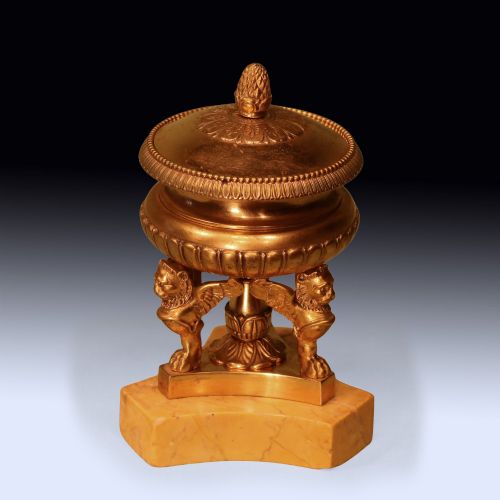
The versions met on this page emerge primarily from the nineteenth century, spanning periods from the Empire and Second Empire through to Art Nouveau. Makers shape them in heavy metals and stone, incorporating figural groups, hinged caskets and lidded glass wells.
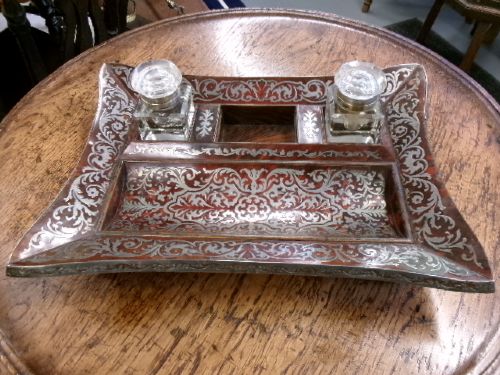
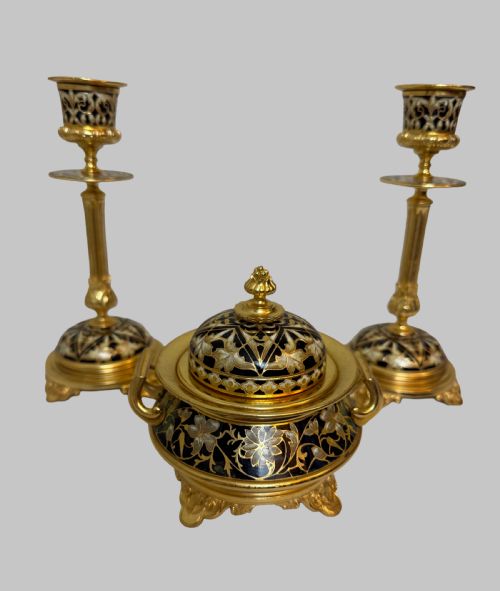
Many examples function as desk sets incorporating candlesticks or matched desk clocks alongside the central inkwell. Others take the form of small figural bronzes or tortoiseshell boulle work trays designed to sit upon library tables.
Materials and Construction
Foundries cast these objects in bronze, brass and ormolu, often applying gilding or patination to the metal surface. Makers mount these metal elements upon heavy stone bases cut from marble, malachite or sienna stone.
The decorative schemes frequently employ champlevé enamel, porcelain inserts and boulle work inlay of brass upon tortoiseshell or mahogany. Glass forms the internal ink liners housed within the hinged or lidded metal mounts.
The listings demonstrate a strong presence of nineteenth-century French manufacturing, utilising ormolu, marble and champlevé enamel across various desk accessories.
Distinctions in Quality
The distinction between tiers rests upon the crispness of the metal chasing and the weight of the materials employed. Superior examples display sharply defined figural modeling and thick fire-gilding upon the bronze or ormolu mounts.
Finer pieces utilise solid marble bases of substantial thickness fitted with precise mechanical hinges on the inkwell lids. Lesser items rely on lighter pressed brass and simpler wood bases with minimal ornamentation.
Edmé Samson·Lefebvre of Belgium·Albert Marionnet·Jules Dalou·Maurice Dufrene·Ernest Louis ADNIN·J.M. Paillard, Paris
The French Desk Inkstand Glossary
- Encrier
- The French term for an inkstand or inkwell designed for the desk. This nomenclature appears frequently on continental pieces.
- Ormolu
- Finely chopped gold leaf amalgamated with mercury and applied to bronze through heat gilding. This technique creates a rich golden finish seen on nineteenth-century mounts.
- Champlevé
- An enamelling technique where troughs are gouged into a metal surface and filled with vitreous paste before firing. The process produces colourful patterned borders around the ink receptacles.
- Boulle work
- Marquetry of brass and tortoiseshell inlaid into a wooden carcase, developed by André-Charles Boulle. Nineteenth-century makers revived this technique for luxury desk sets.
- Grand Tour
- A cultural journey undertaken by wealthy Europeans that popularised classical bronze and marble desk accessories. Souvenirs from these travels often took the form of miniature architectural or sculptural inkstands.
French Desk Inkstand: Frequently Asked Questions
What is a french desk inkstand used for?
These pieces provided a secure station for liquid ink, quill pens and blotting sand during the era of handwritten correspondence. They kept the writing table organised while serving as decorative objects in studies and libraries.
Today, they function as ornamental desk accessories or practical desktop organisers for modern pens and small stationery items.
How do I clean an ormolu inkstand?
Gilt bronze and ormolu require gentle dusting with a soft brush to remove accumulated dirt from the recessed chasing. Moisture and abrasive cleaners will strip the historic gilding from the metal surface.
Stone bases benefit from a wipe with a dry cloth, avoiding any chemical polishes that might seep into the metal mounts or enamel work.
How can I tell the period of an inkstand?
Stylistic indicators such as neoclassical motifs point to the early nineteenth century, whereas flowing vegetal lines identify later Art Nouveau pieces. The weight of the bronze and the method of casting offer further clues to the date of manufacture.
Signatures or foundry marks stamped into the metal can also help attribute the work to specific Parisian makers or workshops.
Are the glass inserts usually original?
Original glass or porcelain liners fit snugly within the metal collars of the inkwell mounts and often show signs of age or ink staining. Replacements appear frequently where the original fragile glass components broke through centuries of use.
Collectors look for liners that match the exact contours and depth of the surrounding bronze housing.