



French Cylinder Top Bureau
These French cylinder top bureau pieces offer enclosed writing surfaces and refined proportions, combining practical security with Continental elegance for the study.
French Cylinder Top Bureau
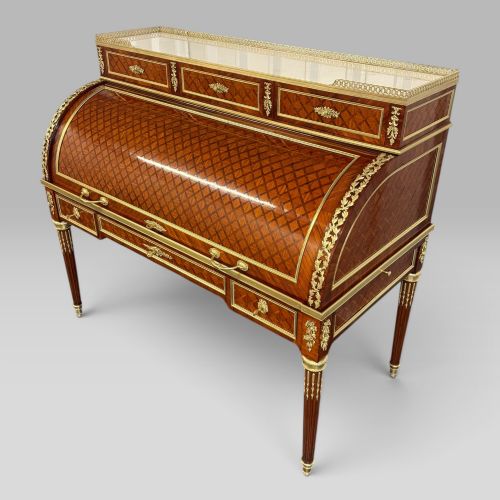
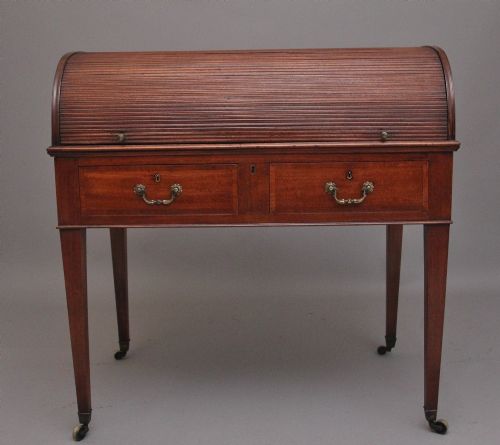
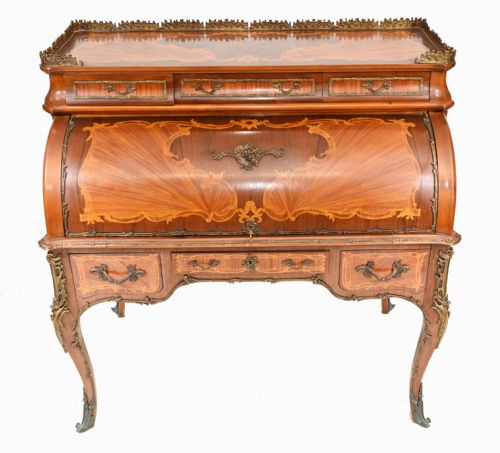
The French cylinder top bureau is a specialised writing desk featuring a curved, rolling wooden shutter that conceals drawers, pigeonholes, and a pull-out writing slide. Buyers exploring this category encounter pieces dating from the eighteenth century through to the early twentieth century, reflecting various revival movements. The selection on this page predominantly includes nineteenth-century examples executed in prominent revival styles such as Louis XVI and Empire.
Forms range from grand architectural desks in flame mahogany to delicate lady's writing desks and miniature models finished in exotic veneers. Continental walnut and kingwood frequently appear alongside mahogany, often accompanied by matching or contrasting parquetry and marquetry patterns. These desks combine the enclosed security of a roll top with the decorative flourishes typical of French cabinet-making traditions.
Quality differences across the range
Quality in a French cylinder top bureau rests on the precision of the veneer work, the fluidity of the cylinder action, and the crispness of the bronze or ormolu mounts. Finer pieces demonstrate continuous grain matching across the curved shutter and harmonious marquetry compositions that follow the contours of the desk without distortion. The mechanical engineering of the interior slides and locking mechanisms also distinguishes master workshops from standard commercial production.
The choice of secondary timbers and the depth of the hand-applied polish reveal the standard of craftsmanship invested in the piece. Heavy, finely chased ormolu mounts indicate a higher workshop tier compared to stamped or thinly gilded brass alternatives. Structural integrity in the rolling mechanism ensures long-term usability without binding or misalignment.
Miniature desks on this page allowed nineteenth-century cabinet-makers to practice complex parquetry on a tiny scale.
Francoise Linke
The French Cylinder Top Bureau Glossary
- Cylinder top
- A curved, quarter-circle wooden shutter that rolls back into the body of the desk to reveal the writing surface and interior compartments. This mechanism protects the contents of the desk while presenting a clean exterior silhouette.
- Ormolu
- Gilded bronze mounts and decorative elements applied to furniture to accent corners, feet, and friezes. The metal is cast and chased by hand before receiving a gold amalgam finish.
- Marquetry
- Decorative veneer work arranged in pictorial or geometric patterns using various coloured woods. Artisans cut thin slices of timber and fit them together like a puzzle to create surface designs.
- Parquetry
- Geometric wood inlay patterns such as cubes, lozenges, or chequers applied to furniture surfaces. It differs from marquetry by relying strictly on repeating geometric shapes rather than pictorial scenes.
- Vernis Martin
- A specialised translucent varnish finish developed in eighteenth-century France to imitate Japanese lacquer. It provides a glossy, layered surface often seen on decorative revival pieces.
French Cylinder Top Bureau: Frequently Asked Questions
How do I operate the cylinder mechanism?
The curved wooden shutter slides smoothly along internal tracks, usually linked to the writing slide so that pulling the writing surface forward retracts the cylinder automatically.
Regular use requires keeping the tracks clean and avoiding excessive force if humidity causes the timber to swell slightly.
What is the difference between a bureau and a secretary?
In historical furniture terminology, both terms describe desks with enclosed writing areas, though secretary often implies a taller piece with vertical storage above.
Continental examples frequently blur these distinctions, using bureau to describe desks featuring the rolling cylinder top.
How do I care for marble-topped desks?
Marble surfaces require gentle cleaning with mild, neutral soap and water, avoiding acidic substances that can etch the polished stone finish.
Because the heavy stone sits directly on the wooden carcase, lifting the desk from the base rather than the top prevents structural strain during relocation.
How do I identify a revival piece?
Nineteenth-century revival pieces utilise historical styles like Louis XVI or Empire, often indicated by machine-sawn veneer thicknesses and nineteenth-century construction methods.
Examining the secondary woods inside the drawers and the composition of the bronze mounts helps confirm the actual period of manufacture.