


French Corbeille King Bed
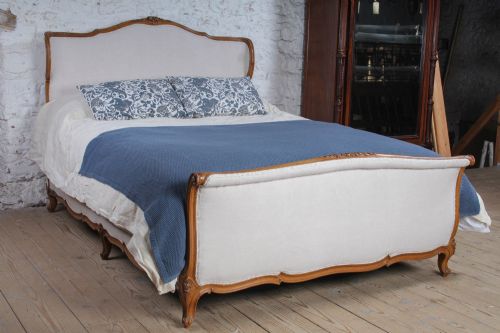
A french corbeille king bed brings sweeping, basket-shaped curves and generous proportions to the bedroom.
French Corbeille King Bed
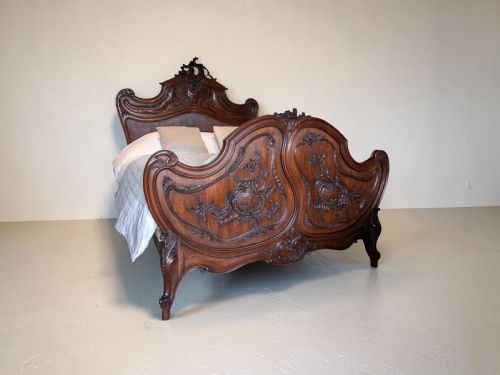
A french corbeille king bed provides a grand sleeping frame defined by its curved, basket-like headboard and footboard. The designs draw heavily on Louis XV and Rococo revival styles, often featuring low-end or enveloping lines that shape the entire frame.
Most examples found here date from the late nineteenth century through to the interwar period of the 1930s. Buyers frequently encounter frames shaped in walnut, beech, or painted wood, alongside versions fitted with cane panels or fresh fabric upholstery.
These pieces serve as substantial focal points in a principal bedroom, combining continental sizing with classic woodcarving. The proportions accommodate modern king-size dimensions while retaining traditional French cabinet-making silhouettes.
How they were made
Frames rely on solid timbers such as walnut, beech, mahogany, and rosewood, chosen for their strength when carved into sweeping curves. Artisans shaped the complex rounded rails and cabriole profiles by hand before applying decorative marquetry or paint.
Caning appears frequently as woven panels set into the headboard and footboard frames for lighter ventilation. Alternatively, interior makers applied heavy textile layers, utilising damask, linen, and general upholstery fabrics secured over traditional padding.
Several beds arrive accompanied by matching bedside cabinets or chairs, ensuring the bedroom suite matches down to the last carved leaf.
What varies in quality
The distinction between ordinary and superior examples rests upon the crispness of the hand-carved woodwork and the depth of the timber figuring. Walnut and rosewood frames with sharp, deep relief carving demonstrate higher workshop investment than plain painted softwoods.
Execution of the corbeille curve determines structural elegance, where tighter, more harmonious enveloping lines create a balanced silhouette. The integration of matching side cabinets or original cane work further elevates the standing of a particular frame.
The French Corbeille King Bed Glossary
- Corbeille
- Basket-shaped in French, describing a bed with curved, enveloping head and footboards that cradle the mattress. This silhouette defines the classic profile of the style.
- Louis XV Style
- A revival aesthetic mimicking eighteenth-century rococo curves, asymmetry, and naturalistic leaf carving. It dominates the decorative detailing on these frames.
- Cane
- Woven rattan material used to create open, breathable panels within the wooden framework of headboards and footboards. It lightens the visual weight of large beds.
- Marquetry
- The art of applying decorative veneer pieces to a structure to form geometric or floral patterns. This technique appears on select high-end wooden frames.
- Bergere
- An enclosed upholstered armchair style whose terminology occasionally extends to beds featuring fully upholstered sides. It denotes a cozy, enclosed seating or sleeping space.
French Corbeille King Bed: Frequently Asked Questions
Will a standard king mattress fit?
Continental and antique sizing can vary slightly from modern dimensions, meaning some frames require careful measurement before fitting a standard king mattress.
Carpentry adjustments or custom slatted bases are occasionally utilised to ensure contemporary mattresses rest securely within the antique wooden rails.
How do I care for the fabric?
Vacuum upholstered panels regularly with a soft brush attachment to prevent dust accumulation within the damask or linen weaves.
Spot clean marks gently with appropriate textile cleaners, avoiding excess moisture that might penetrate the underlying vintage padding.
Are the side rails original?
Many antique French frames arrive with adapted or extended side rails to accommodate modern mattress lengths safely.
Original rails appear on untouched pieces, though structural adaptations are common practice to make these historical beds usable today.
How do I identify the period?
Look closely at the joinery, wood patination, and carving styles to estimate the decade of manufacture between 1890 and 1930.
Revival pieces often blend Louis XV motifs with the manufacturing methods of their specific era, distinguishing turn-of-the-century work from later art deco influences.