
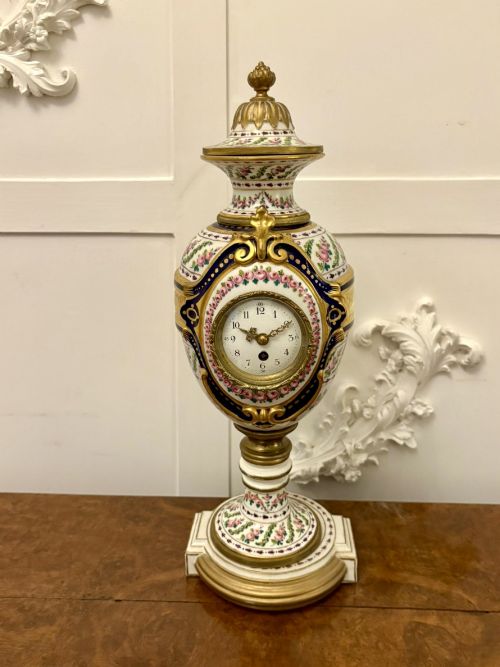


French Classical Urn Clock
A french classical urn clock brings the stately discipline of neoclassical design straight to the mantelpiece through bronze, marble, and gilt.
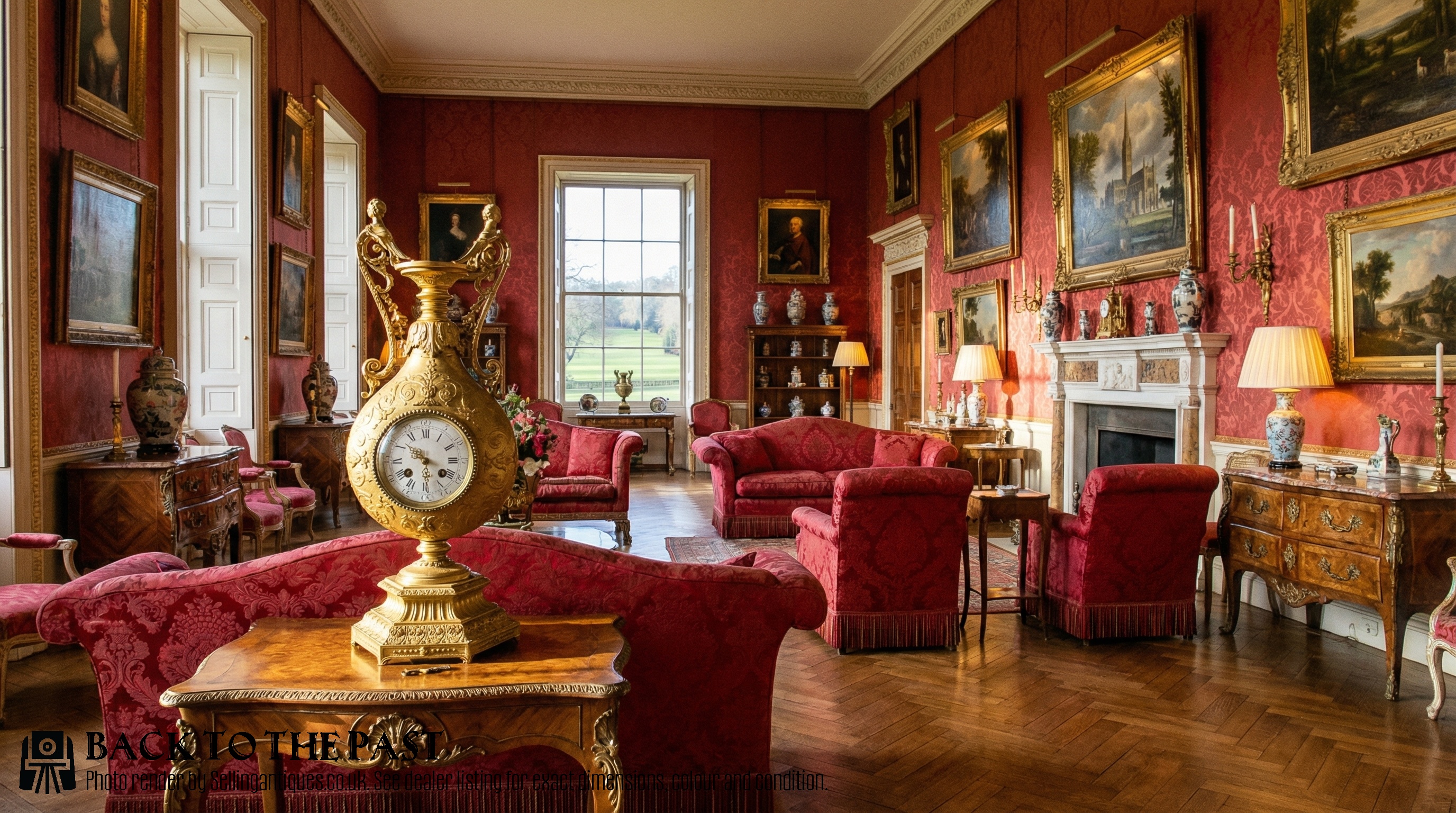
French Classical Urn Clock
A french classical urn clock merges the sculptural presence of a decorative urn with a mechanical timepiece, frequently accompanied by matching garniture sets. These pieces draw heavily on Neoclassical, Louis XVI, and French Empire aesthetics, placing the dial within or beneath a classical vessel form.
Most examples found here date across the nineteenth century, spanning Victorian interpretations and earlier Napoleonic designs. The forms range from simple marble portico structures to elaborate ormolu and bronze cases featuring hand-painted porcelain panels.
Buyers encounter single mantel clocks alongside full three-piece garniture sets featuring matching side urns or candelabra. The overriding visual language remains anchored in classical antiquity, utilising symmetrical proportions and architectural mounts.
Materials and construction
Foundry workers shaped the structural cases from cast bronze, brass, and heavy natural stones including Sienna and white marble. Ormolu decoration, achieved by applying finely ground gold to a bronze base, provided the bright metallic highlights characteristic of the period.
Clockmakers fitted eight-day striking movements behind white enamel dials with delicate painted numerals. Skilled hands assembled intricate cast mounts, hand-painted porcelain bodies, and bevelled glass bezels to complete each housing.
Judging quality in these clocks
Quality reveals itself in the crispness of the bronze chasing and the depth of the gilding across the case. Sharp, deeply carved acanthus leaves and well-defined classical motifs separate superior castings from softer, simpler production pieces.
The integration of the movement with the stone or metal housing indicates the maker's original ambition. Heavier marble blocks, finely painted porcelain urns, and signed movement backplates point to workshops that spared no expense on materials.
Pons de Paul·A.D Mougin·James Ritchie and Son
The French Classical Urn Clock Glossary
- Ormolu
- Gilded bronze created by applying a gold and mercury amalgam to cast bronze before firing. This technique produces a durable, rich metallic finish found on high-end nineteenth-century French cases.
- Garniture
- A matching set of decorative objects, typically consisting of a central clock flanked by two matching side urns or candelabra. These sets created a balanced, symmetrical display on grand mantelpieces.
- Portico clock
- A mantel clock structured like a miniature classical temple, featuring vertical columns supporting an upper entablature that houses the dial. The pendulum usually swings visibly suspended between the pillars.
- Enamel dial
- A metal dial face coated with fused glass powder and fired to create a smooth, glossy white surface. The hour numerals are then painted on and fired again for permanence.
- Movement
- The mechanical inner workings of the clock, comprising gears, springs, escapements, and striking trains. Nineteenth-century French movements commonly ran for eight days between windings.
French Classical Urn Clock: Frequently Asked Questions
How do I wind the clock?
Most nineteenth-century movements utilise a key inserted directly into winding holes on the enamel dial. Turning the key gently tightens the mainspring until resistance is felt.
Care must be taken not to overwind the mechanism, as this can strain the internal springs and disrupt the beat of the pendulum.
What is a clock garniture?
A clock garniture is a matched decorative set comprising a central mantel clock and two matching side pieces such as urns or vases. These items were designed to sit together on a fireplace mantel to create a balanced focal point.
The side pieces share the same materials, gilt mounts, and stylistic motifs as the main clock housing.
How do I distinguish Empire from Louis XVI style?
Louis XVI style leans towards restrained neoclassical elegance with straight lines, ribbon twists, and delicate urns. French Empire design is bolder, reflecting Napoleonic military power through heavier bronze mounts and classical motifs.
Empire clocks frequently employ dark patinated bronze contrasted sharply against bright ormolu details.
Where should I place the clock?
These heavy marble and bronze pieces require a stable, level surface such as a sturdy mantelpiece or a dedicated side table. Uneven placement can easily stop the delicate pendulum swing.
Keeping the clock away from direct sunlight and damp environments helps preserve the enamel dial and gilt surfaces.