
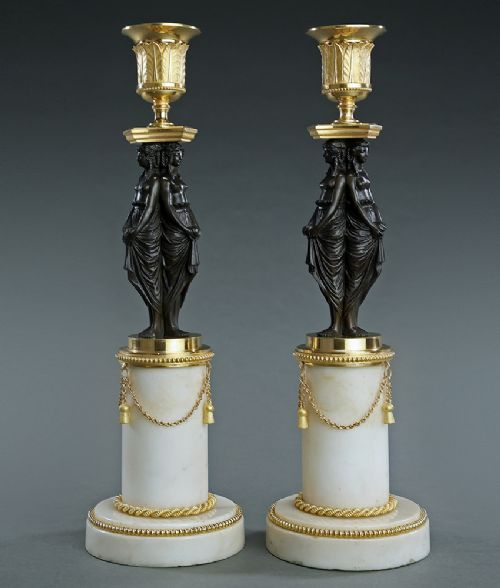


French Caryatid Candle Holders
French caryatid candle holders are sculptural bronze and ormolu lights that bring neoclassical architecture indoors for the collector.
French Caryatid Candle Holders
French caryatid candle holders take the form of classical maiden figures supporting lights, appearing across the nineteenth century in forms such as candlesticks and candelabra. You will most frequently meet pairs cast in bronze and ormolu, drawing directly on Louis XVI, French Empire, and Regency design vocabularies.
The materials span gilt bronze, patinated bronze, marble, and biscuit porcelain, reflecting grand tour influences and neoclassical taste. Makers and designers referenced in the pieces include Galle, Dugourc, and Thomas Hope, setting the aesthetic standard for these figural works.
Makers utilised George IV, Regency, and French Restauration idioms alongside earlier Louis XVI models to shape the shafts and bases of these candle holders. The resulting objects range from simple single candlesticks to elaborate figural candelabra with zodiac details.
How they were made
Foundries cast these pieces in bronze, applying a dark patination to the figures while reserving ormolu gilding for the decorative mounts and bases. This combination of patinated bronze and fire-gilt ormolu creates a high-contrast visual effect characteristic of the period.
Selected examples incorporate carved marble plinths or delicate biscuit porcelain shafts to support the metal nozzles and drip pans. Artisans chased the cast bronze surfaces by hand to sharpen the drapery of the caryatid figures and the botanical motifs on the sconces.
What varies in quality
Material integration also defines the better pieces, particularly where marble bases and biscuit porcelain shafts fit seamlessly with the bronze mounts. The weight and structural stability of the cast components indicate the standard of the foundry responsible for the work.
The French Caryatid Candle Holders Glossary
- Caryatid
- A sculpted female figure serving as an architectural support instead of a column. In these candle holders, the figure forms the central shaft holding the light.
- Ormolu
- Finely ground high-carat gold mercury-gilded to a bronze object. This technique produces a deep, durable golden finish unique to period metalwork.
- Patinated bronze
- Bronze treated with chemical solutions to create a dark, stable surface colour. The dark tone highlights the brighter ormolu elements placed alongside it.
- Biscuit porcelain
- Unglazed white porcelain with a matte, marble-like texture. It appears on shafts to provide a contrasting pale material against the dark bronze.
- Grand Tour
- The nineteenth-century travel tradition of collecting classical antiquities and souvenirs across Europe. Pieces bearing this label often reflect classical sculpture seen during these travels.
French Caryatid Candle Holders: Frequently Asked Questions
How are caryatid candle holders cleaned?
Dust the surfaces gently with a soft dry brush to protect the delicate ormolu and patinated bronze finishes. Avoid commercial metal polishes entirely, as they strip the original fire-gilding from the bronze.
Keep the pieces away from direct heat sources and moisture to preserve the underlying metal and any integrated marble or porcelain elements.
Were these made as pairs?
Many examples survive as balanced pairs designed to sit symmetrically on a mantelpiece or sideboard. Single candlesticks also occur, often originating from larger sets or grand tour souvenirs.
Matching the proportions and patination helps identify genuine pairs from mismatched survivors assembled later.
How do I spot nineteenth century copies?
Examine the chasing on the bronze figure for hand-tooled crispness rather than the soft, uniform blur typical of later reproductions. Period pieces show consistent wear patterns and construction methods appropriate to nineteenth-century foundries.
Look closely at the joins between the bronze mounts, marble bases, and candle nozzles to ensure they reflect period assembly techniques.
What is the difference between an Empire and a Regency piece?
French Empire designs lean heavily into strict classical symmetry, martial motifs, and rich ormolu highlights inspired by Napoleonic taste. Regency and George IV British equivalents often incorporate similar classical elements but frequently blend them with local cabinet-making traditions and distinct bronze patination.
Comparing the base ornamentation and the stance of the caryatid figure usually reveals the intended design idiom.