


French Brass Clock Garniture
These French brass clock garniture sets bring heavy nineteenth-century presence to a mantelpiece, pairing a central timepiece with matching side ornaments.
French Brass Clock Garniture
A french brass clock garniture forms a matched three-piece ensemble, pairing a central mantel clock with a pair of side pieces such as candelabras or urns. These sets emerge primarily across the nineteenth century, including Victorian periods, through to the early twentieth century.
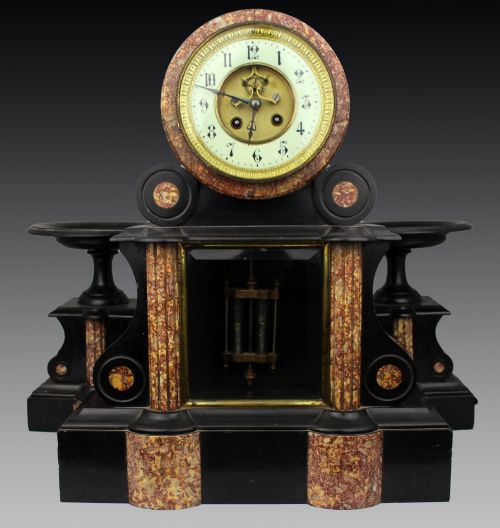
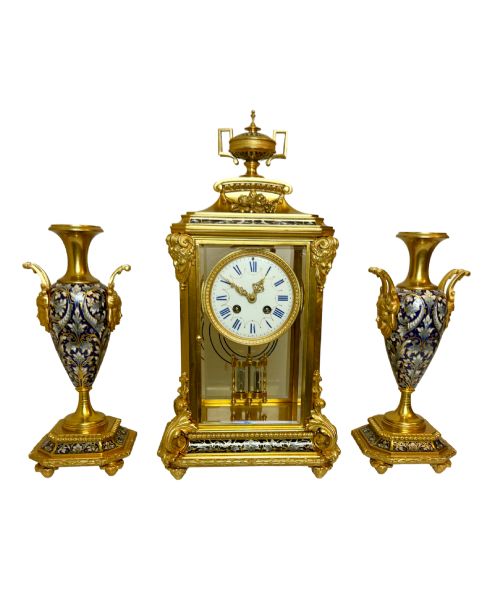
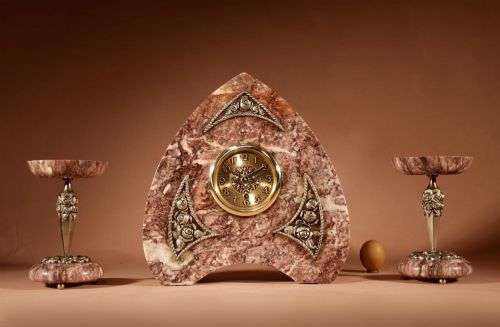
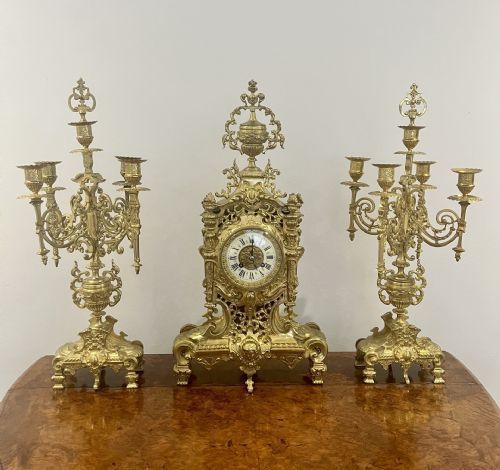
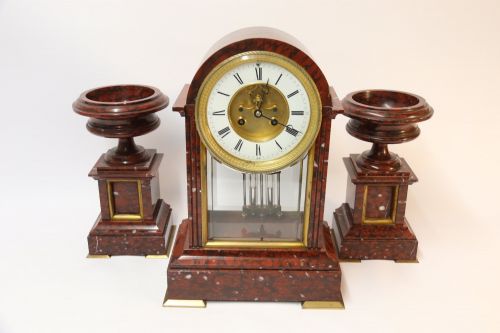
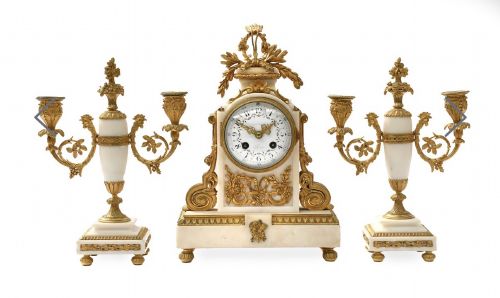
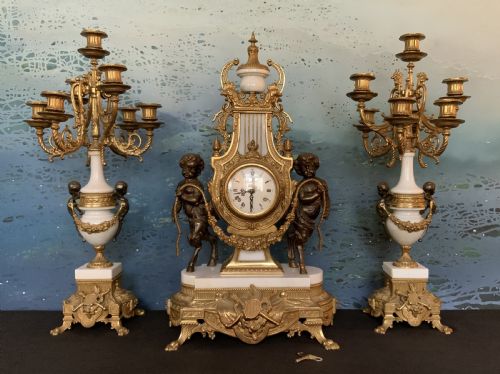
The objects take diverse forms on this page, appearing as portico clocks, heavy marble clock sets, and ornate gilt brass arrangements. Makers such as Japy Frères, Samuel Marti, A.D Mougin, Vincenti of Paris, and Deniere signed the movements or cases of these grand salon pieces.
Compositions range from compact brass designs to monumental combinations of metal and stone. Most examples retain their original matching side pieces, creating a unified display intended for formal reception rooms.
How they were made
Foundries cast heavy brass, gilt bronze, and ormolu into elaborate rococo, neo-classical, or art deco frames, often mounting the metalwork upon bases of black, red, green, or sienna marble. Many pieces incorporate glass panels or delicate champleve and cloisonné enamel work on dials and bezels.
Clockmakers fitted eight-day mechanical movements driven by springs or pendulums behind white enamel chapters. Artisans combined metal casting, stone cutting, and fine gilding to produce matching sets that functioned as both timekeepers and sculptural decor.
Listings feature brass, gilt bronze, ormolu, marble, slate, and glass across periods from the mid-nineteenth century to the art deco era.
What varies in quality
The refinement of the casting and chasing separates standard production from exceptional examples, visible in the sharpness of scrollwork and figural detail on the brass or bronze mounts. Heavier stone bases, intricate enamel dials, and signed movements by noted makers elevate the status of a set.
Completeness dictates much of the appeal, as matching side pieces must share the exact patina, stone colour, and decorative vocabulary of the central clock. The crispness of the mercury gilding or ormolu finish remains a primary indicator of original workshop standard.
Japy Frères·Samuel Marti·A.D Mougin·Vincenti of Paris·Deniere
The French Brass Clock Garniture Glossary
- Garniture
- A set of matched ornamental objects designed to be displayed together on a mantelpiece. It typically consists of a central clock flanked by two matching vases, urns, or candelabras.
- Ormolu
- Finely ground high-carat gold applied to a bronze base using a mercury amalgam technique. This historic process yields a deep, warm metallic lustre distinct from modern electroplating.
- Champleve
- An enamelling technique where troughs or cells are hollowed out of the metal surface and filled with vitreous enamel before firing. It creates vibrant coloured patterns flush with the surrounding brass.
- Portico clock
- A mantel clock featuring a architectural case supported by four columns. This neoclassical form became popular during the nineteenth century in marble and wood.
- Bezel
- The metal ring that holds the glass protecting the clock dial. On better pieces, it is often hinged and bevelled.
French Brass Clock Garniture: Frequently Asked Questions
What is a french brass clock garniture?
A french brass clock garniture is a matching three-piece decorative set for a mantelpiece, consisting of a central clock and two matching side ornaments like candelabras.
These ensembles were designed to create a symmetrical, grand display in nineteenth-century drawing rooms and parlours.
How do these clock movements work?
Most of these pieces utilise an eight-day mechanical movement driven by a mainspring, requiring a key wind approximately once a week.
They typically strike the hours and sometimes halves on a bell or gong, regulated by an internal pendulum or a visible escapement.
Where should I place a heavy marble clock set?
Because these sets combine dense marble and cast metal, they require a deep, sturdy mantelpiece or console table capable of supporting significant weight.
Keep them away from direct sunlight and damp walls to protect the delicate enamel dials and the rich gilt finishes on the brass.
How do I tell nineteenth century styles apart?
Nineteenth-century pieces draw on earlier European movements, with Rococo Revival sets showing asymmetric scrolls and naturalistic flora, while Louis XVI examples feature strict symmetry and classical urns.
Later Victorian iterations often blend these motifs with heavy slate or marble, whereas early twentieth-century pieces adopt cleaner geometric lines.