
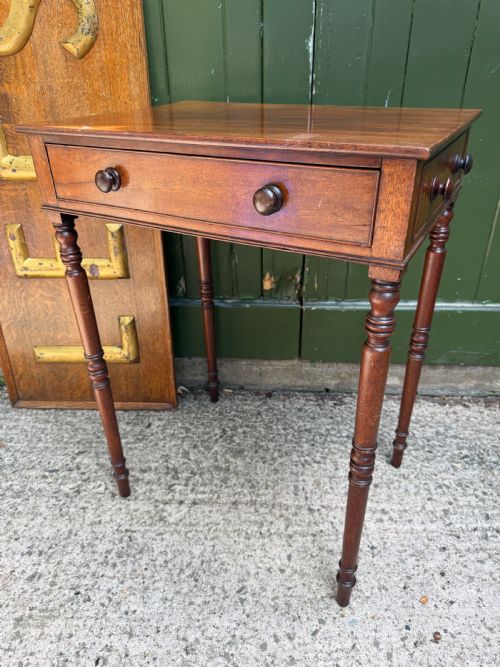


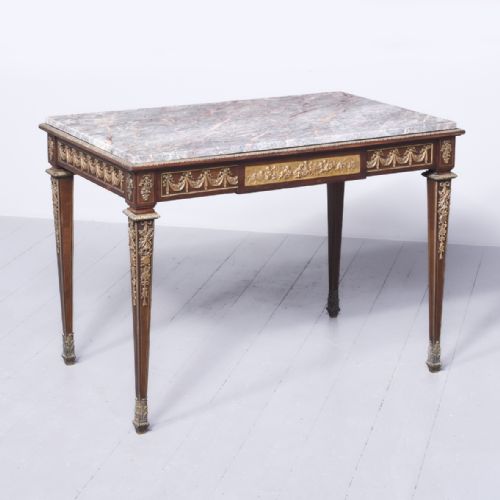


Freestanding Mahogany Side Table
A freestanding mahogany side table brings architectural timber and finished backs to the middle of a room, exactly where standard furniture fails.
Freestanding Mahogany Side Table
A freestanding mahogany side table appears across the Georgian, Regency, and Victorian eras, taking the form of centre tables, sofa tables, and lamp tables. These pieces are designed to be viewed from all angles, featuring finished backs and polished timber throughout rather than the plain panels meant for a wall.
Most examples you encounter on this page date from the nineteenth century, spanning George III origins through to Edwardian interpretations and Louis XVI revivals. They serve multiple domestic uses, functioning as occasional tables, serving surfaces, and writing desks depending on their specific construction.
Materials and construction
Makers built these pieces using solid mahogany and figured timber veneers, often selecting stock for rich grain patterns and deep natural tones. Boxwood inlay adds linear contrast to table tops and friezes, framing the primary wood with precise geometric detail.
Metal mounts in brass and ormolu appear on specific revival and Regency pieces, securing corners and decorating legs. Carved mahogany details manifest in turned pedestals, claw feet, and shaped aprons that demonstrate precise cabinet-making techniques.
The listings on this page span the Georgian, Regency, and Victorian periods, utilising solid mahogany, boxwood inlay, and ormolu mounts.
Judging the execution
The distinction between standard examples and superior pieces rests on the choice of timber and the depth of figure in the mahogany veneer. Finer tables exhibit careful book-matching across the top and consistent colour that has matured gracefully over time.
Construction detail separates the workshops, visible in the sharpness of boxwood inlay, the precision of carved supports, and the quality of brass or ormolu mounts. A well-executed piece maintains structural stability from every viewpoint, confirming that the back received as much attention as the front.
The Freestanding Mahogany Side Table Glossary
- Freestanding
- Finished on all four sides so the table can stand away from a wall in the middle of a room. This design requires polished timber and detailed craftsmanship on the reverse.
- Centre table
- A round, oval, or shaped table meant to occupy the centre of a room rather than sit against a perimeter. These pieces are fully articulated from every lateral perspective.
- Ormolu
- Gilded bronze used for decorative mounts and feet on revival and Regency pieces. The technique involves applying a mercury and gold amalgam to bronze.
- Figure
- The natural pattern in wood grain created by growth rings and branching. Highly figured mahogany displays ripples and flame-like patterns that catch the light.
Freestanding Mahogany Side Table: Frequently Asked Questions
Where should I place a freestanding mahogany side table?
These pieces suit positions behind a sofa, in the middle of a reception room, or as a focal point in a hallway. Because every side is finished, they do not need to anchor against a wall.
They work particularly well where natural light can strike the polished mahogany top and highlight the grain and inlay.
How do I distinguish a Regency table from a Victorian one?
Regency pieces often display cleaner classical lines, brass inlay, and restrained ormolu mounts inspired by ancient Greek and Roman forms. The proportions tend to be crisp and linear.
Victorian examples frequently introduce heavier carved mahogany details, bolder curves, and revival styles such as the Louis XVI or Rococo patterns.
Are these tables sturdy enough for daily use?
Cabinet makers built these tables to serve functional roles in nineteenth-century homes, using dense mahogany and robust joinery. Their weight and pedestal or leg construction provide natural stability.
Normal daily use as a lamp or side table is entirely appropriate, provided you protect the polished surface from moisture and heat.
What is the difference between a side table and a centre table?
Centre tables are typically larger and designed explicitly for the middle of a room, often round or oval with a central pedestal base. Side tables are more often rectangular and sit closer to seating areas or walls while remaining finished on all sides.
Both categories share the freestanding requirement that allows 360-degree viewing.