



Framed Watercolour Street Scene
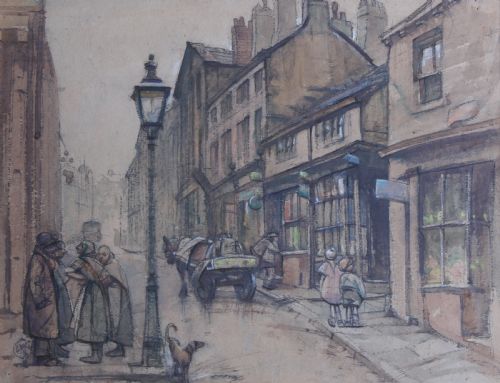
A framed watercolour street scene captures daily life in bustling markets and quiet alleys through fluid washes and precise ink lines.
Framed Watercolour Street Scene
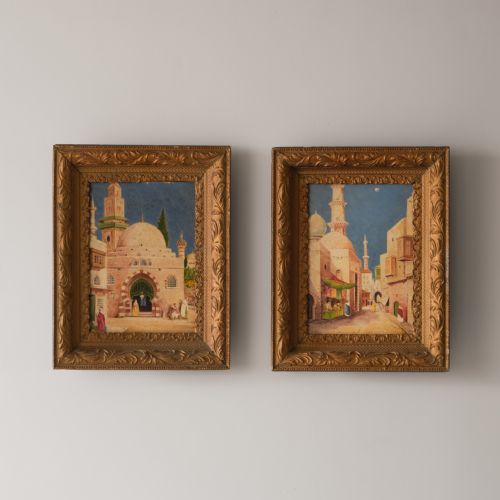
A framed watercolour street scene presents urban and village views captured by artists across the nineteenth and twentieth centuries. These paintings record bustling markets, snowy city streets, and sunlit foreign plazas.
The pieces on this page span several decades, ranging from Victorian genre realism and Edwardian townscapes to mid-century British impressions. One encounters depictions of English villages alongside continental destinations like Venice, Rome, and Paris.
Works appear under various formats including signed townscape watercolours, naive compositions, and framed antique paintings. The selection offers both intimate local alleyways and expansive architectural vistas.
Materials and technique
Artists painted these scenes using watercolour paint on paper supports, frequently applying ink lines to define architectural details and figures. Pigments were layered in transparent washes to build up light, shadow, and atmospheric perspective.
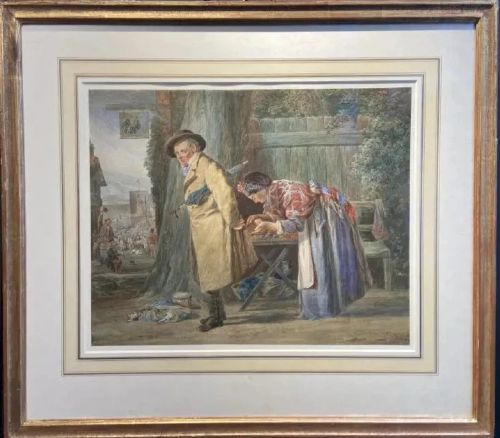
Finished works are typically housed behind glass within wooden frames, occasionally incorporating gilt wood or gold leaf mouldings. This traditional framing protects the delicate paper surface from atmospheric moisture and handling.
Someone once captured engineers dismantling a London railway roof with the exact same delicate medium used for Venetian markets.
Distinctions in quality
Quality rests upon the artist's handling of light, perspective, and atmospheric depth within the urban environment. A superior work commands space convincingly, rendering bustling crowds and stone architecture with confident, fluid brushwork.
The preservation of the paper and the integrity of the pigments also separate standard pieces from exceptional ones. Works retaining vibrant colour without excessive fading or foxing demonstrate superior original materials and careful storage.
Thomas Ellison·Joseph H Barnes·Albert Ludovici Jnr·Louie Stanley Maurice Prince·John Smith Atherton·George Whyatt·Joseph W Milliken·Charles H Poingdestre·William Manners·Rowland Henry Hill·Angus Rands·Walter Emsley·Ettore Ascenzi·Fred Lawson·Tom Dudley·Annie L Lee·Cuthbert Crossley·Matthew Hale·Henry J Neave·Alfred Leyman·T Fairfax·Henry Stanton Lynton
The Framed Watercolour Street Scene Glossary
- Watercolour
- A paint consisting of colour suspended in a water-soluble vehicle. It is traditionally applied to paper in transparent washes.
- Townscape
- A painting or drawing depicting a built urban environment, such as streets, market places, and architectural facades.
- Gilt wood
- Wood that has been coated with a thin layer of gold leaf or metallic paint. This treatment adds reflective brilliance to the surrounding frame.
- Genre realism
- An artistic style depicting subjects from everyday life in a realistic manner. It often focuses on ordinary people engaged in daily activities.
Framed Watercolour Street Scene: Frequently Asked Questions
What periods do these watercolours date from?
The works span from the late nineteenth century through the mid-twentieth century. Examples include Victorian, Edwardian, and mid-century modern interpretations.
Different decades bring distinct stylistic choices, shifting from tight architectural recording to looser, more expressive impressionist brushwork.
How should I display a watercolour at home?
Watercolours require protection from direct sunlight to prevent the delicate pigments from fading over time. Hang them on interior walls away from damp areas like kitchens or unventilated bathrooms.
Keeping the original glass and frame intact helps shield the paper from dust and atmospheric pollutants.
Are these paintings original works of art?
Each listed piece is a unique hand-painted original work on paper, not a mass-produced print or reproduction. Artists applied wet pigments directly to the surface by hand.
Brush texture, pencil underdrawing, and variations in the paper distinguish these individual creations from mechanical copies.
What subjects feature in these street scenes?
Subjects range from local English village high streets and rural inns to busy continental markets and ancient steps. Artists frequently recorded everyday human activity alongside notable architectural landmarks.
Scenes capture specific locations such as York, Whitby, Venice, Rome, and Paris during distinct historical eras.