

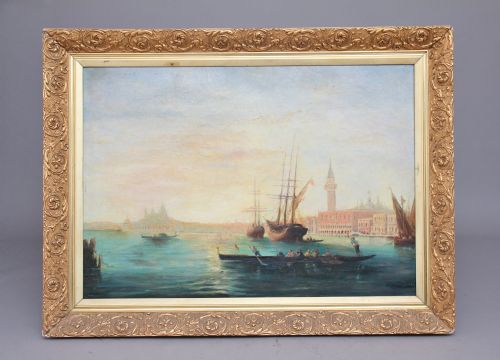

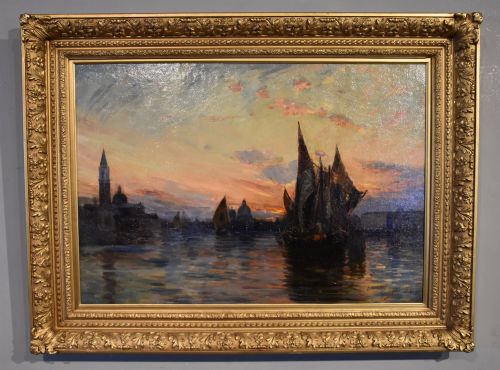


Framed Venetian Landscape
A framed venetian landscape captures the enduring allure of Italy's floating city through historical oil paintings and delicate watercolours.
Framed Venetian Landscape
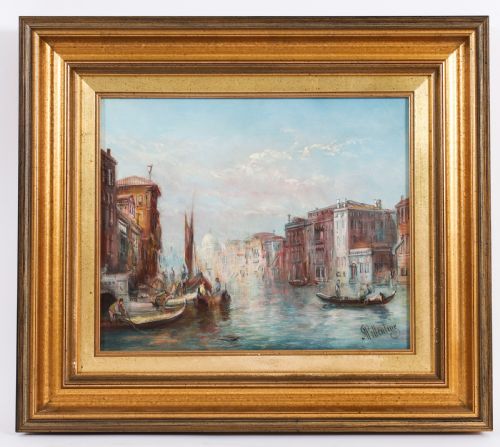
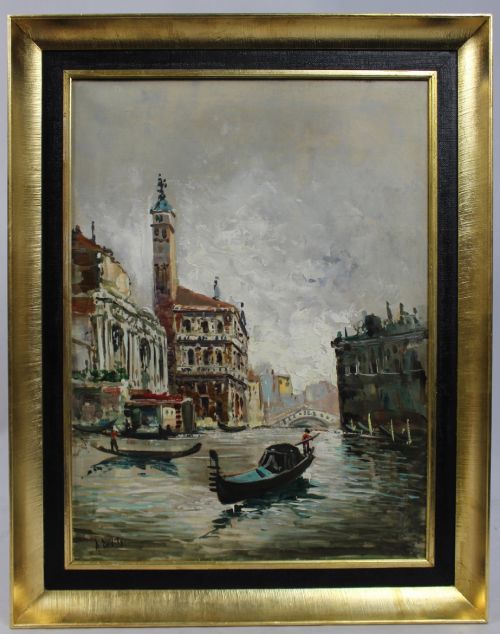
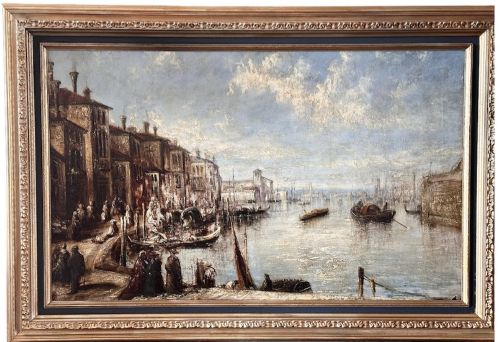
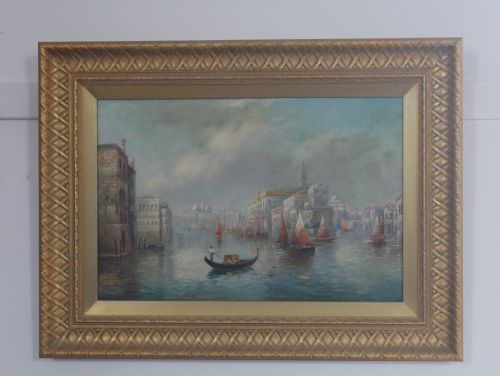
A framed venetian landscape typically portrays the iconic waterways, grand canals, and historic palazzos of Venice through the artistic lens of the nineteenth and twentieth centuries. Buyers frequently encounter nineteenth-century oil paintings and Edwardian watercolours depicting famous landmarks such as the Grand Canal, the Doge's Palace, and Santa Maria della Salute. These works range from detailed architectural townscapes to atmospheric impressions of the Venetian lagoon and moonlight scenes.
How They Were Made
Artists primarily utilised oil paint on canvas or board to build rich, textured depictions of Venetian light and water. Watercolour on paper was equally favoured for capturing the luminous, translucent qualities of the lagoon and cityscapes.
The resulting artworks are housed in frames constructed from wood and giltwood, often featuring carved or gilded details characteristic of their respective periods.
What Varies In Quality
Quality in a framed venetian landscape rests on the artist's ability to command light and atmosphere, distinguishing evocative masterworks from rigid topographical records. The handling of paint, whether through the fine detail of nineteenth-century oil works or the fluid washes of Edwardian watercolours, defines the visual impact of the piece.
The integrity and period appropriateness of the wooden and gilded frames also influence the overall character of the piece, as original surrounds enhance the historical context of the artwork.
Alfred Pollentine·Francis Moltino·Thomas Hodgson Liddell·Antonietta Brandeis·Antoine Bouvard Senior·Jane Vivian·William Raymond Dommersen·Hercules Brabazon Brabazon·Frank Wasley·David Law·William Knox·George Stanfield Walters·Wilfred Knox·Henry Wimbush·Claude Jousset·Emanuele Cappello
The Framed Venetian Landscape Glossary
- Oil on Canvas
- Pigment mixed with drying oil applied to stretched woven fabric. This medium allows for deep colour saturation and rich surface texture.
- Watercolour
- A painting method where paint is made of pigments suspended in a water-based solution. It is traditionally applied to paper to create translucent washes of colour.
- Giltwood
- Wood that has been treated with a thin layer of gold leaf or gold paint. It is commonly found on traditional frames from the nineteenth and early twentieth centuries.
- Lagoon
- The enclosed bay of the Adriatic Sea in which Venice sits. It is a frequent subject for artists seeking to capture open expanses of water and atmospheric skies.
- Impressionism
- An art style characterised by relatively small, thin yet visible brush strokes and an emphasis on accurate depiction of light. This approach appears frequently in mid-century interpretations of Venice.
Framed Venetian Landscape: Frequently Asked Questions
What subjects appear in these paintings?
The artworks predominantly feature iconic Venetian landmarks, including the Grand Canal, the Doge's Palace, the Santa Maria della Salute, and the surrounding lagoon.
Artists also depict quieter canals, gondolas, and old Venetian mansions under various lighting conditions from morning mist to evening moonlight.
How should I hang my framed venetian landscape?
These pieces suit spaces with good ambient light that can highlight the tones of oil paint or the delicate washes of watercolour without causing fading.
Ensure the artwork is hung away from direct heat sources to protect both the canvas and the historical wooden or giltwood frame.
How do I identify the period of a piece?
Periods can often be identified through the painting style, such as Victorian fine art, impressionism, or mid-century expressionism, alongside the framing materials.
Signatures, artist dates, and recorded working lifespans also provide a clear indication of when a specific work was created.