




Framed Seaside Artwork
Framed seaside artwork captures coastal life and marine landscapes through watercolours and oil paintings spanning the nineteenth and twentieth centuries.
Framed Seaside Artwork
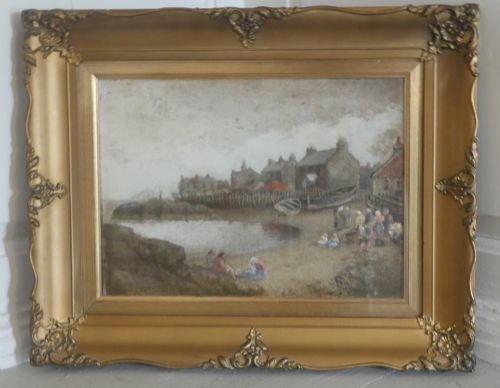
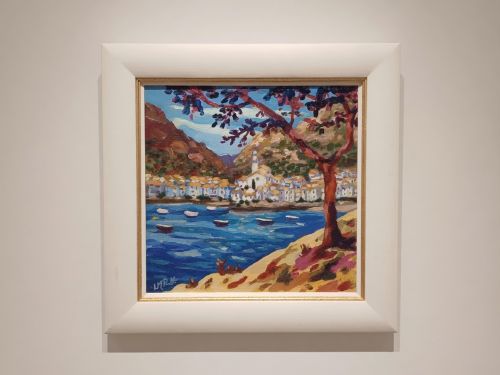
Framed seaside artwork comprises paintings depicting coastal views, harbour scenes, beaches, and maritime activities created across the nineteenth and twentieth centuries. These pieces record shorelines from British and European locations, ranging from Cornish fishing villages to French coastal cliffs.
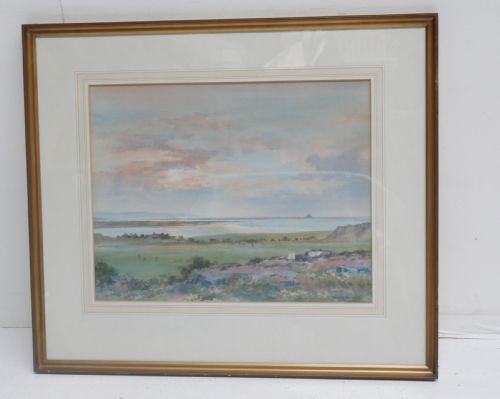
The most common examples encountered here are watercolours on paper and oil paintings on canvas or board, frequently set within wood and gilt wood frames. The selection includes works aligned with Victorian fine art, impressionism, and post-impressionism.
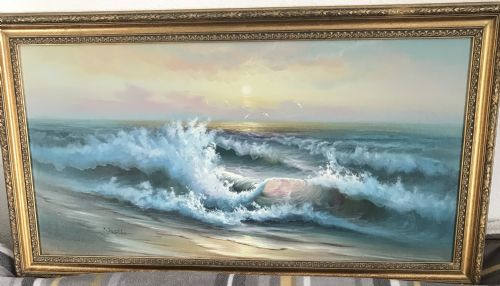
Subjects frequently centre on everyday coastal life, featuring figures on beaches, local fishermen, and seaside gatherings alongside rolling waves and harbour water. Dating spans from Victorian pieces through to mid-century examples.
Materials and Techniques
Artists working on these coastal scenes utilised oil paint and watercolour as primary mediums, applying pigment to canvas, prepared wood boards, or heavy paper. Oil on canvas allows for textured representations of sea spray and coastal light, whilst watercolour on paper yields transparent washes suited to sea and sky.
Works are typically preserved within protective glazing for paper pieces or open surfaces for oil paintings, enclosed in wood and gilt wood frames appropriate to their period. Canvas supports are often mounted on wooden stretchers before framing.
Framed Seaside Artwork Retail Price Guide 2026
Typical asking prices for framed seaside artwork among the pieces listed under this phrase on Sellingantiques today, from the lower quarter to the upper quarter. They describe what is for sale here now, not the wider market.
Represented artistic styles span Victorian Fine Art, British Impressionism, Post-Impressionism, and Modern British Art.
Quality and Execution
Quality in these coastal paintings rests upon the handling of light, atmosphere, and movement within the marine environment. Superior examples demonstrate confident brushwork or delicate washes that convey the specific quality of air and water along a coastline.
Compositional balance and the accurate rendering of maritime architecture, figures, and coastal topography distinguish accomplished works from more routine topographical recordings. The integration of period-appropriate framing also contributes to the overall integrity of the piece.
Clifford Hanney·Edward Mills·William Banks Fortescue·Lucy Pratt·F A Roylance·Lionel Horsnell·John Bedloe Goddard·Norman Lloyd·William J B Jenkins·William Raymond Dommersen·Sir William Russell Flint·Frank Wood·Alfred Henry Vickers·Jeffrey Pratt·Jack R Mould·James George Bingley·John Sanderson Wells·Robert Macaulay Stevenson·John Abernethy Lynas-Gray·William Greaves·James Watson·James Kinnear·Yves Brayer·William Shayer·Henry Valter
The Framed Seaside Artwork Glossary
- Watercolour painting
- A work executed with water-soluble pigments on paper supports. This technique creates translucent layers well-suited for capturing coastal atmospheres and changing weather.
- Oil on canvas
- A painting medium using pigments bound in a drying oil applied to a woven fabric surface. This method permits rich textures and deep tones suitable for dynamic seascapes.
- Gilt wood
- Wood coated with a thin layer of gold leaf or metallic gilt finish. Such frames are frequently found enclosing period paintings.
- Impressionism
- An art style focused on accurate depiction of light and its shifting qualities. In coastal works, this approach emphasises open brushwork and vibrant outdoor colour.
- Post-Impressionism
- A subsequent artistic development extending impressionist methods with personal interpretation and distinct structural forms. Works in this style often employ bolder palettes.
Framed Seaside Artwork: Frequently Asked Questions
What periods do these pieces cover?
The inventory spans the nineteenth century through to the mid-twentieth century, including works created in the Victorian era and the 1950s and 1960s.
Different stylistic movements are represented across these decades, reflecting changing artistic approaches to coastal subjects over time.
Where do these coastal views depict?
Locations include British coastlines such as Yorkshire, Cornwall, and Dorset, alongside European settings in France and Italy.
Specific landmarks like St Ives Harbour, Scarborough Bay, and the Jurassic Coast frequently appear in the titles.
Are these paintings original works?
The selection consists of original hand-painted watercolours and oil paintings rather than modern reproductions or prints.
Many pieces bear artist signatures, dates, or historical framing from their respective periods of creation.
How should I care for a framed watercolour?
Watercolours on paper require protection from direct sunlight to prevent fading of the pigments and paper degradation.
Displaying them in stable indoor environments away from excessive moisture preserves both the paper and the original frame.