



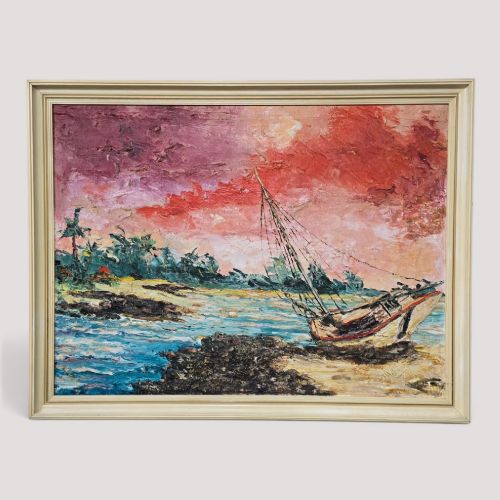
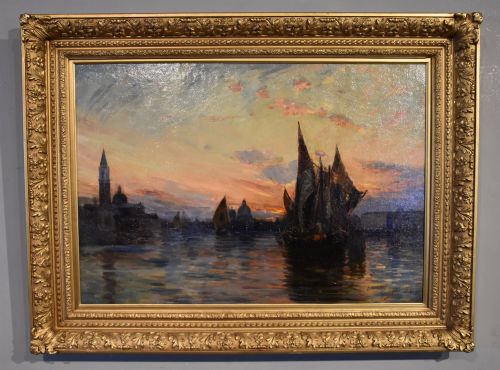


Framed Sailboat Seascape
These framed sailboat seascape works capture the movement of vessels across open water, bringing maritime history directly onto the wall.
Framed Sailboat Seascape
A framed sailboat seascape typically depicts vessels navigating coastal waters, open seas, or busy harbours under varied atmospheric conditions.
Buyers browsing this selection encounter works spanning the nineteenth century through the mid-twentieth century, with strong representation from the Edwardian period and the 1920s.
The objects take the form of paintings, oil paintings on canvas and board, and watercolours on paper, all presented in protective frames with glass or wood surrounds.
Materials and Techniques
Makers utilised oil paint on canvas or board to build textured surfaces, capturing the heavy weight of water and the dense fabric of sails.
Watercolour and gouache on paper offer a lighter alternative, often employed to render the translucent quality of light upon coastal air and calm seas.
Protective framing relies on wood, glass, and gilt wood, sealing the painted surface against environmental changes while enclosing the artwork.
Sailboats have braved storms on canvas longer than most domestic walls have stood.
Distinctions in Quality
Quality rests in the handling of light and water, where confident brushwork or delicate pigment application conveys true atmospheric depth rather than a rigid formula.
The stability of the primary support and the preservation of the painted surface dictate the longevity and visual integrity of each piece.
The relationship between the artwork and its surrounding frame contributes to the visual coherence of the finished object.
B. Nash·Thomas Hodgson Liddell·Elisabeth Bardon·Paul Delvaux·Richard Harry Carter·Louis Suire·Norman Lloyd·Adrian Van Porten·Edward Seago·Hendrik Willebrord Jansen·Samuel Owen·Ernest F. Hill·Jane Vivian·George Henry Knight·E Tucker·John McDougal·Frank Wasley·Paul Jean Clays·Charles Euphrasie Kuwasseg·Thomas Bush Hardy
The Framed Sailboat Seascape Glossary
- Impasto
- Paint applied thickly to a canvas, leaving visible brush or palette knife marks that stand proud of the surface. This technique adds tactile dimension to churning waves and billowing sails.
- Board
- A rigid flat substrate used instead of woven canvas for painting. Artists frequently utilised wooden panels or heavy millboard for smaller outdoor studies.
- Gouache
- An opaque water-based medium containing pigment and binding agent. It provides solid, flat areas of colour and dense highlights in works on paper.
- Lugger
- A traditional small fishing vessel carrying lug sails set on one or more masts. These working boats appear frequently in coastal scenes from the nineteenth and early twentieth centuries.
- Provenance
- The documented history of ownership surrounding an artwork. Clear records help establish authenticity and trace the journey of a painting through time.
Framed Sailboat Seascape: Frequently Asked Questions
What periods do these paintings cover?
The selection spans from the nineteenth century through the Edwardian era and into the mid-twentieth century.
Most pieces originate between the late 1800s and the 1960s, reflecting changing artistic movements from realism to early modernism.
How should I hang a framed seascape?
Choose a wall with stable humidity away from direct sunlight to protect both the canvas or paper and the wooden frame.
Ensure the hanging fixings match the weight of the frame, particularly for large oil paintings on canvas.
Are these works signed by the artists?
Many examples feature artist signatures or attributions recorded in the title details.
Others represent the work of specific regional schools from the nineteenth and twentieth centuries without a legible individual signature.
What is the difference between oil and watercolour?
Oil paintings use pigment suspended in drying oil on canvas or board, allowing for thick textures and rich colour blending.
Watercolours employ water-soluble pigments on paper under glass, offering a transparent and luminous finish.